

Rubric: Geopolitics
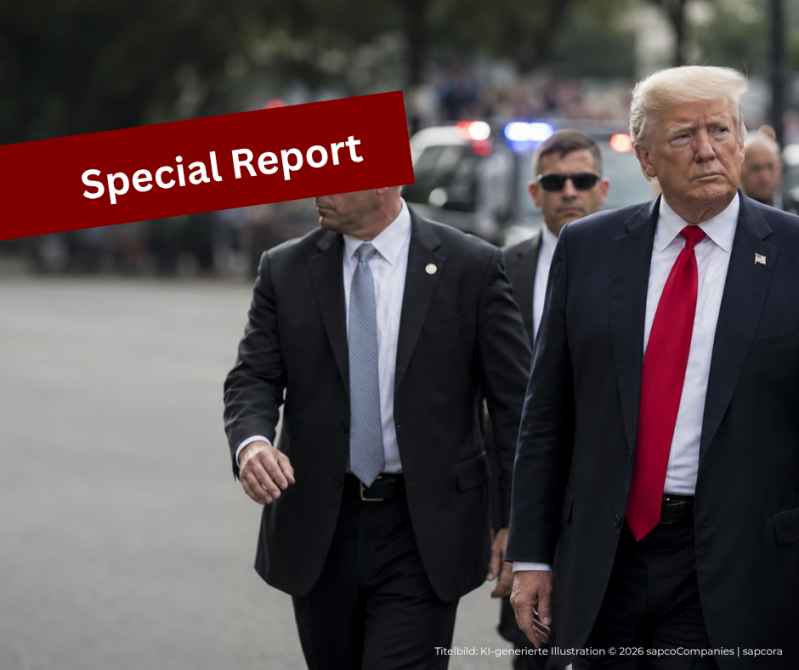
Format: Special Report
Author: Sinisa Brkic (sb)
Donald Trump Under Threat: Iran, Succession and What Happens to America Next. A deep U.S. focused special report on the threat environment around Donald Trump, the Iran dimension, constitutional succession, military continuity procedures and the political consequences of a successful assassination.
President Donald Trump is not merely the president of the United States. He is the dominant force in American politics, the defining figure of a movement that reshaped the Republican Party, and a symbol onto whom enemies at home and abroad project power, grievance and revenge. That is why the question of a successful assassination cannot be treated as a narrow security issue. It is a scenario that would strike at the presidency, the American political order, the global balance of risk and the fragile boundary between constitutional continuity and national fracture.
The threat is real because the target is not ordinary
The danger surrounding Donald Trump cannot be measured solely in the standard language of political security. He is not simply one more protected national leader moving through a volatile age. He is a political singularity. He is at once a former outsider, a sitting president, a movement leader, a grievance vessel, a global symbol and, for some of his enemies, a historic target.
That distinction matters. In ordinary political systems, an attack on a head of state is an assault on government. In the case of Trump, it would be read by tens of millions as something larger and darker: an assault on a political identity, a social bloc and an idea of America itself. His removal by violence would not be processed as a contained national tragedy. It would be received as a rupture in the country’s struggle over power, legitimacy and direction.
The documented attacks and plots already surrounding Trump have stripped away the fiction that such a scenario belongs only to speculation. The United States has already seen how close the danger can get. The point now is not to dramatize that reality beyond the facts. The point is to understand the scale of what it would mean if one of those efforts ever succeeded.
Why Iran changes the nature of the threat
Iran is not relevant here as a rhetorical flourish or a convenient villain. It matters because it introduces a foreign state dimension into a threat environment that is already unusually combustible. Since the killing of Qassem Soleimani, Trump has held a uniquely charged place in Tehran’s political memory and revenge lexicon. That does not license careless claims. It does, however, mean that Trump is not only vulnerable to domestic radicals or isolated attackers. He also exists within a broader field of geopolitical hostility.
That distinction is critical because a threat linked to Iran would not be interpreted as another violent episode in America’s already violent political age. It would immediately acquire the character of international confrontation. The United States would not simply be facing the death of a president. It would be confronting the possibility that a foreign adversary, directly or indirectly, had reached into the center of American power.
Modern state threats are rarely simple. They move through intermediaries, proxies, deniable networks, ideological sympathizers and blurred lines of operational influence. That is what makes the Iran question so serious. Even where hard proof takes time, prior allegations, past plots and longstanding revenge rhetoric would ensure that the political system reacts from the first moment as though the international dimension cannot be dismissed.
Trump’s political centrality makes the consequences far more dangerous
The threat cannot be understood unless one begins with Trump’s actual place in American life. He is not only the holder of an office. He is the central engine of a political age. For nearly a decade, American politics has been organized around him, against him, through him or in response to him. He is not an interchangeable president in an interchangeable cycle. He is the gravitational center of a conflict that has reshaped institutions, parties, media ecosystems and voter identity.
That is why a successful assassination would not produce an ordinary succession story. The United States would not simply lose a president and gain another. It would lose the one figure around whom a large share of the country has organized its political hopes, resentments and ambitions. The office could be filled in an instant. The force he represents could not.
This is where the scenario becomes profoundly destabilizing. Trump’s supporters would not experience his death as a routine transfer of constitutional authority. Many would experience it as a historical theft, a strike at the movement itself or proof that the system around him had failed catastrophically or worse. Even those who reject conspiratorial explanations would almost certainly see the event as a turning point after which the old assumptions about American stability no longer apply.
America’s internal climate has made a lethal outcome more imaginable
The United States has spent years eroding the guardrails that once separated political opposition from existential hatred. Institutions are mistrusted, the language of politics is harsher, the cultural divide is deeper and the temptation to cast opponents as enemies of the nation has become dangerously familiar. Trump did not create all of that, but he stands at the center of it.
That matters because high profile political violence does not emerge only from disciplined conspiracies. It also emerges from a culture in which mythology, resentment and obsession can incubate action. Some attackers operate through networks. Others act alone after absorbing the atmosphere of total conflict. When a nation begins to treat politics as a civilizational struggle, singular figures become vulnerable in singular ways.
Trump is especially exposed because he carries an intensity few leaders in modern America have carried. He is admired with unusual fervor and hated with unusual intensity. He draws not merely disagreement, but fixation. That makes the threat around him more persistent, more layered and more difficult to contain within the familiar frameworks of presidential security.
If Trump were assassinated, the first shock would be constitutional and psychological at once
If a sitting President Trump were killed, the constitutional mechanism would move immediately. The vice president would become president at once. That part is clear and legally settled. There would be no vacuum in the formal sense. The United States was designed to prevent that kind of void.
But what the Constitution can supply in legality, it cannot supply automatically in public psychology. That is where the real danger begins. America would have an answer in law within minutes. It would not have an answer in emotion, legitimacy or political trust within minutes. The country would move instantly from a Trump presidency to a post Trump presidency without any period of civic adaptation, electoral preparation or political digestion.
That abruptness would matter enormously. Trump’s presidency is personal in a way few presidencies are. The system might continue, but the public would feel as if something larger than a single office had been violently removed. The result would be a collision between constitutional order and national disbelief.
Who takes power and why that answer would not calm the country
The legal answer is straightforward. JD Vance would become president. He would not temporarily hold the role. He would become the president of the United States for the remainder of the term. He would then nominate a vice president, subject to confirmation by Congress. If both the presidency and vice presidency were vacant, the succession line would move to the Speaker of the House and then further down the statutory order.
That is the machinery. The political meaning is another matter.
A Vance succession would be lawful, immediate and internationally recognized. It would also unfold under conditions no election can simulate. He would inherit the office at the exact moment the country enters one of the most emotionally charged crises in modern memory. He would possess presidential power immediately, but not Trump’s organic hold over the movement, the electorate or the political imagination. That gap would define the early phase of the new presidency.
This is the point many institutional accounts understate. America would not merely be asking who is next in line. It would be asking whether anyone can occupy the office without also inheriting the commanding political force Trump brought to it. The answer, at least initially, would almost certainly be no.
The first days of a Vance presidency would be a test of authority, not just legality
A new President Vance would face one immediate burden above all others: proving that continuity is real without pretending that continuity is enough. He would need to reassure markets, command the executive branch, calm allies, deter adversaries and address a shaken public that may not be ready to separate constitutional succession from political dispossession.
His first appearances would matter enormously. Too much managerial calm and he could seem technocratic in the face of trauma. Too much martial force and he could seem eager to consolidate power through catastrophe. Too much emotional language and he could inflame a movement already primed for rage. Too little and he could seem smaller than the moment.
That is why the new presidency would begin under acute strain. Vance would hold full constitutional power, but the symbolic scale of the presidency he inherited would tower over him. He would not only have to govern. He would have to convince Trump’s movement that the office remains in the hands of a legitimate heir, while convincing the wider country that the government has not entered a phase of destabilized emergency rule.
Scenario One: orderly succession, visible unity and delayed fracture
In the most stable scenario, the institutions work fast enough to contain the first wave of national panic. Vance is sworn in quickly. Congressional Republicans rally around him. Democratic leaders, at least initially, avoid language that could deepen the fracture. The White House projects seriousness, continuity and resolve. The federal apparatus performs with enough discipline to reassure allies and discourage adversaries.
In that version, the country still enters mourning and anger, but not immediate state level fragmentation. The new president gains a short window of deference simply because the gravity of the event suppresses overt political warfare at the top.
Yet even then, the stability would be provisional. The deeper problem would remain untouched. Trump is not merely a president who can be replaced by constitutional sequence. He is the organizing force of a movement. The office might stabilize more quickly than the political reality beneath it. Beneath the formal unity, the Republican coalition would almost immediately begin to ask whether Vance is preserving Trump’s legacy, borrowing it or merely standing beneath its shadow.
Scenario Two: Iran is blamed and the presidency hardens overnight
If credible evidence pointed toward Iranian involvement, directly or through a network plausibly linked to the regime, the political atmosphere would change within hours. The succession question would remain important, but the center of gravity would move toward retaliation, deterrence and state honor. In practical terms, a Vance presidency could become a national security presidency overnight.
The pressure would be immense. Large parts of the Republican base would demand a visible response. Congressional hawks would intensify that pressure. Media figures aligned with Trump’s worldview would cast restraint as weakness. The death of a president at the hands of a foreign adversary or its proxies would not be debated in the same language as an ordinary foreign policy confrontation. The emotional demand for force would be far stronger and far harder to resist.
That does not automatically mean immediate war. It could mean a ladder of escalation: intelligence disclosure, sanctions, cyber action, force repositioning, covert operations or targeted strikes. But whatever form it took, the new administration would begin not in ordinary governance but in confrontation. The presidency would harden rapidly, and America’s allies and adversaries alike would read the new leadership through the lens of retaliation.
Scenario Three: the evidence is murky and America tears itself apart over the meaning
The most politically toxic outcome may not be a clear foreign link. It may be uncertainty. If Trump were assassinated and attribution remained contested or incomplete, the country could enter a far more dangerous internal phase. In such a case, the struggle over who killed him would become inseparable from the struggle over what America itself has become.
One part of the country would insist that the answer was obvious and foreign. Another would see domestic extremism. Another would immediately suspect a deeper institutional betrayal or catastrophic complicity. In a healthier system, such questions would wait for evidence. In the current American system, they would become instant ideological commitments.
This is the scenario in which constitutional continuity exists on paper while civic legitimacy deteriorates in real time. A Vance administration would be forced to operate inside an information war in which every move could be cast either as necessary leadership or opportunistic exploitation. The federal government would still function. The shared belief that it is functioning honestly could crack.
Scenario Four: a wider attack and a brutal test of succession itself
The darker possibility is not simply the death of one president, but a strike that removes or incapacitates multiple senior officials at once. This is precisely why American continuity law extends beyond the vice president. If Trump and Vance were both lost in the same event, the line would move to the Speaker and then to the president pro tempore, followed by Cabinet officers in statutory order.
That outcome would be lawful and stabilizing in one sense. It would also be profoundly jarring in another. A president elevated from deeper in the succession chain would be constitutional, but the emotional distance between legality and public acceptance would widen sharply. Americans understand succession in theory. They do not often imagine it in a mass casualty context tied to a political assassination.
This is where the brilliance and the coldness of the constitutional design become most visible. The state is built to survive decapitation risk. It does not ask whether the public finds the path emotionally intuitive. It asks only whether lawful authority can be preserved. In a severe attack, that design would prove essential. It would not necessarily make the country feel governable.
What the military would do and what it would not do
Public imagination often becomes unstable at this point, so precision matters. The U.S. military does not decide succession. It does not interpret the Constitution for itself. It does not enter politics to stabilize leadership. Its role is to maintain defense readiness, protect continuity of command and obey the lawful civilian authority as that authority changes under the Constitution.
That distinction is central. If Trump were assassinated, the armed forces would not enter a waiting period of uncertainty about who commands them. Their task would be to recognize the lawful successor and preserve continuous command and control. The military is built precisely to avoid ambiguity at moments when ambiguity would be most dangerous.
What would change immediately is posture, not constitutional principle. The armed forces, in coordination with the wider national security system, would move to ensure protected communications, confirm command relationships, raise vigilance where required and make clear to adversaries that a blow against American leadership has not produced strategic paralysis. The purpose would be continuity, deterrence and prevention of further exploitation.
How the protocol would likely unfold from the armed forces’ perspective
At the public level, the outline is disciplined rather than dramatic. Command authentication would be secured. The lawful successor would be integrated into the full chain of presidential authority. Senior national security communications would be protected and, if necessary, redistributed through hardened or alternate channels. Force protection around key nodes of national leadership and strategic assets would likely increase. Intelligence monitoring would intensify immediately in case the assassination were part of a broader operation, a coordinated campaign or a trigger for copycat violence.
The National Military Command architecture exists to prevent the system from losing its ability to function under shock. That includes the communications structure that connects civilian authority to the military instrument and preserves credible command even in severe disruption. In public discussion, this is sometimes flattened into imagery of emergency aircraft or doomsday symbolism. The more accurate point is simpler: the United States has long assumed that leadership continuity must remain operational even when the country is under its worst imaginable strain.
That is why airborne and hardened command capabilities matter. They are not a theatrical detail. They are part of the logic by which American command remains intact even when events are chaotic, violent and politically destabilizing.
Nuclear command would not drift into limbo, but panic would try to tell a different story
Few topics invite more irresponsible speculation than nuclear command after a presidential assassination. The serious answer is that the system is explicitly designed to prevent command drift in exactly such a crisis. Once the lawful successor is established, the continuity architecture exists to ensure that the most sensitive elements of state power remain under authenticated civilian control.
The greater danger in public life would not be actual command collapse. It would be a panic driven misreading of how the system works. In moments of extreme national trauma, rumor often outruns structure. The temptation to imagine chaos at the top of the command chain would be enormous. That is precisely why continuity procedures matter. They are not only military safeguards. They are political safeguards against panic, miscalculation and the perception of a superpower suddenly unmoored from itself.
Congress would become the next theater of power and legitimacy
After the first emergency phase, attention would swing toward Congress. If Vance had become president, his vice presidential nominee would require confirmation by both chambers. Under ordinary conditions that would be a major political event. Under these conditions it would become something close to a constitutional stress test.
A smooth confirmation would suggest that the system still retains enough seriousness to distinguish institutional maintenance from factional warfare. A prolonged or poisoned battle would signal the opposite: that even under the shock of presidential assassination, Washington remains unable to separate the preservation of state continuity from opportunistic struggle.
Congress would also become the arena for multiple simultaneous fights. Investigations into the security failure. Battles over attribution. Hearings on intelligence. Pressure for retaliatory measures if a foreign connection were established. Attempts to define whether the event was a criminal act, an act of war or something in between. The assassination would not simply pass through Congress. It would transform Congress into one of the main battlegrounds over the meaning of the crisis.
The Republican Party would unify in public and struggle in private
Outwardly, Republicans would close ranks around the fallen president and his successor. The emotional logic of the moment would make that inevitable. Trump’s movement would demand unity, reverence and force. Any visible hesitation would be punished.
But beneath that unity, a deeper struggle would begin almost immediately. Trump’s coalition has been built around more than policy. It has been built around him personally: his instincts, his rhetoric, his conflict style, his sense of dominance and his unmatched capacity to command attention. Remove him, and the question becomes unavoidable. Can Trumpism survive as a governing force when the man himself is gone?
Vance would inherit the office. Whether he could inherit Trump’s authority over the movement is another matter entirely. Some would insist on total continuity. Others would see an opening for consolidation under a more disciplined post Trump structure. Others would worry that the emotional energy of the movement cannot simply be transferred by oath. That struggle would shape the next phase of Republican politics far more than formal succession alone.
Democrats would face a narrower path than many assume
For Democrats, the immediate moral response would be easy. Condemn the violence, support constitutional continuity and reject reckless conspiracy making. The harder question would come after that. How does an opposition party operate against a new president who assumes office through trauma, national shock and the martyrdom of the figure who dominated American politics.
Any appearance of opportunism would be devastating. Yet silence or passivity would leave the entire national narrative to the new administration and its allied media. Democrats would have to defend the legitimacy of succession while resisting any attempt to turn the killing into a blank check for open ended executive power, political purges or external war without scrutiny.
That is a difficult balance in any circumstance. In the aftermath of an assassination, it would become one of the most delicate political tasks in modern American opposition politics.
Revelation 6 and the danger of apocalyptic interpretation
There is one more layer that cannot be ignored, particularly in the American context. Certain religious and conspiratorial subcultures would almost certainly absorb such an event into apocalyptic interpretation. Revelation 6, especially the imagery of conflict and the removal of peace from the earth, would be invoked as proof by those already predisposed to read politics through prophetic drama.
This does not make the interpretation valid. It makes it potent.
The danger is not abstract theology. The danger is political mobilization through sacred narrative. Once a violent event is coded as part of an end times struggle, the ordinary disciplines of evidence and proportion lose ground. The assassination is no longer treated as a crime to be investigated and understood. It becomes a sign, a revelation, a vindication of prior belief. The victim becomes more than a president. He becomes martyr, symbol and instrument of a larger myth.
In a country already saturated with ideological media, populist prophecy, digital rage and conspiratorial subcultures, that kind of narrative acceleration would not be a marginal sideshow. It would become part of the instability itself.
America would still have a government, but it might not feel governable
That is the central truth running through every scenario. If Donald Trump were assassinated, the United States would still have a functioning constitutional order. It would still have a successor. It would still have a military chain of command. It would still have continuity procedures, legal authority and institutional mechanisms built precisely for moments of shock.
But none of that guarantees something equally important: that the country would still feel governable to itself.
That is where Trump’s singularity becomes decisive. This would not be the death of a generic officeholder. It would be the violent removal of the central figure in a political era, a leader whose presence has reordered party identity, media attention, cultural conflict and state power. The Constitution could replace the officeholder in seconds. It could not replace the force he represented.
That is why the true question is larger than succession. The formal answer to succession is clear. The deeper question is whether the American republic, already divided, suspicious and overstretched, could absorb the violent removal of Donald Trump without becoming harder, more fractured and more dangerous to itself. If such an event ever occurred, the world would not mainly be watching whether America has rules. It would be watching whether America still has enough civic strength left to live under them.
Kommentar hinzufügen
Kommentare