

Rubric: Business
Format: Special Report
Author: Sinisa Brkic (sb)
Trump Intensifies Tariff Dispute With Canada: Section 338, USMCA and Risks for Europe. Trump has imposed new 50 percent tariffs on selected Canadian goods under Section 338 of the Tariff Act of 1930. What is affected, why the legal basis matters, and why Europe is watching closely.
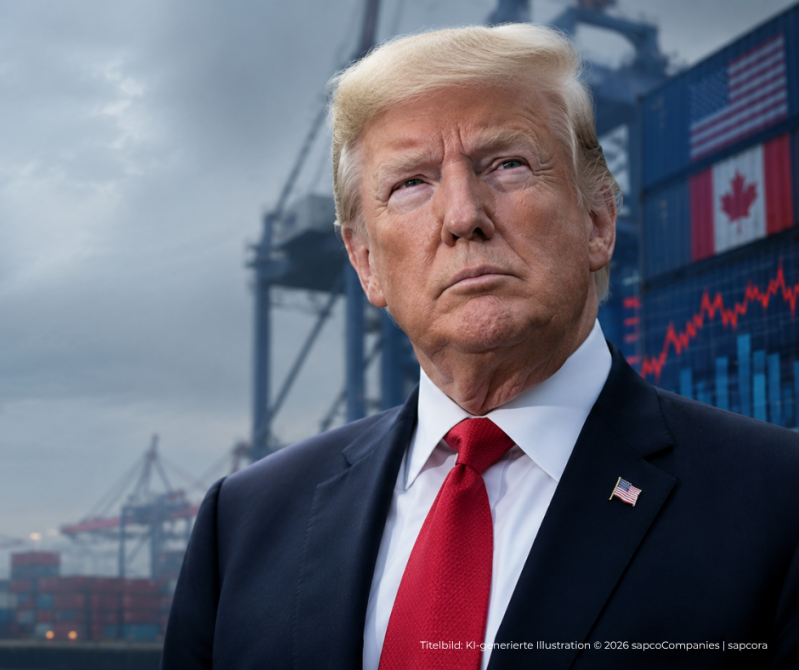
Donald Trump has opened a new phase in the US Canada trade conflict by invoking a rarely used law from 1930 and ordering fresh 50 percent tariffs on selected Canadian goods. The move reaches far beyond a bilateral quarrel over cars, alcohol and dairy. It raises difficult questions about the future of North American trade rules, the durability of the USMCA, and the possibility that Washington could revive the same legal instrument against other partners, including Europe.
Tariff Dispute with Canada
The headline figure is simple enough: three new tariff proclamations, each imposing an additional 50 percent duty on selected Canadian imports. The larger significance lies elsewhere. Trump is not merely raising trade barriers. He is reviving Section 338 of the Tariff Act of 1930, a legal provision that allows the president to impose new or additional duties of up to 50 percent if a foreign country is found to discriminate against US commerce. The White House says the measures will take effect on 19 August 2026 at 12:01 a.m. Eastern Time and will apply to goods covered by the proclamations whether or not they qualify under USMCA rules, subject to specific exceptions.
That is what turns a trade confrontation into something far more consequential. Washington is not relying here on the more familiar machinery of Section 232 or Section 301. It is reaching for an older and broader instrument, one that has sat largely outside the center of modern trade enforcement. In practical terms, the administration is telling markets and allies alike that it is prepared to widen the legal architecture of tariff escalation. In strategic terms, it is testing how far presidential trade power can be pushed under statutes that many businesses and even many trade specialists have not had to reckon with in years.
Three sectors at the center of the clash
The White House has framed the action around three areas in which it says Canada discriminates against US goods: motor vehicles, alcoholic beverages and dairy products. Each sector is covered by a separate proclamation. In the case of motor vehicles, Washington points to Canadian tariffs and treatment that it argues penalize US producers. In alcohol, the administration argues that Canadian provinces and territories have pushed American products out of procurement, distribution and retail channels. In dairy, the White House points to how Canadian tariff rate quotas are administered, especially in ways that it says disadvantage US cheese exports compared with those from Europe.
The White House fact sheet says the three measures together cover nearly 20 billion dollars in Canadian imports. It also states that the new Section 338 duties can stack on top of existing tariffs unless an exception applies. At the same time, the administration has carved out several categories, including energy, potash, products already subject to Section 232 tariffs, and certain other goods such as fish and critical minerals. That design is politically revealing. Washington is escalating hard, but not blindly. It is trying to maximize leverage against Ottawa while limiting the risk of immediate disruption in some strategically sensitive supply chains.
Why Section 338 matters more than the tariff rate
The legal basis is the real story. Section 338 is written broadly enough to matter well beyond this dispute. It authorizes additional duties of up to 50 percent and requires advance notice before they take effect, which is consistent with the 30 day lead time built into the current proclamations. On paper, this is about alleged discrimination by Canada. In practice, it is a demonstration that the administration is willing to activate dormant statutory powers if they can serve a wider political and economic strategy.
That makes this a precedent case. Section 338 is not a Canada specific tool. It is a general instrument. If the administration is prepared to use it here, it has also shown that the threshold for invoking old trade authorities is no longer merely theoretical. That does not mean the European Union or other partners are next. It does mean that a line has been crossed. A legal mechanism that once looked historical has now become operational again. For Brussels, Berlin and other export dependent economies, that is the warning.
USMCA remains in force, but the political foundation is weakening
The timing is no accident. This tariff move lands just weeks after the latest USMCA joint review failed to produce a renewal in its current form. USTR said on 1 July that the United States did not agree to renew the agreement as it stands, but also stated that the USMCA remains in force pending resolution of the issues or termination of the agreement. That is a narrow legal formulation with broad economic consequences. The treaty framework survives for now, but confidence in its political stability has been damaged.
This is where the commercial risk begins to widen. Businesses can cope with difficult rules. What they struggle to price is legal continuity paired with political volatility. A trade agreement that still exists on paper but is being openly renegotiated, narrowed or challenged in practice is a far less reliable foundation for investment decisions, sourcing strategies and cross border production planning. That matters in every sector touched by North American integration, but nowhere more than in autos.
The auto industry faces the sharpest shock risk
Cars and parts are the most sensitive part of this story because the North American automotive market is not a simple export import relationship. It is an integrated production system. Vehicles and components cross borders multiple times. Rules of origin, compliance thresholds, tariff treatment and local content calculations are already central to how manufacturers structure production. Any new layer of tariffs adds friction not only at the border but across the entire industrial chain.
The White House proclamation on motor vehicles argues that Canadian measures have distorted competition against US made vehicles, while imports from other countries including Germany have gained share. Whether that claim will stand up to legal and economic scrutiny is a separate matter. What is already clear is that further fragmentation in North America would not remain a purely American Canadian problem. European manufacturers, suppliers and logistics operators with exposure to the region would feel the consequences through changed sourcing patterns, delayed investment decisions and greater regulatory uncertainty.
Consumers will feel the effects, but unevenly
A 50 percent tariff does not translate mechanically into a 50 percent retail price increase. That is the easy slogan, not the serious analysis. The actual impact depends on whether importers absorb part of the cost, whether substitute products are available, how much inventory is already in the market, and whether companies can reroute shipments before the 19 August start date. Still, the basic economics are unavoidable. Higher border costs increase pressure throughout wholesale, industrial and consumer channels, especially in categories where branding, origin or supply constraints limit flexibility.
That is why the carve outs matter. Exempting energy and potash is not a technical footnote. It is an attempt to avoid an immediate hit to some politically and economically sensitive inputs. Even so, the administration cannot fully control where the cost burden will land. Tariffs are designed as pressure on foreign exporters, but in the real economy they are processed by domestic importers, distributors, manufacturers and ultimately consumers. The political target may be Ottawa. The financial bill will not stop at the Canadian border.
What remains unresolved
Several critical questions are still open. The administration has confirmed the existence of defined product lists in the annexes to the proclamations, but those lists are not yet translated into a clear public facing guide that ordinary businesses and consumers can quickly understand. Canada’s full response is also unresolved. Ottawa may retaliate, seek negotiations, pursue legal avenues, or try to combine all three. What is certain for now is narrower but still significant: the tariffs have been ordered, they are not yet in force, and the period before 19 August leaves room for political bargaining, legal challenges or technical revisions.
The legal verdict is also unsettled. Whether the measures are compatible with the USMCA, with WTO obligations, or with the limits of US domestic trade law is likely to become contested. It is too early to present any final legal conclusion as settled fact. What can already be said, however, is that this is not a routine tariff adjustment. It is a test of how aggressively a US administration can reinterpret its trade authority in a period of rising economic nationalism and strategic mistrust.
A trade dispute, and a warning for Europe
The immediate confrontation is between Washington and Ottawa. The broader message is aimed far beyond Canada. By activating Section 338 in this way, the White House has shown that older and more obscure tariff powers can be pulled back into active service when the political incentive is strong enough. That changes the risk landscape for every major US trading partner. Europe does not need to be the next target for this case to matter. It only needs to understand what has now been demonstrated: that the legal menu for tariff escalation in Washington may be wider than many assumed.
For Germany and the European Union, that is the most important conclusion. The current dispute is about Canada, but the underlying significance is systemic. This is not simply a headline about a 50 percent tariff. It is a signal that trade law, industrial policy and geopolitical leverage are being fused more openly and more aggressively. If that approach hardens into doctrine, the repercussions will not stop with cars, cheese or wine. They will shape the next chapter of global trade politics.
Kommentar hinzufügen
Kommentare