

Rubric: Politics
Format: Special Report
Author: Sinisa Brkic (sb)
Middle East war spreads as Jordan comes under pressure and oil fears rise. Missiles over Jordan, Trump threats, wider flight warnings, and fresh oil market fears signal a dangerous new stage in the Middle East war.
The Middle East is sliding into a wider and more dangerous war. Missiles and drones over Jordan, fresh threats from President Donald Trump, expanding flight warnings, and rising oil jitters are all flashing the same message: this fight is breaking out beyond its original battlefield. What was already volatile now looks like a regional crisis with real consequences for security, air travel, shipping, and global prices.
The war is breaking containment
This is no longer a conflict that can be boxed in and explained away as another round of blows between Washington and Tehran. The map is changing. The pressure is spreading. And the list of countries, flight paths, and energy routes now caught in the fallout is getting longer. That is the real story. Once Jordan is pulled into the line of fire, once Gulf states start bracing for danger, and once civil aviation warnings widen, the crisis stops looking contained. It starts looking like a regional fire pushing past its original borders.
Jordan is not just collateral
Jordan is not some side stage in this drama. It sits at the center of one of the most sensitive security corridors in the Middle East, bordering Israel, Syria, Iraq, and Saudi Arabia while serving as a key Western partner. If Jordan comes under direct pressure, the whole region feels it.
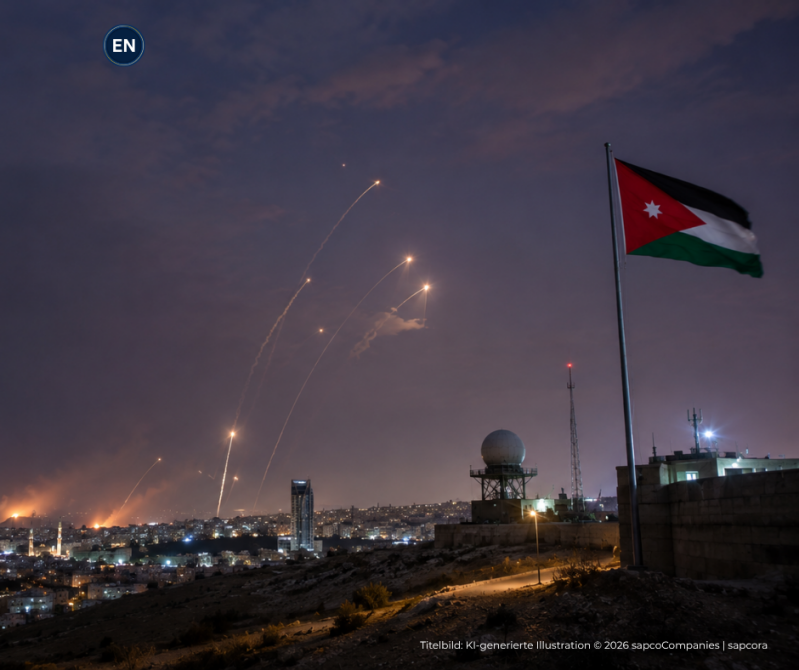
According to the current brief, Iranian missiles and drones entered Jordanian territory. Most were intercepted. Others landed in remote areas. Even without early reports of mass casualties or major damage, the message is unmistakable: the war is no longer staying where it started. That matters because Jordan is woven into regional intelligence, logistics, and military planning. If that country is forced deeper into the conflict, the risk does not stay local. It spreads through alliances, base networks, and already strained neighboring states trying to stop a broader meltdown.
Trump turns up the heat
At the same time, the United States has kept up military pressure on Iran, while President Donald Trump publicly threatened to destroy Iranian bridges or power plants if shipping in the Strait of Hormuz is attacked. That is not a small rhetorical flourish. It is a major escalation signal. A threat is not the same thing as a signed order. But when power plants and major infrastructure enter the public language of retaliation, the stakes change instantly. This is where the crisis starts looking especially combustible. Once strategic infrastructure becomes part of the message, the range of what could happen next gets wider and uglier. The danger is no longer just what has already been hit. It is what may soon be put on the table.
The skies are now part of the crisis
One of the clearest signs that this war is spreading is the growing alarm around civilian airspace. This is no longer just a military problem. Airlines, cargo carriers, insurers, and governments now have to make decisions inside an active risk zone shaped by missiles, drones, air defense systems, and uncertainty. That has real consequences fast. Flights can be rerouted. Travel times can stretch. Insurance costs can rise. Freight schedules can be disrupted. Major transit hubs can feel the pressure even when planes are still flying. That is what makes this moment so serious. When commercial aviation has to bend around a war zone spreading across multiple states, the conflict has already broken beyond the battlefield.
Oil nerves are back in full force
Markets are reacting where they were always likely to react: at the energy chokepoints that keep the global system moving. The Strait of Hormuz remains one of the most important shipping arteries on the planet, and any threat around it sends immediate tremors through oil, gas, freight, and insurance markets. A full shutdown is not required to create panic. Perceived risk is enough. A missile threat, a shipping warning, a new retaliatory statement, or a fresh military move can all jolt prices because traders are betting on what could come next, not just what has already happened. That is why this matters far beyond the region. If pressure on these routes intensifies, fuel costs, transport costs, and broader inflation risks can move with it. Families, airlines, freight operators, manufacturers, and governments all end up paying attention when these sea lanes start looking shaky.
Europe is already in the blast radius
Europe may not be at the center of the shooting, but it is well within the fallout zone. This is not just a diplomatic headache unfolding far away. It is an aviation problem, an energy problem, and a trade problem with the potential to hit daily economic life. Longer routes into Asia, higher airline operating costs, fresh strain on logistics, and renewed volatility in energy markets all make this more than a distant foreign story. Europe is exposed whether it likes it or not. That is also why public interest is surging. People are not just asking who hit whom. They want to know whether the war is widening, whether flights remain safe, whether oil routes are at risk, and whether the next shock will show up at the airport, the gas pump, or both.
The danger is in the pattern
The most important thing right now is to separate confirmed facts from threats and scenarios without pretending the danger is theoretical. Not every warning means closure. Not every threat becomes action. Not every worst case scenario will happen. But this is not empty noise either. The pattern is what matters. Jordan has been pulled into the military picture. Gulf states are on alert. Civilian airspace is under pressure. Energy routes are back in the danger zone. More and more systems around this war are starting to shake at the same time.
That is how a regional conflict turns into something much bigger. Not always in one spectacular instant, but through rolling pressure across multiple fronts. That process now appears to be underway. The question is no longer whether the war is spreading. The question is how much farther it will go.
Kommentar hinzufügen
Kommentare