

Section: Geopolitics
Format: Special Report
Author: Sinisa Brkic (sb)
Two Wars, One White House: What Zelenskyy and Netanyahu Want From Trump. Zelenskyy and Netanyahu meet Donald Trump as the wars in Ukraine and Iran compete for U.S. weapons, political attention and strategic support.
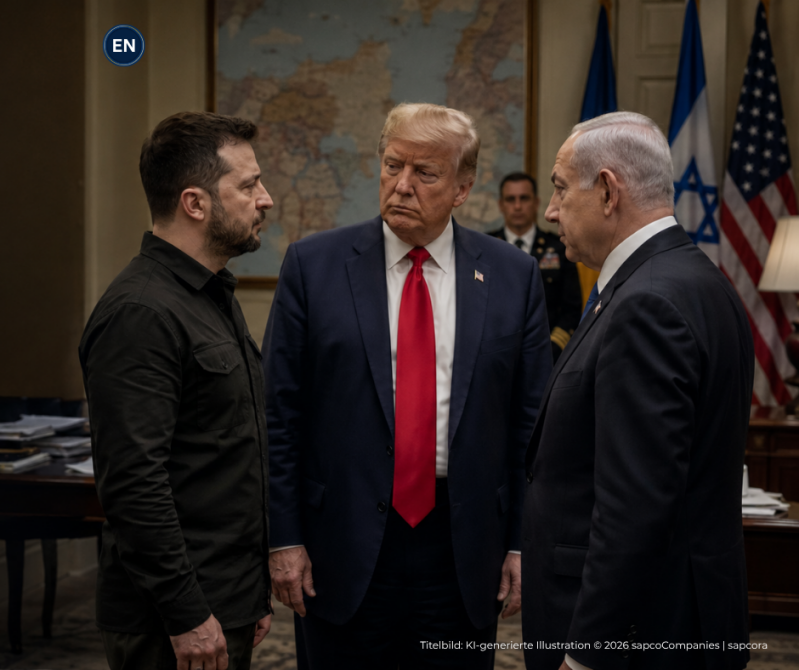
Volodymyr Zelenskyy and Benjamin Netanyahu are arriving at the White House on the same day with different wars, different demands and the same indispensable audience. Their meetings with Donald Trump are formally separate, but they expose a common strategic problem: Washington is being asked to supply weapons, political backing and diplomatic leverage across two conflicts whose costs and risks continue to rise. The decisive question is not which leader receives the warmer welcome. It is whether Trump is prepared to convert presidential attention into durable commitments, and which conflict he considers more useful to pressure, contain or end.
Washington’s Double Audience
The White House is hosting two leaders whose military positions remain heavily influenced by decisions made in Washington. Zelenskyy needs American air defense capacity and continued strategic cooperation as Russia intensifies missile and drone attacks. Netanyahu wants clarity on how far Trump is prepared to go against Iran and whether the recent pause in American military action marks a temporary restraint or a deeper shift toward diplomacy.
The meetings are not a joint negotiation, and neither leader is formally bargaining against the other. Yet they are competing indirectly for the same center of power, the same defense establishment and the same president’s willingness to accept further political and military exposure.
Their presence in Washington also carries symbolic weight. Both are attending events honoring Senator Lindsey Graham, one of the most forceful advocates of American support for Ukraine and Israel. His absence leaves behind a political vacuum at precisely the moment when both governments are seeking to preserve Washington’s commitment to conflicts that increasingly divide the American political system.
Zelenskyy’s Priority Is Protection, Not Ceremony
Zelenskyy’s most urgent demand concerns air defense. Ukraine faces continuing Russian attacks on cities, infrastructure and military targets, while the number of available interceptors remains limited and replacement cycles are slow. For Kyiv, additional Patriot capability is not an abstract procurement objective. It is tied directly to the ability to protect population centers, energy systems and critical military infrastructure.
The immediate issue is not simply whether Washington supports Ukraine in principle. Kyiv needs authorization to purchase more Patriot interceptors, progress on the proposed production arrangement and clarity about the timing of future deliveries. A political declaration without delivery schedules, production commitments or financing mechanisms would offer reassurance but little immediate protection.
Trump has previously indicated that Ukraine could receive a license to produce Patriot interceptors. That would represent a significant structural change, but licensing alone does not create factories, trained workers or an immediate stockpile. Production agreements require technology transfers, industrial capacity, secure supply chains and time, all of which Ukraine has in short supply.
Zelenskyy is therefore seeking two forms of assistance at once. He needs near term access to existing weapons while attempting to build a longer term production base that reduces dependence on unpredictable political decisions in Washington.
The $400 Million Contradiction
The Ukrainian request arrives as the Pentagon faces criticism over the pace at which previously authorized assistance is being spent. The Trump administration has informed Congress that approximately $400 million allocated for Ukraine may not be fully disbursed until fiscal year 2029.
The amount is modest compared with the total cost of the war, but the delay has significance beyond its size. It reveals the widening distance between congressional authorization, administrative execution and battlefield urgency. Money approved in Washington has limited military value if it remains trapped in procedural schedules while Ukraine is consuming interceptors in real time.
This contradiction will test whether Trump views military assistance primarily as a bargaining instrument or as a continuing strategic commitment. Delayed aid gives Washington leverage over Kyiv, but excessive uncertainty also weakens Ukraine’s ability to plan its defense and may encourage Moscow to believe that American support can be exhausted politically. Zelenskyy must therefore persuade Trump that strengthening Ukraine’s defensive position supports the president’s stated desire for negotiations. Kyiv’s argument is that diplomacy without military resilience would not produce a balanced settlement. It would produce negotiations under pressure from Russia.
Netanyahu Wants to Shape Trump’s Iran Decision
Netanyahu enters the White House with a different objective. Iran is expected to dominate his meeting with Trump, which will be their first personal encounter since the conflict expanded into direct American and Israeli military action.
The Israeli prime minister has consistently treated Iran’s military capabilities and nuclear program as an existential security issue. He is likely to argue that sustained pressure is necessary to prevent Tehran from rebuilding damaged capabilities, restoring deterrence or using negotiations to gain time.
Trump’s position appears more conditional. He has paused American strikes to leave room for renewed diplomacy, while keeping the threat of further action available if negotiations fail. That approach preserves his freedom of movement, but it also creates uncertainty in Jerusalem about how long the United States intends to remain militarily engaged. Netanyahu’s challenge is to convince Trump that restraint could strengthen Iran without appearing to demand an unlimited American war. The political danger is obvious. Parts of Trump’s coalition oppose deeper involvement in the Middle East and regard extended military campaigns as a violation of the president’s promise to avoid costly foreign entanglements.
A successful meeting for Netanyahu would not necessarily require an immediate announcement of new strikes. Clear conditions for renewed military action, tighter coordination with Israel or additional pressure on Tehran could give him much of what he needs while allowing Trump to retain the language of diplomacy.
Two Conflicts, Different Military Demands
Ukraine and Israel are not drawing from one identical pool of weapons. Their operational needs, supply structures and military relationships with the United States differ substantially. It would therefore be misleading to claim that every weapon sent to one country is automatically denied to the other. The competition is more complex. Both conflicts place pressure on American missile defense capacity, precision weapons production, logistics, intelligence resources and military readiness. They also require the attention of the same senior officials, congressional committees and defense contractors.
Patriot interceptors are especially sensitive because global demand is high and production cannot be expanded quickly. Ukraine needs them against Russian ballistic and cruise missile attacks. American forces and regional partners also require layered missile defenses to protect bases and infrastructure from Iranian retaliation.The true constraint is not only the number of weapons currently stored in depots. It is the speed at which industry can replace what is used, the number of production slots available and the extent to which Washington is prepared to reduce its own reserves. This makes prioritization unavoidable even without a formal choice between Ukraine and Israel. Every new commitment creates consequences for training, maintenance, replenishment and future contingency planning.
Trump’s Real Priority Is Control
For Trump, the two meetings offer an opportunity to demonstrate that access to American power runs through him personally. Both Zelenskyy and Netanyahu need decisions that cannot be secured through ceremonial diplomacy alone. They require presidential approval, political protection or direct intervention in the machinery of government. Trump is likely to resist any arrangement that appears automatic or permanent. His political method favors conditional commitments that preserve leverage and allow him to present later concessions as the result of his own intervention.
In Ukraine, that may mean linking weapons access to progress in negotiations with Russia. In the Middle East, it may mean keeping both military escalation and diplomatic talks available while refusing to give Netanyahu complete control over the timetable.
This preference for flexibility has strategic advantages. It prevents allies from assuming unconditional support and keeps adversaries uncertain about Washington’s next move. It also carries a serious cost, because allies cannot build stable military plans around decisions that remain dependent on presidential mood, personal relationships or immediate political calculation.
Zelenskyy Arrives With Improving Leverage
The relationship between Trump and Zelenskyy has improved after a period of repeated tension. Ukraine’s ability to slow Russian advances and expand attacks against Russian energy infrastructure has strengthened Kyiv’s argument that continued support can produce measurable military effects. Zelenskyy is also approaching the meeting with a more disciplined message. His emphasis on air defense, strategic cooperation and a dignified peace is designed to align Ukrainian needs with Trump’s preference for visible results and negotiated outcomes.
The Ukrainian president must avoid appearing resistant to diplomacy while making clear that negotiations conducted from a position of weakness would reward Russian pressure. His task is to convince Trump that additional defense capability is not an alternative to peace talks, but a condition for making them credible.
The strongest possible result would combine short term interceptor access, progress on domestic production and a clearer American position on further sanctions against Russia. Anything less may still improve political relations, but it would leave Ukraine’s immediate military problem unresolved.
Netanyahu Arrives With Greater Political Risk
Netanyahu’s relationship with Trump has traditionally been close, but their interests are no longer fully aligned. Trump wants freedom to negotiate with Iran and to decide when American military force should be used. Netanyahu has stronger incentives to prevent Iran from recovering and to maintain pressure while Tehran remains vulnerable.
Domestic politics add another layer. Israel is approaching an election on October 27, and Netanyahu would benefit from an image of continued access and influence in Washington. A visible display of American support could strengthen his claim that only he can manage Israel’s most important strategic relationship. The opposite outcome would be politically damaging. A meeting without public reassurance, military coordination or a clear diplomatic result could reinforce the impression that Netanyahu’s influence over Trump has weakened.
Trump also understands the political value of withholding a full endorsement. By keeping Netanyahu uncertain, he retains leverage over Israeli decisions involving Iran, Lebanon and broader regional diplomacy.
The President May Prefer Negotiations in Both Wars
Despite the differences between the conflicts, Trump’s preferred outcome may be similar in each case. He wants negotiations that can be presented as evidence of American dominance without requiring open ended military commitments.
In Ukraine, that means pressing Kyiv and Moscow toward renewed talks while maintaining enough pressure to prevent either side from dismissing the process. In the Iran conflict, it means pausing military action without removing the threat that strikes could resume.
The difficulty is that diplomacy requires more than presidential insistence. Russia may interpret pressure on Ukraine as an opportunity to demand greater concessions. Iran may use a pause to reorganize its forces or improve its bargaining position. Israel and Ukraine may therefore see the same diplomatic flexibility that Trump values as a source of strategic danger. Both visiting leaders will attempt to shape the conditions under which Trump negotiates. Zelenskyy wants diplomacy backed by stronger Ukrainian defenses. Netanyahu wants negotiations backed by a credible threat of renewed force.
What Each Leader Can Realistically Gain
For Zelenskyy, the most meaningful outcome would be operational rather than rhetorical. Approval to purchase additional Patriot interceptors, a defined production pathway and movement on delayed assistance would materially strengthen Ukraine’s position.
A commitment to further sanctions on Russia would also matter, particularly if it targeted energy revenue, financial institutions or countries that facilitate Russian exports. Sanctions without enforcement, however, would have limited effect. Netanyahu will be looking for clarity on the threshold for renewed American military action against Iran. He may also seek commitments involving intelligence cooperation, regional missile defense and continued pressure on Tehran’s military and nuclear infrastructure. Trump may give both leaders enough support to claim progress while avoiding irreversible commitments. That would fit his preference for maintaining leverage, but it would postpone the central decisions each visitor wants him to make.
As of 11:27 UTC on July 28, no new weapons package, sanctions program, security guarantee or formal agreement arising from the meetings had been publicly confirmed. Expectations must therefore remain separate from outcomes.
Washington Cannot Treat Capacity as Unlimited
The larger issue extends beyond the two meetings. American strategy still assumes that the United States can deter adversaries, reassure allies and supply multiple conflicts while preserving sufficient reserves for future crises.
That assumption is becoming harder to sustain without a major expansion of industrial capacity. Missile defense systems, interceptors and precision weapons require long production cycles and specialized components. Political leaders can announce support faster than factories can manufacture the equipment required to deliver it.
Europe also faces a direct responsibility. If European governments want Ukraine protected without leaving every critical decision to Washington, they must invest more heavily in production, procurement and long term financing. Dependence on American approval has become a strategic vulnerability, not merely a budgetary convenience. Israel has greater access to established American military channels, but even that relationship is no longer insulated from domestic resistance in the United States. The political consensus behind extensive foreign military commitments is narrowing, particularly when those commitments risk drawing American forces into prolonged wars.
The Outcome Will Be Measured in Decisions
The political imagery of the day will be powerful. Two wartime leaders, two private meetings and one president positioned as the indispensable arbiter of military support and diplomatic access.
The photographs will not reveal which conflict received priority. That will become visible only through decisions made afterward: interceptor approvals, production licenses, sanctions, deployment orders, diplomatic deadlines and the language Washington uses toward Moscow and Tehran. Zelenskyy needs protection from a war that has become an endurance test. Netanyahu wants leverage in a conflict whose next phase depends heavily on whether Trump chooses restraint or renewed force. Both are asking the United States to remain decisive, but neither can assume that American support will be unlimited, automatic or evenly distributed.
The White House is not choosing formally between Ukraine and Israel. It is deciding how much risk, capacity and political capital the United States is still willing to spend on wars it cannot fully control. That is the real contest taking place in Washington.
Kommentar hinzufügen
Kommentare