

Section: Geopolitics
Format: Special Report
Author: Sinisa Brkic (sb)
Iran Missile Attack on U.S. Forces Ends Fragile Pause. Iran fired ballistic missiles toward U.S. forces in the Middle East, threatening renewed military escalation, diplomatic efforts and global energy markets.
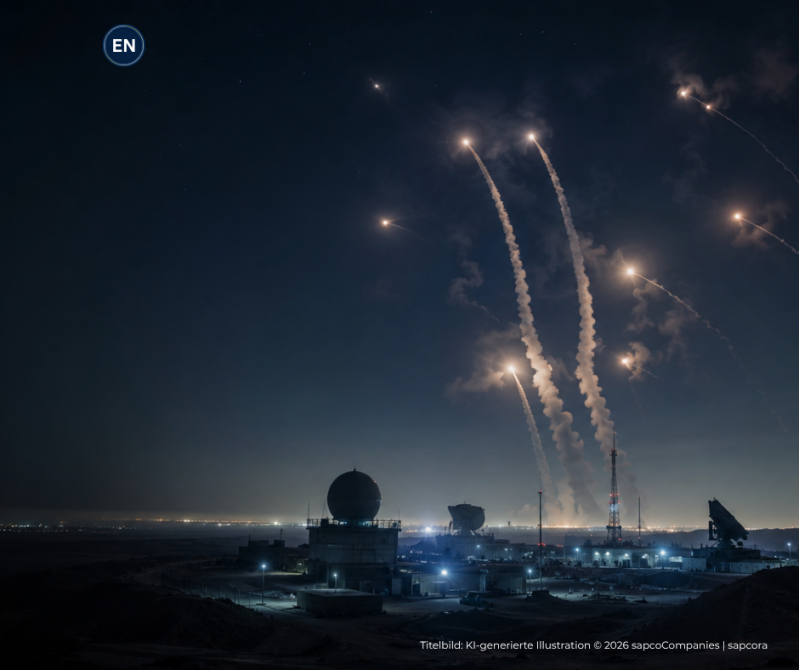
Iran has launched ballistic missiles toward American forces in the Middle East, abruptly ending a brief lull in direct hostilities. U.S. Central Command says every missile was intercepted, while Iran’s Revolutionary Guards say the targets were American military installations in Jordan. The immediate damage may have been contained, but the attack has reopened the most dangerous question in the region: whether Washington and Tehran can still limit a confrontation that is already spilling across borders, energy routes and military alliances.
A direct attack at the worst possible moment
The confirmed facts remain limited but serious. U.S. Central Command said Iran launched multiple ballistic missiles in what it described as an attempted surprise attack on American forces based in the Middle East. The command did not identify the intended location in its initial public statement, although the Revolutionary Guards later said they had targeted a U.S. air base and a Central Command facility in Jordan.
CENTCOM said all the missiles were successfully intercepted. Public statements available at the time of publication had not identified U.S. casualties or confirmed damage, but neither the number of missiles nor the systems used to stop them had been disclosed. There was also no independently verified account of the flight paths, interception points or debris impact zones.
That distinction matters. The assertion that every missile was intercepted is an official American military assessment, not yet a fully documented public reconstruction of the attack. In a conflict defined by competing claims about targets, damage and operational success, the absence of immediate evidence of casualties cannot be treated as proof that the attack produced no consequences.
The pause was never a settlement
The missile launch came after several days in which the United States and Iran had largely refrained from announcing new attacks. President Donald Trump had halted a two-week American bombing campaign over the weekend, while a senior Iranian official had indicated that Tehran would also suspend attacks as long as the United States maintained its pause.
That fragile calm created room for mediators to explore a return to negotiations. Trump said on Tuesday that there had been good talks with Iran, but his language remained openly coercive. He again threatened strikes against fortified nuclear infrastructure, bridges and power plants if Tehran failed to reach an agreement.
Iran, for its part, denied that it was seeking to resume direct talks with Washington. The Revolutionary Guards described the missile attack as a response to continuing American actions against Iranian interests, suggesting that Tehran did not regard the operational pause as a political truce.
The contradiction was visible before the missiles were fired. Washington was speaking about progress while threatening another campaign against Iranian infrastructure. Tehran was allowing diplomatic contacts to continue while preserving the right to retaliate. The result was not de-escalation, but a temporary suspension inside a conflict whose basic terms had never been resolved.
Jordan emerges as a critical point of exposure
The Revolutionary Guards’ statement places Jordan at the center of the latest confrontation, although the United States has not publicly confirmed the target. That uncertainty prevents a definitive account of which installation or military unit Iran intended to strike. It also leaves unanswered whether regional partners participated in the interception.
Jordan’s involvement would carry significance beyond the immediate military operation. A direct Iranian strike against American forces stationed in a partner country increases the political burden on the host government and raises the risk that regional states become active theaters rather than supporting locations behind the front line.
A successful interception does not remove that risk. Ballistic missile attacks can generate falling debris, force civilian airspace restrictions and compel governments to activate defensive systems at substantial cost. Repeated attacks also test whether regional defenses can withstand saturation over time, rather than stop a single limited barrage.
Iraq becomes the next front
Within hours of the Iranian launch, American and Saudi aircraft struck logistics and weapons sites used by Iran-aligned groups in eastern Iraq. U.S. Central Command said the operation followed more than 30 drone attacks over the previous 72 hours against American forces and Saudi energy infrastructure, which it attributed to direction from Iran’s Revolutionary Guards.
The sequence created an immediate impression of retaliation, but the available evidence does not establish that connection. An American official said the Iranian ballistic missile launch occurred before the U.S.-Saudi strikes and maintained that the two operations were not directly linked. The strikes in Iraq were presented instead as a response to the preceding wave of drone attacks.
Saudi Arabia said it did not seek escalation but would respond to attacks on its territory and energy installations. Iran denied responsibility for projectiles launched from other countries toward Saudi targets, while an Iranian military official warned that attributing attacks on American interests to Tehran would be a major miscalculation.
Iraq now faces the consequences of that widening confrontation. The Popular Mobilization Forces said several of its headquarters had been hit and reported deaths, injuries and damage in preliminary accounts. Iraqi territory is increasingly becoming the arena in which Washington, Riyadh, Tehran and armed groups aligned with Iran exchange military pressure without accepting full responsibility for the broader escalation.
The attack raises a harder military question
The immediate American defense appears to have worked. The strategic concern is whether the same level of protection can be sustained through weeks or months of repeated missile and drone attacks.
An analysis cited by the Associated Press estimates that the conflict has sharply reduced U.S. inventories of Patriot and Terminal High Altitude Area Defense interceptors. Based on public budget documents and other available information, the Center for Strategic and International Studies estimated that the Patriot inventory may have fallen by at least 65 percent from its prewar level, while the THAAD stockpile may be at least 38 percent smaller. These figures are estimates, not official inventory disclosures.
The Pentagon disputes suggestions that American military capability has been critically weakened. Its chief spokesperson said the United States retains the forces and weapons required to protect its personnel and execute presidential orders. Exact operational stockpiles remain classified, making confident public conclusions impossible.
The underlying problem is nevertheless real. Modern missile defense depends on expensive interceptors that cannot be manufactured or replenished at the speed with which cheaper drones and larger missile inventories can be launched. Even when every incoming weapon is defeated, the defender may be consuming scarce resources at an unfavorable rate.
No public evidence has identified whether Patriot, THAAD, Aegis or another system was used in the latest interception. Any claim about the specific defensive architecture involved would therefore be premature. What can be said is that every new barrage forces Washington to balance immediate force protection against the preservation of high-end munitions for future attacks and other global commitments.
Diplomacy now operates under missile pressure
The timing of the attack places renewed strain on diplomatic efforts led by regional intermediaries. Oman has proposed a framework for shared regional management of the Strait of Hormuz, including a system of voluntary contributions from commercial vessels rather than unilateral Iranian control or mandatory tolls. Washington has rejected Iranian claims to impose fees or restrictions on an international waterway.
The wider negotiations were expected to address more than shipping. The unresolved agenda includes Iran’s nuclear program, the presence of American forces in the region, attacks on energy infrastructure and the conditions under which the United States might permanently end its campaign.
Iran’s decision to fire ballistic missiles directly from its territory reduces the space for diplomatic ambiguity. Proxy attacks can be denied, disowned or attributed to local commanders. A declared Revolutionary Guard missile operation is a state action, and Washington must now decide whether to answer it militarily, absorb it because the missiles were intercepted, or use the attack as leverage in negotiations.
The motive remains uncertain. Tehran may have intended to retaliate for previous American operations, demonstrate that the pause did not amount to surrender, improve its bargaining position or disrupt negotiations it considered unfavorable. The available evidence does not establish which of those calculations was decisive.
The Trump-Netanyahu meeting adds another layer
The escalation occurred on the same day Israeli Prime Minister Benjamin Netanyahu met Trump at the White House. It was their first White House meeting since the United States and Israel began their military campaign against Iran on February 28. Both leaders described the talks positively but released few substantive details.
Iran, the future of the nuclear program and the possibility of renewed strikes were central to the political context surrounding the meeting. Trump had already made clear that he was prepared to attack additional Iranian infrastructure if diplomacy failed, while also signaling that he did not require Israeli persuasion to act.
There is no verified evidence that the Iranian missile launch was timed specifically in response to Netanyahu’s visit. The overlap nevertheless sharpens Tehran’s strategic message: negotiations with Washington will proceed, if at all, while Iran retains the capacity and willingness to threaten American forces directly.
For Trump, the decision is no longer simply whether to support another Israeli operation. He must determine how the United States responds when its own personnel are targeted during a diplomatic pause that he publicly presented as progress.
Hormuz remains the economic fault line
The military confrontation cannot be separated from the Strait of Hormuz. Before the war disrupted traffic, roughly one-fifth of the world’s traded oil and liquefied natural gas moved through the waterway. Control over shipping routes, vessel inspections and the possible collection of fees has become part of the conflict itself.
Iran’s Revolutionary Guards said on Wednesday that they had stopped three oil tankers in the strait after the vessels allegedly ignored Iranian warnings. That account had not been independently verified at the time of publication. The claim nevertheless reinforced market fears that the confrontation could again restrict one of the world’s most important energy corridors.
Oil prices reacted immediately. Brent crude rose $3.30, or 3.9 percent, to $87.39 a barrel in early trading, while West Texas Intermediate climbed $3.05, or 3.8 percent, to $82.31. The move reflected renewed concern about escalation, although inventory data and expectations surrounding future OPEC+ production also influenced prices.
A sustained disruption would reach far beyond the energy sector. Higher crude prices would increase pressure on transportation, aviation, manufacturing and consumer inflation. Shipping companies could face higher insurance costs and longer routes, while financial markets would have to reprice the possibility that the conflict is moving away from negotiation and back toward a broader regional campaign.
Washington’s options are all costly
Trump can order a direct strike on Iranian missile sites or other military infrastructure, but doing so would risk another and potentially larger wave of retaliation. He can limit the response to defensive deployments and operations against Iranian-aligned groups, but Tehran may interpret restraint as evidence that attacks producing no American casualties carry an acceptable price.
The administration can also attempt to preserve negotiations while warning that another strike will trigger a different response. That approach would keep diplomacy alive, but it would require both sides to accept that military pressure and negotiations are proceeding at the same time.
None of these paths offers control without risk. Retaliation could widen the war, restraint could invite further testing, and diplomacy could collapse under the weight of another attack before an agreement is reached.
The unanswered questions now matter most
The exact number and type of missiles remain undisclosed. So do their launch locations, intended impact points, interception systems and the identities of any regional forces that may have participated in the defense.
It is also unclear whether Washington has decided on a military response, whether Oman and other intermediaries remain in contact with both sides, and whether Iran will treat the latest exchange as a completed act of retaliation. Reports of damage or casualties could still change the political and military calculation if new evidence emerges.
The U.S.-Saudi strikes in Iraq require separate scrutiny. Their targets, casualty figures and legal basis will affect Iraq’s response and could determine whether armed groups there launch additional attacks against American or Saudi interests.
An interception buys time, not stability
The failure of the Iranian missiles to reach their reported targets may prevent an immediate rush toward a far larger American response. It does not restore the pause that existed before the launch, and it does not resolve the disputes over Iran’s nuclear infrastructure, American military operations or control of the Strait of Hormuz.
The decisive issue is now whether the attack remains a contained exchange or becomes the first move in another cycle of retaliation. Washington and Tehran continue to speak the language of negotiation, but their military actions are narrowing the room in which diplomacy can operate.
Air defense has bought the United States time. What the administration does with that time will determine whether the latest barrage becomes a warning that was absorbed, or the moment the brief pause gave way to a more dangerous phase of the conflict.
Kommentar hinzufügen
Kommentare