

Category: Politics
Format: Special Report
Author: Sinisa Brkic (sb)
Fauci Invokes Fifth Amendment in US Senate COVID Hearing. Anthony Fauci invoked the Fifth Amendment before the US Senate. What his silence means, how far Biden’s pardon reaches, and which COVID questions remain unresolved.
Anthony Fauci declined to answer 15 questions before a US Senate committee, repeatedly invoking his constitutional right against self-incrimination. The hearing was meant to clarify questions about federal research funding, the possible origins of SARS-CoV-2, and Fauci’s previous testimony. Instead, it opened a legal and political confrontation whose impact already exceeds the hearing’s limited factual findings.
Fifteen Questions, Fifteen Refusals
Anthony Fauci appeared before the Senate Committee on Homeland Security and Governmental Affairs on July 29, 2026, as the hearing’s sole witness. The former director of the National Institute of Allergy and Infectious Diseases had been compelled to testify about his role during the pandemic, federal research funding, and the still unresolved origins of the coronavirus.
Little substantive testimony followed. Acting on the advice of counsel, Fauci said at the outset that he would rely on the Fifth Amendment’s protection against self-incrimination. He then invoked that right in response to 15 questions from Republican committee chairman Rand Paul.
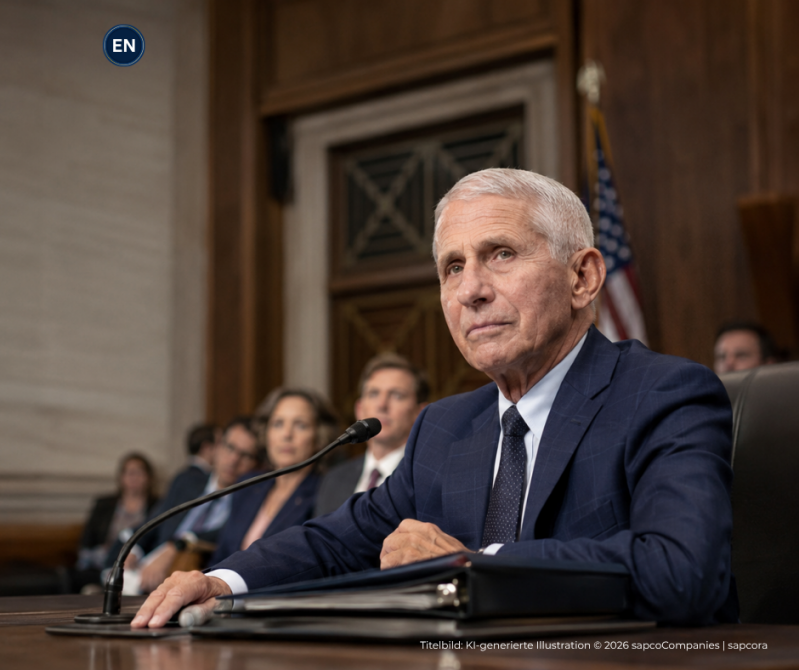
The hearing’s most powerful political image was created within minutes. Fauci, once the most visible face of federal pandemic policy, sat before the Senate and declined to answer the central accusations raised by one of his longest-standing political adversaries.
Silence Is Not an Admission of Guilt
Invoking the Fifth Amendment does not amount to admitting a crime. The US Constitution protects individuals from being forced to provide testimony that could later be used against them in a criminal proceeding. That protection can also apply during congressional investigations.
The public meaning of silence, however, is very different from its legal meaning. In a deeply polarized hearing, refusing to answer can quickly be portrayed as confirmation of suspicion, even though that conclusion is neither legally valid nor factually inevitable.
A witness who invokes the Fifth is not declaring guilt. The witness is asserting that an answer may create a realistic risk of criminal exposure.
Fauci’s attorneys have pointed to Paul’s repeated calls for prosecution as evidence that such a risk exists. Fauci accused the senator of pursuing a personal and politically motivated campaign aimed not at clarification, but at imprisonment. Paul rejected that characterization and said the committee would consider consequences for Fauci’s refusal to respond.
Biden’s Pardon Creates a Legal Paradox
The central legal question is whether Fauci can still face a meaningful risk of self-incrimination. On January 19, 2025, President Joe Biden issued Fauci a full and unconditional federal pardon covering potential offenses committed between January 1, 2014, and the date of the pardon. The document covers conduct connected to Fauci’s work as NIAID director, a member of White House coronavirus task forces, and chief medical adviser to the president.
A pardon can significantly weaken a Fifth Amendment claim when it fully eliminates the possibility of federal prosecution for the conduct at issue. If no criminal exposure remains, the legal basis for refusing to answer may also disappear. Paul relies on that principle when he argues that Fauci cannot invoke the Fifth regarding conduct covered by the pardon.
The situation is not entirely clear. Biden’s pardon ends on January 19, 2025, and does not cover later conduct or every possible state offense. Testimony given in 2026 could also raise questions about actions or statements outside the pardon’s defined period.
A pardon does not authorize false testimony. Any knowingly false statement made before Congress could create a new legal risk. Truthful testimony would not itself be a crime, but it could disclose information relevant to other investigative theories or proceedings.
Whether Fauci’s broad refusal to answer was legally justified cannot be settled by the committee chairman alone. If the confrontation escalates, the scope of the pardon and the validity of Fauci’s Fifth Amendment claim may have to be tested in court.
Rand Paul’s Accusations Go Back Years
The conflict between Paul and Fauci did not begin with this hearing. For years, the senator has accused the former public health official of misleading Congress about US funding for coronavirus research conducted in Wuhan. Fauci has consistently denied the allegation and has argued that his earlier testimony reflected the regulatory definitions in force at the time.
It is documented that US research funds moved through the nonprofit EcoHealth Alliance to projects involving the Wuhan Institute of Virology. Those projects included research on bat coronaviruses. The existence of that funding chain, however, does not by itself establish that Fauci knowingly made a materially false statement.
Much of the dispute turns on the phrase “gain of function.” In broad scientific usage, the term can describe experiments that give an organism a new or enhanced property. US oversight rules have at times used a narrower definition focused on research expected to increase the transmissibility or severity of potential pandemic pathogens.
Paul relies on a broader interpretation and argues that the experiments prove Fauci’s previous testimony was false. Fauci has cited the narrower regulatory definition and maintained that the funded work did not fall within it.
Turning that technical dispute into a criminal false-statement case would require more than showing that the two sides used different definitions. Prosecutors would have to establish what Fauci understood, what he intended to communicate, and whether any inaccurate statement was knowingly and materially false.
The Diaries Provide Material, Not Yet Proof
Shortly before the hearing, Paul released 1,141 pages of Fauci’s diary entries covering the period from December 2019 through December 2022. The senator claims the private notes conflict with Fauci’s public statements about a possible laboratory origin, China’s transparency, and the government’s early understanding of the virus.
Fauci’s representatives dispute that interpretation. They argue that the entries show he considered multiple origin theories, criticized the lack of transparency from China, and recognized the risk of asymptomatic transmission at an early stage.
The disagreement therefore concerns more than the wording of the notes. It also concerns selection, context, timing, and the way individual passages are being interpreted.
Personal records can provide valuable evidence about internal assessments and decision-making. They do not replace a complete reconstruction of what information was available at a particular moment, how reliable it appeared, and how official conclusions changed over time. So far, the hearing has not produced a new and conclusive piece of evidence proving that Fauci committed a crime or intentionally deceived Congress. The release of extensive records also does not establish that every allegation against him is unfounded. The documents require independent review in full context, not only political presentation.
Wuhan Remains an Unresolved Question
More than six years after the pandemic began, the origin of SARS-CoV-2 has not been conclusively established. US intelligence agencies have reached different assessments. Some consider a laboratory-related incident more likely, while others continue to favor a natural spillover from animals to humans.
Several of those assessments have been expressed with low or moderate confidence. No infected animal has been identified as the definitive source, and no publicly available evidence has established that the pandemic virus or its immediate precursor was present in a laboratory before the outbreak.
Both leading hypotheses therefore remain unresolved. That uncertainty must be separated from the specific allegations against Fauci.
A possible laboratory accident would not automatically prove that the virus was genetically engineered. It would also not establish that the virus was designed as a biological weapon or deliberately released. These distinctions are often blurred in political debate. Questions about research funding, laboratory safety, public disclosure, and viral origin are related, but they are not the same evidentiary question. Treating them as interchangeable may strengthen political narratives, but it weakens serious investigation.
A Legitimate Inquiry Inside a Poisoned Process
Congress has a legitimate responsibility to oversee federally funded research involving serious biological risks. That includes examining grant conditions, reporting obligations, laboratory standards, agency decision-making, and the accuracy of testimony given by senior officials.
Past statements by public officials may also be reexamined when newly released records raise credible questions about their completeness or accuracy. Oversight does not become illegitimate simply because it is politically contentious.
The credibility of an investigation, however, depends heavily on its methods. When a committee chairman has spent years publicly demanding the imprisonment of a witness, the process carries an obvious burden. Even valid questions lose force when the inquiry appears designed to confirm a conclusion already reached.
Democrats on the committee described the hearing as politically predetermined. That criticism does not automatically invalidate Paul’s questions, but it identifies a central problem. An investigation can earn public trust only when incriminating and exculpatory evidence are tested by the same standards. Fauci’s refusal to answer also prevents substantive clarification. His legal caution may be understandable from a defense perspective, but it inevitably strengthens those who want the silence to serve as proof of wrongdoing. Legal strategy and public credibility operate according to different rules.
Contempt of Congress Has Not Been Established
Paul said the committee would consider possible consequences. That statement does not mean a contempt proceeding has begun, nor does it establish criminal liability. Before further action could be taken, lawmakers would have to determine whether the questions were valid and whether Fauci’s Fifth Amendment claim could lawfully be rejected. Additional committee action, a Senate vote, a referral to the Justice Department, or litigation could then follow, depending on the path chosen.
The legal obstacles are substantial. Congress and federal prosecutors would have to evaluate the pardon’s scope and demonstrate that Fauci refused to comply with a valid obligation to testify without sufficient constitutional grounds.
Until those issues are formally resolved, Paul’s warning remains an escalation of political pressure, not a settled legal finding.
The Real Accountability Question Is Larger Than Fauci
Focusing on one individual risks obscuring the structural failures that deserve scrutiny. Decisions about research funding, laboratory safety, international cooperation, intelligence sharing, and crisis communication were not made by Fauci alone. They emerged from agencies, scientific institutions, contractors, and political offices whose responsibilities remain only partly understood.
A credible review would have to go further. It would need to establish how research risks were evaluated, what information arrived from Wuhan and when, why reporting problems were not identified earlier, and how officials communicated scientific uncertainty to the public.
It should also examine the extent to which political pressure shaped the interpretation and presentation of scientific evidence. Those questions matter more for the next health emergency than the symbolic destruction of a single former official. Public trust will not be restored through hero worship, but it will not be restored through the construction of a universal villain either. It requires accessible records, clearly assigned responsibility, and investigative procedures that distinguish accountability from retaliation.
A Powerful Image, but Not a Final Answer
The July 29 hearing will be remembered primarily for Fauci’s repeated invocation of the Fifth Amendment. The image of a former senior government official refusing to answer senators carries enormous political force. It does not resolve the origin of the pandemic or establish criminal responsibility. Paul increased the pressure on Fauci, but he has not yet presented a court-tested case. Fauci exercised a constitutional protection, but in doing so he also prevented his version of events from being tested in public.
Both sides left the hearing with material that supports their preferred political narrative. The public, however, received little new certainty. The pandemic reckoning has reached a dangerous stage. If it is reduced to personal hostility, selective documents, and the manufacture of suspicion, it will lose what remains of its credibility. A serious inquiry must separate the legal, scientific, and institutional questions, then follow the evidence wherever it leads.
Kommentar hinzufügen
Kommentare