

Section: International
Format: Special Report
Author: Sinisa Brkic (sb)
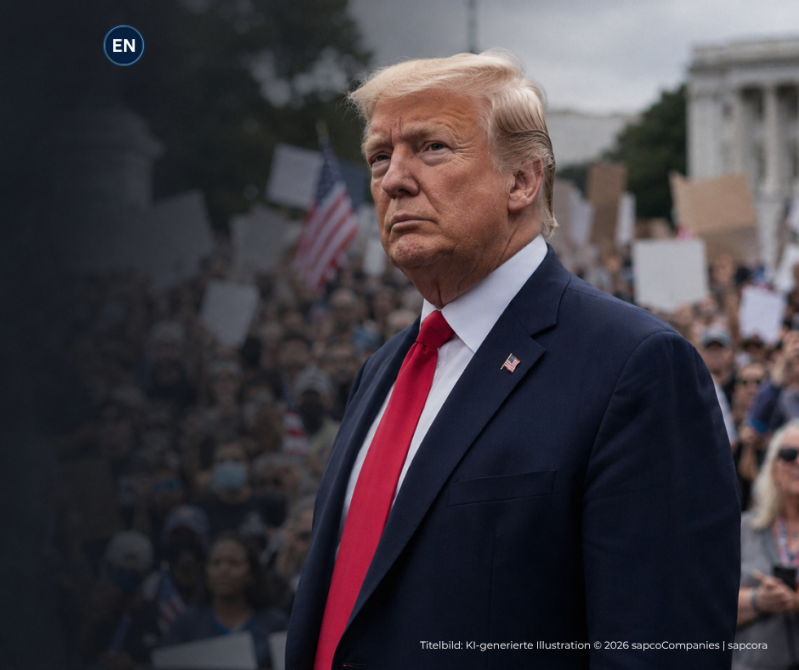
America’s Anti-Trump Network: Protest, Power and the Midterms. America’s opposition to Donald Trump has grown into a nationwide protest network. The 2026 midterms will reveal whether mobilization can become power.
Opposition to Donald Trump has developed into one of the broadest protest networks in contemporary American politics. It reaches from national civil rights organizations and labor unions to suburban groups, student organizers and activists in deeply conservative states. Its scale is evident, but its political power remains unproven.
A coalition larger than any single organization
The opposition confronting Donald Trump is often described as a movement. That description captures its scale, but not its structure. What has emerged across the United States is better understood as a decentralized network of organizations, local groups and temporary alliances connected by resistance to the president and his administration.
Indivisible, the 50501 Movement, civil liberties organizations, labor unions, educators, immigration advocates and Democratic activists operate within the same political space, but they do not answer to a common leadership. They share campaign infrastructure, protest dates and broad democratic language while retaining different priorities, constituencies and methods.
That flexibility is one reason the network has expanded. National organizers can coordinate demonstrations across all 50 states, while local groups determine where to gather, which issues to emphasize and how to continue their work after a national action ends. The result is not a disciplined organization with a unified program, but a political ecosystem capable of mobilizing at unusual speed.
The distinction is important. A coherent movement can negotiate, set priorities and impose discipline. A network can spread faster and reach further, but it may struggle to decide what victory looks like once the immediate protest is over.
Protest at a national scale
Demonstration activity in the United States rose sharply during 2025, reaching its highest level since the racial justice protests of 2020. Opposition to Trump was the largest driver of that increase and accounted for close to 40 percent of recorded demonstrations during the year.
The national No Kings mobilizations became the clearest expression of that opposition. On March 28, 2026, protest monitors recorded more than 2,400 demonstrations, making it one of the largest single days of coordinated mobilization in recent American history. More than 3,200 events had been announced across all 50 states.
Organizers claimed that several million people participated. No comprehensive national authority independently counts attendance at decentralized protests, which means such estimates must be treated with caution. The number of events, their geographical distribution and the visible crowds nevertheless confirm a protest operation of exceptional breadth.
The demonstrations were also overwhelmingly peaceful. Isolated clashes and arrests occurred in several cities, but they represented a small fraction of the day’s events. That matters because the administration and its allies have repeatedly sought to associate opposition with disorder, extremism and threats to public safety.
Immigration turned policy into confrontation
The network draws energy from several issues, including executive power, voting rights, federal restructuring, civil liberties, education and foreign policy. Immigration enforcement, however, has become its most potent source of mobilization because it places federal authority directly inside local communities.
The administration’s deportation campaign has affected homes, workplaces, schools, transportation hubs and public streets. It has transformed a national policy debate into a series of immediate confrontations involving federal agents, local authorities, families and civilian observers.
Minnesota became the defining example. The fatal shootings of US citizens Renee Good and Alex Pretti during separate encounters with federal immigration officers triggered demonstrations, legal disputes and intense scrutiny of the government’s initial accounts. Video evidence raised serious questions about claims made in the immediate aftermath of the incidents.
The deployment of thousands of federal agents to the Minneapolis area deepened the conflict. Residents, labor groups, religious leaders and local businesses participated in protests against the operation, while state and city officials challenged aspects of the federal response.
Trump threatened to invoke the Insurrection Act if state authorities failed to control demonstrators whom he characterized as agitators and insurrectionists. The administration later adjusted its posture, ordering federal homeland security personnel not to intervene in protests in Democratic led cities unless local assistance was requested or federal property was threatened.
That partial recalibration revealed the political cost of the confrontation. The administration did not abandon its immigration policy, but it was forced to respond to public anger, disputed official narratives and resistance from state and local institutions.
The protest map reaches beyond liberal America
The network’s geographical expansion may prove more significant than the size of its largest rallies. Anti-Trump demonstrations are no longer confined to Washington, New York, Los Angeles, Chicago or university communities where progressive activism is established and politically protected.
A substantial majority of announced No Kings events took place outside major cities. Demonstrations appeared in suburbs, county seats and smaller communities, including areas where Republican candidates normally dominate elections.
This does not demonstrate a broad collapse of support for Trump in conservative America. His hold over the Republican electorate remains strong, and protest participation represents only one segment of public opinion. It does show that electoral maps can conceal organized dissent within politically uniform states and counties.
The local context changes the meaning of participation. Joining a rally in Manhattan carries different social and professional risks from publicly opposing Trump in a small Republican community. A modest demonstration in such a place may reveal more about political pressure than a much larger gathering in a Democratic stronghold.
Suburban participation is particularly important. These communities contain many of the competitive congressional districts that will determine control of the House of Representatives. They also include voters who may dislike Trump’s conduct or specific policies without identifying with the ideological left.
A constitutional message broadens the coalition
The phrase No Kings is effective because it avoids the language of a conventional party campaign. It invokes limited government, constitutional restraint and the American rejection of unaccountable rule. These ideas allow organizers to present opposition to Trump as a defense of the republic rather than simply an extension of Democratic politics.
That framing creates space for liberals, moderates, independents, union members, civil libertarians and disaffected conservatives to appear under the same banner. It also allows protesters to criticize presidential power without first reaching agreement on every question of taxation, health care, foreign policy or social reform.
The coalition’s diversity is an advantage during mass mobilization. It becomes more difficult when organizers move from protest to policy. Participants who agree that Trump has accumulated excessive power may disagree sharply about immigration, policing, the Democratic Party, military intervention or the scale of economic change they consider necessary.
A broad constitutional message can therefore bring millions into the streets without producing a common governing program. The network’s future depends on whether it can preserve that breadth while developing clear priorities beyond opposition to the president.
Trump’s response is a battle over legitimacy
Trump and his allies do not treat the protests as neutral expressions of democratic participation. They portray them as partisan operations driven by radical activists, hostile organizations and political opponents seeking to obstruct an elected government.
The administration’s core argument is straightforward. Trump won a national election, campaigned openly on mass deportations and stronger executive action, and considers the implementation of those policies an electoral mandate. From this perspective, resistance is legitimate only until it interferes with federal enforcement or public order.
Protest organizers advance the opposite argument. Elections authorize governments to govern, but they do not remove constitutional limits, judicial review, state authority, press scrutiny or the public’s right to oppose government action. Their central claim is that democratic legitimacy cannot be reduced to a presidential victory.
The conflict is therefore not merely about individual policies. It concerns competing definitions of political authority. Trump emphasizes mandate, control and executive capacity, while the opposition emphasizes restraint, accountability and the legitimacy of organized dissent.
His rhetoric reinforces that divide. Trump has repeatedly described Democratic opponents in radical terms and used campaign appearances to present them as a threat to the country. Such language consolidates his base, but it also helps protest organizers argue that the dispute concerns the boundaries of democratic opposition itself.
From mass turnout to political infrastructure
Large demonstrations generate attention, solidarity and a visible sense of national scale. They do not automatically change legislation, restrain executive agencies or win elections. A protest network becomes politically consequential only when it can maintain pressure after the crowds leave.
That transition is already visible in parts of the coalition. Indivisible is preparing election protection operations across all 50 states, supporting local organizing and intervening in Democratic primary contests. Other groups are directing participants toward voter registration, congressional pressure, legal support and local campaigns.
These efforts show that organizers understand the limits of symbolic protest. A march can introduce people to political participation, but durable influence requires trained volunteers, local leadership, money, reliable communications and institutions capable of functioning between national events.
The evidence remains incomplete. Publicly available turnout figures do not reveal how many protesters later attend local meetings, contact lawmakers, join campaigns or vote. The network has demonstrated an ability to convene opposition, but its capacity to retain and direct that opposition has not been measured convincingly.
This is where the language of a unified movement can become misleading. Millions may attend demonstrations for different reasons and with different expectations. Without durable participation, large crowds can represent a political mood rather than an organized force.
The Democratic Party problem
The anti-Trump network cannot avoid the Democratic Party, but it cannot afford to become indistinguishable from it. Democrats are the only national electoral organization capable of removing Republican congressional majorities in November. They are also viewed with suspicion by activists who believe party leaders have responded too cautiously to Trump.
This tension is structural. The network needs Democratic candidates, campaign infrastructure and legislative power to achieve many of its immediate objectives. At the same time, its credibility depends on retaining the ability to pressure Democrats, challenge incumbents and criticize institutional passivity.
Indivisible’s involvement in Democratic primaries reflects that strategy. Rather than simply asking activists to support the party, it is attempting to influence what kind of party emerges from the current confrontation. That approach may strengthen the network’s leverage, but it also exposes internal divisions between progressive activists and more moderate voters.
The risk of full partisan absorption is considerable. Once a civic protest network is perceived primarily as a Democratic campaign instrument, it becomes harder to reach independents, moderate Republicans and people distrustful of both major parties. Its constitutional message would narrow into an electoral one.
November will provide the first hard test
The congressional elections on November 3, 2026, will be the first national measure of whether anti-Trump mobilization can produce institutional consequences. Control of Congress will determine the administration’s freedom of action during the final two years of Trump’s term.
The political environment offers the opposition an opening. Trump’s approval rating has remained below 40 percent in recent national polling, while dissatisfaction has grown over immigration enforcement, economic conditions and the war with Iran. Independent voters have also shown greater willingness to support Democratic congressional candidates.
None of this guarantees an electoral backlash. Low presidential approval does not automatically produce enthusiasm for the opposition party, and congressional elections are decided district by district. Republicans retain a loyal base, significant financial resources and a powerful media infrastructure.
Trump has already turned official appearances into campaign events, portraying Democrats as extremists and presenting the election as a struggle over national survival. The anti-Trump network faces a comparable challenge from the other direction. It must persuade voters that its opposition represents more than anger and that divided government would produce meaningful accountability.
The election will not determine the ultimate fate of the network. It will reveal whether its scale exists mainly on designated protest days or whether it has entered the machinery of American political power.
A network at the threshold
America’s anti-Trump opposition has moved beyond spontaneous outrage. It now possesses national brands, local groups, experienced organizers and the capacity to coordinate thousands of peaceful demonstrations across an entire continent.
It has not yet become a unified movement with a common strategy or a measurable command over elections and institutions. Its participants remain connected more clearly by what they reject than by the political order they want to build.
That is not an unusual weakness in the early development of a broad protest coalition. It is, however, the central question the network can no longer postpone. Opposition can mobilize people, but only organization can preserve their power.
The test ahead is therefore not whether Americans will protest Trump again. They will. The real test is whether the network can turn recurring resistance into disciplined participation, electoral influence and institutional restraint without losing the breadth that made it significant in the first place.
Kommentar hinzufügen
Kommentare