

Section: Geopolitics
Format: Special Report
Author: Sinisa Brkic (sb)
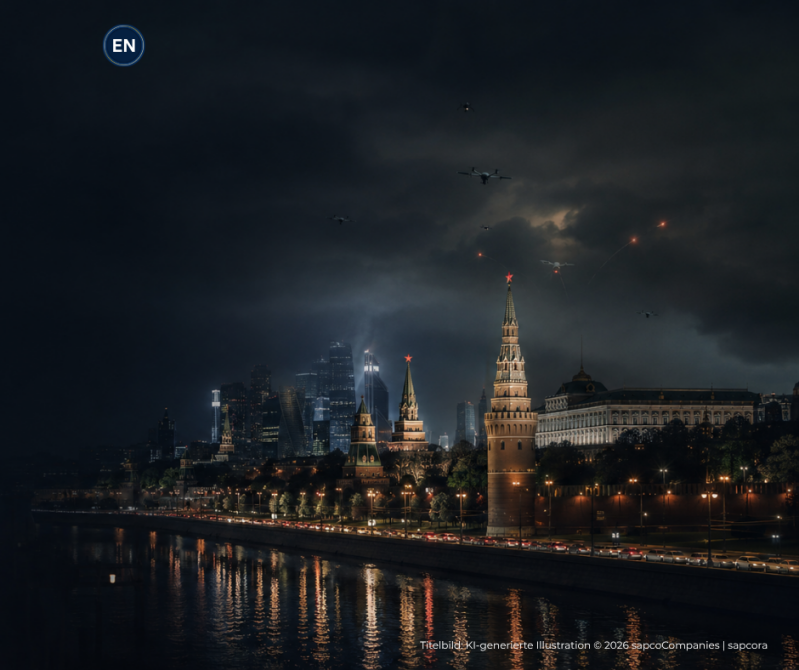
Putin’s Strategic Miscalculation as the War Reaches Moscow. Ukrainian drones are reaching Moscow and targets deep inside Russia. This special report examines Putin’s original miscalculation and the growing risk of escalation.
Vladimir Putin launched the invasion of Ukraine expecting to overwhelm the country politically and militarily within a short period of time. More than four years later, Ukrainian drones are reaching the Moscow region in large numbers, striking logistical and economic targets and forcing Russia to devote growing resources to the defense of its own capital. The war the Kremlin intended to wage on Ukrainian territory, insulated from everyday life in Russia’s political center, has returned to the heart of Putin’s system of power.
A War That Was Supposed to Remain Distant
Russia has subjected Ukraine to missile strikes, cruise missiles, glide bombs and drone attacks since the beginning of its full-scale invasion in February 2022. Ukrainian cities have been damaged repeatedly, critical energy infrastructure has been targeted and millions of civilians have been forced to live with the immediate consequences of war.
For much of the Russian population, particularly in Moscow, the conflict remained a distant and tightly managed reality. The Kremlin demanded loyalty, acceptance of military losses and tolerance of economic costs, but it sought to prevent the war from fundamentally disrupting daily life in the capital.
That distance was politically valuable. Moscow was meant to project stability, control and national strength while destruction remained largely confined to Ukraine and Russia’s border regions. The capital served as the stage on which the Kremlin presented the image of a state that could wage war without exposing its own center of power to comparable vulnerability.
That image can no longer be sustained. Ukrainian drones now reach the Moscow region with increasing frequency, triggering air defenses, disrupting aviation and threatening industrial, logistical and energy facilities. The scale of violence remains profoundly unequal, but the geographical and psychological separation on which the Kremlin relied has been broken.
The First Miscalculation Began Outside Kyiv
There is no publicly verifiable evidence showing precisely what Putin expected regarding future Ukrainian strikes on Moscow. His personal assumptions about the development of Ukraine’s long-range capabilities remain a matter of inference rather than established fact.
Russia’s broader strategic miscalculation, however, is well documented. Moscow expected Ukrainian state structures to fracture, the country’s political leadership to become paralyzed and Russian forces to achieve a rapid military decision.
An analysis based on Ukrainian operational data concluded that the original Russian plan envisioned defeating Ukraine within approximately ten days, followed by an occupation intended to enable annexation. The operation depended on speed, deception and the rapid capture of Kyiv, but lacked viable alternatives once the initial advance failed.
Putin’s most consequential error was therefore not simply a mistaken assessment of Ukrainian weapons. He underestimated Ukraine as a state, a society and a political nation. The Kremlin planned for fear, institutional collapse and fragmentation, but encountered resistance, military adaptation and a government that refused to abandon the capital.
The failure outside Kyiv changed the nature of the war. It did not end Russia’s campaign, but it destroyed the assumption that Ukraine could be subordinated quickly and at manageable cost.
Moscow Is Not Kyiv, but the Direction of the War Has Changed
The statement that the war has reached Moscow requires precision. Ukraine is not conducting a sustained bombing campaign against the Russian capital on a scale comparable to Russia’s attacks on Kyiv, Kharkiv and other Ukrainian cities.
Ukraine primarily relies on domestically developed long-range drones to target military, logistical, industrial and energy infrastructure. These operations are intended to weaken Russia’s ability to finance, supply and sustain the war rather than to destroy Moscow as an urban center.
The risks to civilians are nevertheless real. Intercepted drones, falling debris and malfunctioning systems can strike residential buildings, injure civilians and cause deaths. The legitimacy of any individual operation depends on the nature of the target, the precautions taken and whether the expected military advantage is proportionate to the danger imposed on civilians.
The scale of recent operations illustrates how rapidly the strategic environment has changed. On July 20, Russian officials said approximately 400 drones had been launched toward Moscow and the surrounding region. Ten people were reported injured, buildings caught fire near Domodedovo and Ukrainian authorities said logistical facilities and an oil depot were among the targets.
Another major wave followed on July 28. Russian authorities reported that more than 390 drones were heading toward the wider Moscow region, with 81 intercepted near the capital. An apartment building in Chekhov was damaged, although local officials reported no casualties.
These figures are largely based on statements from Russian authorities and cannot be independently verified in every detail. The repeated activation of air defenses, aviation restrictions and documented physical damage nevertheless confirm that the threat to the capital region has moved beyond isolated incidents.
The Drone Is Changing the Cost of War
Ukraine cannot match Russia aircraft for aircraft, missile for missile or industrial complex for industrial complex. Its strategy therefore depends on asymmetric systems capable of exploiting vulnerabilities that traditional military power does not fully eliminate.
Long-range drones are central to that approach. They are generally less expensive than many of the air defense systems required to intercept them, can be produced in significant numbers and force Russia to defend a vast territory containing refineries, airfields, weapons plants, storage facilities and transportation networks.
Their strategic value cannot be measured solely by the number of buildings destroyed. Every major attack requires Russia to deploy radar systems, electronic warfare equipment, interceptor missiles and personnel far behind the front. Resources assigned to the defense of Moscow or critical industrial sites are resources that cannot be used with equal intensity elsewhere.
The campaign is designed to increase the cost of aggression. It seeks to interrupt production, complicate military logistics, damage fuel infrastructure and undermine the assumption that Russia can attack Ukraine indefinitely without exposing its own strategic rear to sustained pressure.
Repetition is essential to this strategy. A single drone attack can be dismissed, absorbed or turned into propaganda. A continuing campaign forces the Russian state to alter its resource allocation, infrastructure protection and domestic security planning.
The Attacks Strike at Putin’s Core Political Promise
Putin’s rule rests on more than repression, political control and the removal of meaningful opposition. It also rests on a political bargain in which the state promises order, predictability and security in exchange for public obedience.
Moscow is the most important symbol of that bargain. It is the administrative, financial and political center from which the Kremlin projects the image of a state that has overcome the instability of the 1990s and restored Russia’s status as a major power.
Drones over the capital region strike directly at that image. If the attacks are minimized, the government risks appearing passive and vulnerable. If they are presented as an existential threat, the Kremlin must explain how a war portrayed as controlled and successful has brought sustained danger to the country’s political center.
This contradiction does not mean that widespread public revolt is imminent. The Russian state retains powerful instruments of censorship, surveillance, repression and narrative control. It can redirect anger toward Ukraine and the West while criminalizing criticism of the war.
The political cost is subtler but still significant. Airport closures, damaged buildings, industrial fires and air defense activity over populated areas make the war harder to separate from daily life. They weaken the Kremlin’s ability to present the conflict as something distant, limited and fully under control.
Putin promised a demonstration of Russian strength. What is now visible is a war whose consequences can no longer be kept outside the perimeter of the capital.
Russia Has Adapted and Remains Dangerous
The original Russian failure should not be confused with an inability to learn or adjust. Russia changed its military approach after the collapse of the offensive against Kyiv, expanded defense production and reorganized its forces for a prolonged war of attrition.
The Kremlin is no longer relying primarily on one dramatic breakthrough to determine the outcome. Its strategy increasingly seeks to exhaust Ukrainian manpower, air defenses, energy systems and economic resilience over time.
Russia is attempting to convert scale into strategic advantage. Its leadership is relying on industrial capacity, personnel reserves and the expectation that political support for Ukraine will weaken in Western capitals before the Russian system reaches its own limits.
This adaptation makes the situation more dangerous, not less. A regime that failed to secure a rapid victory still possesses the military capacity to inflict enormous damage, while its political objectives have not fundamentally disappeared.
The attacks on Moscow are therefore not proof that Russia is approaching collapse. They expose vulnerabilities, impose costs and damage the image of invulnerability, but they do not by themselves determine the outcome of the war.
Conventional Escalation Remains the Most Likely Response
The growing vulnerability of Moscow increases military and political pressure on the Kremlin. That does not mean Russia is certain to move immediately toward the most extreme form of escalation.
Russia still has numerous conventional options available. It can expand missile and drone attacks against Ukrainian cities, energy infrastructure, defense production, transportation networks and government facilities. It can also increase the frequency of attacks in an effort to overwhelm Ukraine’s limited stock of air defense interceptors.
This pattern is already visible. In early July, Russia launched 74 missiles and 496 drones in a major attack that killed at least 30 people in Kyiv, injured dozens and damaged approximately 130 buildings. Moscow described the strikes as retaliation for Ukrainian attacks inside Russia and said it would continue increasing pressure in pursuit of its war aims.
The language of retaliation serves an important political purpose. It allows the Kremlin to portray further Russian escalation as a forced response, even though Russia’s systematic campaign against Ukrainian cities and infrastructure began long before Ukraine developed its current long-range strike capability.
The most immediate danger is therefore not necessarily an abrupt nuclear decision. It is the continued expansion of conventional attacks that produce mass casualties, destroy critical infrastructure and deepen the civilian cost of the war.
Europe Is Also on the Escalation Ladder
Russian retaliation does not have to remain confined to Ukrainian territory. Cyberattacks, sabotage, information operations, covert violence and disruption of critical infrastructure offer Moscow ways to impose costs on European supporters of Ukraine without initiating an open military conflict with NATO.
European governments have documented what they describe as a coordinated and persistent Russian hybrid campaign. The reported activity includes cyber operations, sabotage, attacks on infrastructure, physical violence, information manipulation and interference in democratic institutions.
Such operations are strategically useful because they create uncertainty. Attribution may take time, evidence may remain classified and governments may disagree over whether an incident warrants a diplomatic, economic or military response.
This ambiguity allows Russia to test Western cohesion while attempting to remain below the threshold of direct war. It can increase the domestic cost of supporting Ukraine and encourage political actors who argue that resistance to Moscow creates unacceptable risks.
The danger lies in the possibility that a supposedly limited operation produces consequences its planners did not anticipate. A sabotage attack causing mass casualties, a major strike on critical infrastructure or a serious incident on NATO territory could create political pressure for a response that neither side initially intended.
NATO has stated that significant cyber or hybrid attacks can, depending on their severity and circumstances, be considered an armed attack under Article 5. Such decisions would be made case by case, which preserves strategic flexibility but also underscores how quickly an ambiguous incident could become a major security crisis.
The Nuclear Threat Is Serious, but It Is Not Automatic
Russia revised its nuclear doctrine in November 2024, broadening the publicly stated circumstances in which nuclear weapons could be considered. The document includes severe conventional attacks and large-scale incursions involving missiles, aircraft and drones among the scenarios relevant to nuclear deterrence.
The revision matters because it increases uncertainty and gives the Kremlin a wider rhetorical framework for threatening escalation. It also reinforces Russia’s effort to influence Western decision making by creating fear that conventional support for Ukraine could lead to nuclear confrontation.
It does not establish an automatic connection between a large drone attack on Moscow and the use of nuclear weapons. Military doctrines define options and communicate threats, but they do not replace a political decision by the Russian leadership.
A nuclear strike would carry extraordinary military, diplomatic and economic consequences. It could trigger unpredictable Western responses and alienate governments that have maintained economic or political ties with Moscow despite the invasion.
The record also demonstrates that doctrinal language does not function as a mechanical trigger. Russia has already experienced large drone attacks and deep strikes without using nuclear weapons. That does not eliminate the danger, but it argues against treating every new attack as evidence that nuclear use is imminent.
The nuclear dimension must therefore be handled with discipline. It should neither be dismissed as empty theater nor inflated to the point where any Russian threat is allowed to paralyze Western policy.
Putin’s Most Dangerous Trap Is His Own Logic of Loss
For Putin, the war is not defined solely by the control of individual towns or sections of the front. It concerns the political future of Ukraine, Russia’s claim to a privileged sphere of influence and the Kremlin’s effort to demonstrate that force can reshape the European security order.
Failure would therefore affect more than Russia’s military position. It would challenge Putin’s historical narrative, his claim to strategic competence and the political system built around his personal authority.
The more closely the war becomes identified with one leader, the harder it becomes to reduce its objectives without appearing to concede defeat. A government that cannot acknowledge the failure of its original strategy may attempt to compensate through greater violence rather than political correction.
This is where the attacks on Moscow become especially dangerous. They demonstrate that distance, size and military power do not provide complete protection. At the same time, they increase pressure on a regime that routinely treats compromise as weakness and military setbacks as justification for further escalation.
Putin’s strategic miscalculation is therefore not merely a historical judgment about February 2022. It continues to shape the war because every new reality conflicts with the assumptions on which the invasion was launched.
The wider the gap becomes between the promised victory and the actual course of the war, the stronger the temptation may become to close that gap through escalation rather than through a change of strategy.
The West Must Avoid Two Opposite Errors
Ukraine’s Western partners face two distinct strategic risks. The first is to underestimate Russia’s capacity for escalation and mistake Ukrainian successes for evidence that the Russian system is close to collapse.
The second is to treat every Russian threat as so dangerous that Moscow can obtain political concessions simply by invoking the possibility of catastrophic consequences. That would reward nuclear coercion and make future threats more effective.
A sustainable policy must avoid both errors. It requires continued support for Ukraine’s defense, stronger protection of European infrastructure, credible deterrence and reliable channels of communication during periods of acute crisis.
Determination without control would be dangerous. Control without determination would invite further pressure.
Ukrainian attacks on military and economic targets inside Russia can complicate the Kremlin’s planning and raise the price of continuing the war. They cannot substitute for air defense systems, ammunition, industrial capacity, trained personnel and consistent international support.
Their importance lies in expanding Ukraine’s strategic options. They do not offer an automatic path to victory.
The War Has Returned, but the Kremlin Has Not Been Defeated
The war has reached Moscow because Putin’s original assumptions failed. Ukraine did not collapse, its government was not removed and its armed forces developed the ability to threaten targets deep inside Russia.
What began as an intended demonstration of Russian dominance has forced the Kremlin to defend its capital region against the country it expected to subjugate quickly. That is a strategic and symbolic setback of considerable importance.
It is not yet a Russian defeat. Russia remains militarily powerful, politically repressive and capable of inflicting far greater destruction on Ukraine.
The decisive question is no longer whether Putin miscalculated. He did. The question is how far he is prepared to go to avoid acknowledging the consequences of that error.
That is the central danger of the next phase. The war has reached Moscow, but political systems that cannot admit failure rarely respond to reality with restraint. They respond by trying to overpower it.
Kommentar hinzufügen
Kommentare