

Rubrik: Technologie & KI
Format: Spezialbericht
Autor: Sinisa Brkic (sb)
China Tightens Controls on America’s Drone Supply Chain. China has imposed stricter reviews on drone exports to the United States and restricted dealings with seven American entities. The measures expose industrial dependencies and widen the technology conflict between Beijing and Washington.
China is tightening its control over drones, critical components and related technologies destined for the United States. The move is not a complete export ban, but it gives Beijing greater power to delay deliveries, reject applications and expose weaknesses in America’s attempt to build an independent drone industry. What appears to be a narrow trade measure is part of a much broader struggle over technology, certification, human rights and national security.
Beijing chooses a strategic pressure point
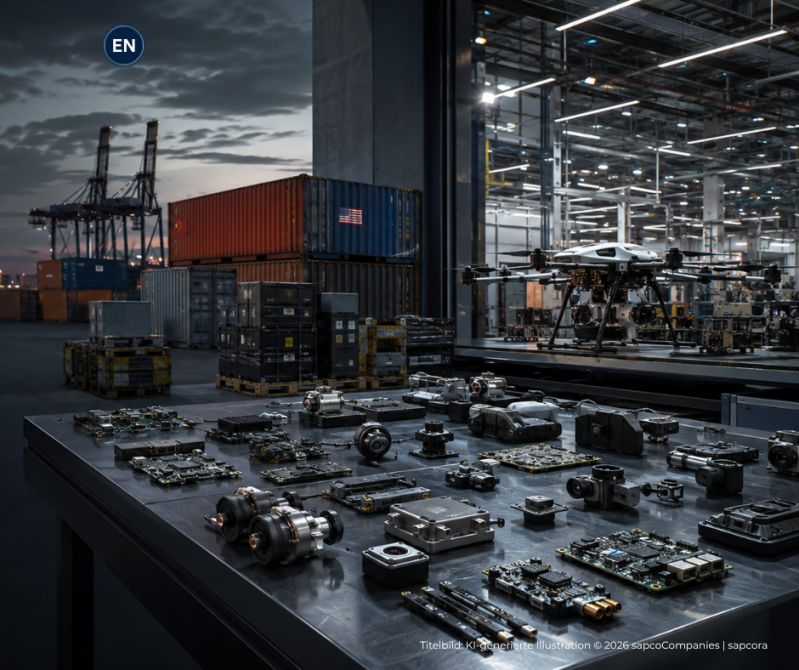
China’s latest response to American restrictions reaches far beyond the sale of finished aircraft. Beijing is targeting the industrial structure beneath the drone market, including controlled components and technologies that can be used in both civilian and military systems. This is precisely where the United States remains most vulnerable while attempting to replace Chinese products with domestic alternatives.
The measures announced on August 5 require stricter individual reviews for controlled drones, key components and related technologies exported to the United States. Licensing procedures intended to simplify or accelerate approval will no longer apply. The rules entered into force immediately.
Beijing has not prohibited every drone shipment to the United States. Consumer products outside the relevant control categories are not automatically covered, and the announcement does not create a new list of prohibited goods. It applies stricter treatment to products already included in China’s dual use export control system.
A restriction that can work without becoming an embargo
The distinction between tighter licensing and a complete ban is economically important. A formal embargo produces an immediate break, while an unpredictable approval process creates a slower and less visible form of pressure. Manufacturers may still receive permission, but they can no longer rely on established processing times, simplified procedures or predictable delivery schedules.
For a drone producer, that uncertainty can be highly disruptive. Components must arrive in sequence, production lines depend on coordinated inventories, and customers expect delivery within fixed periods. Even temporary delays can force companies to hold larger stocks, redesign products or seek more expensive suppliers.
This gives Beijing considerable leverage without requiring the political escalation of a total export prohibition. China can intensify or relax the pressure through individual licensing decisions, while retaining the argument that legal trade remains possible. The instrument is therefore narrow in form, but potentially broad in effect.
Seven American entities face Chinese restrictions
China also prohibited domestic organisations and individuals from conducting transactions or cooperation with six American companies and organisations. The entities are Applied DNA Sciences, Stratum Reservoir, Altana Technologies, the Responsible Business Alliance, Verité Group and Human Rights in China. Beijing accuses them of assisting or supporting American sanctions connected to allegations of forced labour in Xinjiang.
The group is not composed solely of technology companies. Several of the organisations work on supply chain verification, labour standards, corporate compliance or human rights. China’s decision therefore also targets the information and certification systems used by international businesses to examine their suppliers.
Compliance Testing LLC was placed under a separate Chinese countermeasure. Beijing says the Arizona based testing and certification company supported measures adopted by the Federal Communications Commission that harmed Chinese interests. Chinese organisations and individuals are now barred from conducting relevant business or cooperation with the company.
The orders do not specify asset freezes or travel restrictions. Their immediate effect is to sever access to Chinese customers, partners and institutions. For organisations whose work depends on information from Chinese production networks, the practical consequences may extend beyond lost commercial contracts.
Xinjiang becomes part of the technology conflict
The Chinese measures followed the addition of 43 Chinese companies to the American entity list established under the Uyghur Forced Labor Prevention Act. The United States says the mechanism is intended to prevent goods linked to forced labour from entering the country. Goods produced wholly or partly by listed entities are presumed to be ineligible for import unless the importer can overcome that presumption.
The newly listed companies operate in sectors including electronics, metals, battery materials, food production and industrial supply chains. This gives the measure consequences beyond the companies named, since American importers must examine whether products or raw materials have passed through affected suppliers. Compliance systems, tracing services and external audits therefore become part of the enforcement structure.
China rejects the allegations concerning forced labour in Xinjiang and describes the American restrictions as politically motivated sanctions. That denial represents the position of the Chinese government and does not constitute an independent rebuttal of the allegations. The dispute now connects human rights policy directly with industrial and technological competition.
Washington has already restricted foreign drones
The American measures did not begin with the latest Xinjiang decision. In December 2025, the Federal Communications Commission added foreign produced unmanned aircraft systems and critical drone components to its Covered List. New covered equipment generally cannot receive the FCC authorisation required for import, marketing or sale in the United States, although specified exemptions and conditional approvals remain possible.
The policy does not automatically remove previously authorised models from operation. Existing users can continue to operate lawfully acquired systems under the applicable rules, and the restrictions are primarily directed at new authorisations and future market access. This creates a gradual separation rather than an immediate shutdown.
Washington has since extended the same regulatory logic to other technology categories. Foreign produced advanced robotic devices and power inverters were added to the Covered List in July, while routers, telecommunications equipment, testing laboratories and certification bodies have also come under tighter scrutiny. The emerging pattern is clear: market access is increasingly being determined through security classification rather than conventional tariff policy.
China has responded by restricting the role of United States based agencies in follow up factory inspections required under its compulsory product certification system. American manufacturers may have to use approved bodies outside the United States, potentially increasing costs and delays. Beijing has also opened a national security investigation into imported printing, copying and office equipment, although it has not publicly named specific companies in that inquiry.
America’s weakest point lies below final assembly
The central question is not whether the United States can assemble drones on American soil. It is whether manufacturers can obtain motors, batteries, sensors, cameras, navigation electronics, communications modules and specialised production capacity without relying on Chinese suppliers. Final assembly alone does not establish an independent industrial base.
The exposure of individual American manufacturers is difficult to determine from public information. Supply contracts are often confidential, sourcing can differ between product models, and components may be acquired through intermediaries. It would therefore be inaccurate to claim that every American drone producer depends on China, but equally misleading to assume that an American label guarantees a fully domestic supply chain.
Alternative suppliers exist in the United States, Europe, Japan, South Korea, Taiwan and other manufacturing centres. Replacing an established Chinese component, however, requires more than finding a nominal substitute. Performance, price, software compatibility, production volume, certification and delivery reliability must all be reproduced at the same time.
That transition is expensive and slow. American restrictions may create demand for domestic suppliers, but regulatory protection cannot instantly create manufacturing depth. China’s new licensing regime places pressure on the United States precisely during this period of industrial reconstruction.
Civilian operators will feel the pressure later
The measures do not mean that American farms, police departments, fire services, rescue teams or infrastructure operators must immediately stop using their current drones. Existing fleets remain operational unless separate American rules restrict a particular model or application. The immediate effect is therefore limited for many end users.
The more serious risk concerns future procurement, replacement equipment and spare parts. Public agencies and commercial operators may face narrower product choices, higher prices and longer delivery times if new systems or controlled components become harder to import. Smaller operators are particularly exposed because they have less capacity to maintain large inventories or finance an early transition.
Agriculture could be affected through mapping, crop monitoring and precision spraying systems. Emergency services rely on thermal imaging and rapid aerial reconnaissance, while energy and infrastructure companies use drones for inspection work. A supply chain conflict that begins with export licences can therefore reach sectors far removed from defence policy.
Europe is not outside the conflict
European companies are not directly targeted by the August 5 drone order, which concerns controlled exports to the United States. Their exposure is nevertheless significant where European manufacturers use Chinese components and sell finished products into the American market. Additional documentation, origin checks and redesign requirements may become necessary as both governments tighten their rules.
Europe also faces a strategic policy choice. It can continue to rely on globally integrated supply chains, seek greater technological autonomy or align more closely with American security restrictions. Each option carries costs, and a complete separation from Chinese manufacturing would be difficult in industries shaped by scale, specialised suppliers and competitive prices.
Taiwan is relevant for a different reason. Drone components sit at the intersection of commercial manufacturing and military planning, while Washington is seeking trusted supply chains for systems that may have defence applications. Any further deterioration in relations with Beijing would increase the strategic importance of production capacity outside mainland China.
A controlled escalation with room to widen
For now, China’s action remains selective. Beijing has not announced a general halt to drone exports, nor has it included batteries, rare earths or semiconductor materials in this specific measure. The response is designed to impose costs while preserving the ability to adjust the pressure.
That restraint should not be mistaken for de-escalation. Drones now join telecommunications, routers, robotics, power electronics, certification services and supply chain data as instruments in the bilateral conflict. The boundary between trade policy and national security policy is steadily disappearing.
The next stage will depend less on political rhetoric than on licensing decisions and industrial reactions. Rejected applications, extended reviews or shortages of particular components would turn the current warning into a measurable economic disruption. Additional American restrictions could in turn produce further Chinese countermeasures.
The conflict is moving into the factory
The dispute between China and the United States is no longer centred only on tariffs or access to advanced semiconductors. It is moving into factories, testing laboratories, component catalogues and certification procedures. These are less visible battlegrounds, but they determine which companies can manufacture at scale and which products can enter a market.
China’s latest move does not shut down America’s drone industry. It exposes how difficult it is to build a sovereign technology sector while remaining connected to the manufacturing system one is trying to exclude. The decisive contest will not be won by announcing restrictions, but by proving that alternative supply chains can function without sacrificing cost, performance or speed.
Kommentar hinzufügen
Kommentare