

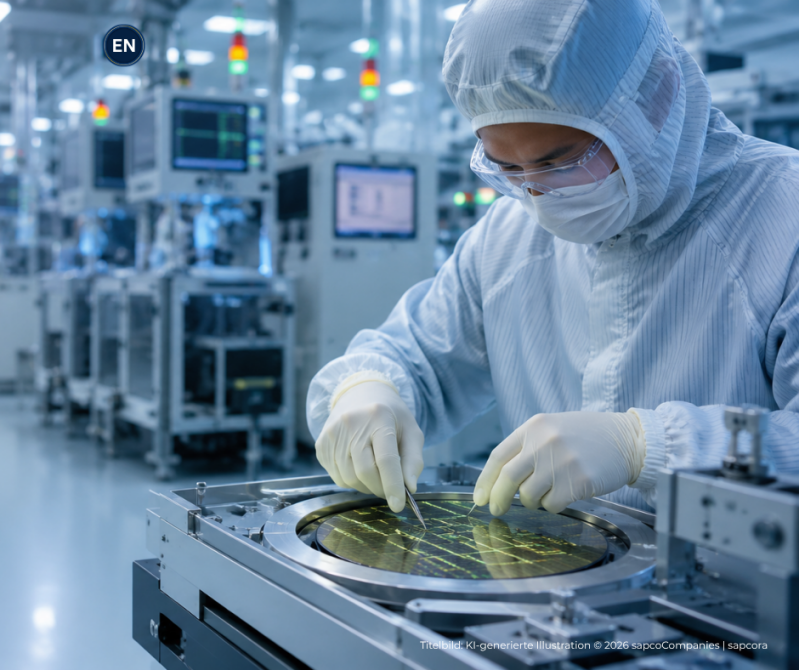
Section: Technology & AI
Format: Article
Author: Sinisa Brkic
South Korea is pushing its semiconductor strategy into a new phase. President Lee Jae Myung wants a military air base in Gwangju relocated by mid 2028 to create space for a new semiconductor hub, while Samsung Electronics and SK Hynix continue to expand investments tied to advanced chips, memory and artificial intelligence.
A military site becomes part of industrial policy
South Korea’s semiconductor ambitions are beginning to reshape decisions far beyond the factory floor. President Lee Jae Myung has called for the military air base in Gwangju to be relocated by the middle of 2028 so that the area can be used for a major new semiconductor site.
Lee raised the issue on August 10, 2026, during a meeting with companies involved in the project. The request does not mean that the relocation has already been finalized. Military requirements, financing, planning procedures and the practical conditions surrounding such a move still have to be resolved.
Even so, the political significance is considerable. Semiconductor production has become important enough to influence decisions involving military infrastructure, regional development and long term national planning. What might once have been treated as a corporate location question is now being handled as part of a broader strategic policy.
Gwangju therefore represents more than another possible factory location. The debate shows how closely South Korea is linking industrial capacity with national competitiveness at a time when advanced semiconductors have become essential to artificial intelligence, data centers and high performance computing.
More than $500 billion behind South Korea’s broader plans
The proposed Gwangju development sits within a much larger semiconductor expansion. Samsung Electronics, SK Hynix and other participants are pursuing projects that together involve more than $500 billion in planned investment in manufacturing capacity and related infrastructure over an extended period.
That number requires careful interpretation. It is not the price tag for the Gwangju project, nor does it represent money that will be spent immediately. The broader program stretches across different sites, companies and investment periods, with individual projects at different stages of planning and implementation.
Still, the scale reveals the direction of South Korean industrial policy. Seoul is seeking to expand an industry that already occupies a central position in the country’s economy and export structure while preparing for a new wave of demand linked increasingly to AI infrastructure.
The semiconductor business has also become more strategically sensitive. Governments no longer regard chip manufacturing simply as another industrial sector. Access to production capacity, advanced memory, computing components and reliable supply chains increasingly affects economic resilience as well as technological competitiveness.
South Korea enters that environment with an unusually strong industrial base.
SK Hynix places another major bet on AI memory
One of the clearest examples is SK Hynix. The company has announced plans to invest approximately 54.3 trillion won in additional production capacity in Yongin and Cheongju, driven in large part by demand for memory chips and high bandwidth memory.
HBM has become one of the critical components of the current AI infrastructure boom. Advanced computing systems require enormous amounts of fast memory to move data efficiently between processors, making high performance memory increasingly important alongside the computing chips themselves.
SK Hynix has become a major supplier of HBM used with Nvidia systems. That position gives the company direct exposure to one of the strongest areas of semiconductor demand created by the rapid expansion of artificial intelligence.
The significance for South Korea goes beyond one company. Memory has long been one of the country’s greatest strengths in the global chip industry. AI is now increasing the strategic value of precisely that capability.
As AI systems become larger and computing requirements increase, competition is no longer limited to who can manufacture the most advanced processors. The ability to supply enough high performance memory at scale has become another decisive part of the technology chain.
Samsung and SK Hynix give Seoul unusual industrial leverage
South Korea’s position is strengthened by the presence of both Samsung Electronics and SK Hynix. Few countries possess two semiconductor companies with comparable international importance operating from the same national industrial base.
That gives policymakers options that many governments seeking to build domestic semiconductor industries do not have. Seoul is not trying to create a chip sector from scratch. It is attempting to expand and reorganize an existing ecosystem that already has global scale.
The challenge lies in turning increasingly large investment announcements into functioning industrial capacity. Semiconductor plants require far more than land and capital. They depend on stable electricity supplies, large quantities of water, specialist equipment, highly trained workers, transport infrastructure and dense networks of suppliers.
Those requirements become more difficult as manufacturing clusters grow. A new semiconductor center cannot simply be declared into existence. The surrounding infrastructure has to develop at roughly the same pace as production itself.
This is particularly important if South Korea wants to spread semiconductor activity beyond its existing concentration around the greater Seoul region and Yongin. Regional expansion could reduce some geographic concentration, but it also requires the creation of new industrial ecosystems capable of supporting highly complex manufacturing.
Gwangju will therefore test more than political commitment. It will test whether South Korea can translate national semiconductor strategy into viable new regional capacity.
AI is changing the economics of the chip industry
The current expansion is being driven in part by a structural shift in semiconductor demand. Artificial intelligence has created extraordinary demand for computing infrastructure, particularly for processors, advanced memory and the systems that connect them.
For South Korean companies, that development creates both an opportunity and a challenge. Strong demand for HBM and other memory products can support major new investment, but it also increases pressure to expand capacity quickly while technological competition remains intense.
The enormous sums being discussed reflect the cost of competing at the top of the semiconductor industry. New facilities are capital intensive, production technology changes rapidly and companies must invest years before knowing exactly how market demand will develop.
This makes announced investment totals important but not definitive. Plans can change, projects can be delayed and spending can be adjusted as technology and market conditions evolve. The scale of the commitments shows ambition, but execution remains the decisive measure.
South Korea faces competition on several fronts
The international context makes the expansion more consequential. Taiwan remains central to advanced semiconductor manufacturing through TSMC. The United States is trying to strengthen domestic production, Japan is rebuilding parts of its semiconductor ecosystem and China continues to invest heavily in its own technological capabilities.
South Korea is competing within that environment from a different starting point. Its greatest strength lies particularly in memory, where Samsung and SK Hynix have long held major positions. The rapid rise of HBM demand gives that specialization new strategic value.
That does not mean South Korea is about to displace Taiwan or TSMC as the leading center of advanced chip manufacturing. Semiconductor leadership is divided across different parts of the industry, from logic manufacturing and memory to equipment, materials, chip design and packaging.
The more relevant question is whether South Korea can use its existing strength in memory and its expanding industrial base to secure a larger role in the next generation of AI infrastructure. Current investment plans suggest that Seoul intends to try.
The Gwangju decision reveals the scale of the ambition
The debate over the Gwangju military air base brings that strategy into unusually sharp focus. Moving a military facility is neither routine nor simple, and President Lee’s request should not be confused with a completed decision. But the fact that such a proposal is being pursued for a semiconductor project illustrates the political weight now attached to the industry.
South Korea is preparing for a semiconductor market in which AI, strategic supply chains and industrial policy are increasingly intertwined. Samsung Electronics and SK Hynix provide the country with a powerful corporate foundation, while the government is seeking to create the infrastructure and geographic capacity for further expansion.
There are still important uncertainties. Not every announced investment is guaranteed to be completed on schedule, the Gwangju relocation remains subject to further decisions, and new clusters will have to overcome constraints involving energy, water, workers and suppliers.
What is no longer uncertain is the strategic direction. South Korea is treating semiconductors not simply as one of its most successful industries, but as a national asset whose importance is growing with every new stage of the global AI boom.
South Korea Raises the Stakes in the Global Chip Race. South Korea is accelerating its semiconductor strategy as President Lee Jae Myung pushes for a new chip hub in Gwangju and Samsung Electronics and SK Hynix expand investment in AI and advanced memory production.
Kommentar hinzufügen
Kommentare