

Rubric: Economics / Business
Format: Special Report
Author: Sinisa Brkic (sb)
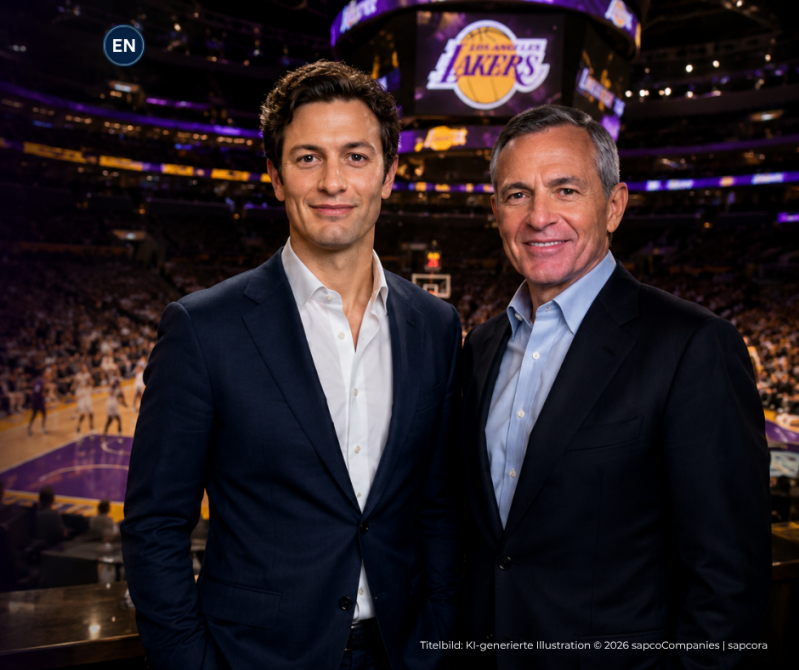
Josh Kushner and Bob Iger have agreed to acquire control of the Los Angeles Lakers in a transaction valuing the franchise at $12.5 billion. The price would establish a new record for a U.S. professional sports team and comes less than a year after Mark Walter took control at a $10 billion valuation. More important than the record itself is what the deal may now do to the price of every other scarce, globally recognized sports franchise.
A record transaction that is not yet complete
The Los Angeles Lakers are changing hands again, this time at a valuation that pushes the economics of professional sports into new territory. Venture investor Josh Kushner and former Disney chief executive Bob Iger have agreed to acquire a controlling interest in the franchise from Mark Walter in a transaction valuing the Lakers at approximately $12.5 billion. The agreement still requires approval from the NBA Board of Governors, whose next meeting is scheduled for September.
That distinction matters. The transaction has been agreed, but it has not yet completed the league approval process. Specific details regarding the final ownership percentages, financing arrangements and the individual capital contributions of Kushner, Iger and any additional investors have not been publicly disclosed. Reporting has described the buyers as leading an investment group, which means the $12.5 billion figure should not be interpreted as a personal cash purchase funded solely by the two men.
From $10 billion to $12.5 billion in less than a year
The speed of the repricing is almost as significant as the price itself. Walter acquired control of the Lakers from the Buss family in 2025 in a transaction that valued the franchise at $10 billion. NBA owners approved that deal in October. Now, less than a year later, the new agreement places the Lakers at $12.5 billion, representing a 25 percent increase in the stated franchise valuation.
It would be misleading, however, to describe that difference automatically as a $2.5 billion personal profit for Walter. The two headline numbers are franchise valuations attached to separate ownership transactions. Without full disclosure of the percentage being sold, Walter’s retained interests, transaction costs and the structure of the consideration, his actual proceeds cannot be calculated from the valuation figures alone.
What can be said is more consequential for the wider market. A buyer group is apparently prepared to establish a new transaction benchmark only months after the previous record was set. In a market where marquee franchises rarely become available, an actual control transaction can carry considerably more weight than an annual theoretical valuation.
Why Wall Street is already looking at the Knicks
The financial market reacted almost immediately. Shares of Madison Square Garden Sports, the publicly traded owner of the New York Knicks and New York Rangers, rose about 5 percent after reports of the Lakers agreement emerged. Investors appear to be reassessing what another trophy sports asset could command if it were ever sold.
The comparison is imperfect because Madison Square Garden Sports owns more than the Knicks, and a publicly traded company cannot be valued exactly like a private franchise sale. The direction of the reaction is nevertheless important. The Lakers transaction has created a new comparable that investors can place beside existing estimates for the most valuable NBA organizations.
Forbes had valued the Golden State Warriors at $11 billion before the Lakers agreement, while the Lakers had been estimated at $10 billion and the Knicks at roughly $9.75 billion. A completed Lakers transaction at $12.5 billion would therefore move the market beyond those prior appraisal levels and create pressure to reconsider the value of other elite franchises.
Kushner and Iger bring two different forms of capital
Josh Kushner arrives from venture capital. He founded Thrive Capital and has already moved deeper into sports investment, including previous and current minority interests in NBA teams. He is also the younger brother of Jared Kushner, the former White House adviser and son in law of President Donald Trump.
Iger brings a different profile. His career was built at Disney, where he oversaw one of the most important periods of acquisition and intellectual property consolidation in modern media. He and his wife, Willow Bay, also became controlling owners of Angel City FC in 2024. Disney’s regulatory filings show that Iger received approximately $45.8 million in total compensation for fiscal 2025, but that figure should not be confused with his personal net worth. A reliable current accounting of Iger’s total private wealth is not publicly available.
That matters because the Lakers transaction is best understood as an ownership consortium rather than a simple billionaire purchase. Until the financing structure is disclosed, claims about exactly how much Kushner or Iger is personally contributing remain speculative.
The Lakers are becoming a financial benchmark
The NBA has spent years benefiting from a structural feature that conventional businesses cannot easily reproduce. There are only 30 existing franchises, ownership opportunities are rare, global media reach continues to expand and the league controls entry of new competitors through its expansion process. Scarcity therefore sits at the center of the asset class.
The Lakers add another layer. They combine a major U.S. media market with international recognition, championship history and a commercial identity extending well beyond basketball. Those characteristics help explain why a buyer may accept a valuation multiple that looks aggressive when compared with conventional operating businesses.
The $12.5 billion price does not mean every NBA team suddenly deserves the same percentage increase. Market size, arena economics, local media rights, sponsorship capacity, ownership of real estate and the strength of each franchise brand differ substantially. What the Lakers deal does provide is evidence that buyers with access to very large pools of capital are willing to pay a substantial scarcity premium for the league’s most exceptional assets.
Las Vegas may have lost two prominent bidders
The transaction also changes the developing NBA expansion story. Kushner and Iger had previously been associated with efforts to pursue a potential franchise in Las Vegas. Purchasing control of the Lakers would effectively give them immediate access to an established NBA asset instead of waiting for a new team to be created.
Commissioner Adam Silver said in July that NBA owners want to make a decision on expansion by the end of 2026, with groups in Las Vegas and Seattle already presenting financing, ownership and arena concepts. If the Lakers agreement removes Kushner and Iger from that process, the competitive landscape for one of the most anticipated expansion rounds in U.S. sports changes with it.
The larger implication is financial. Any future expansion fee will now be discussed against a market in which the Lakers have attracted a $12.5 billion valuation. An expansion franchise would not possess the Lakers’ history, brand or established commercial ecosystem, but the record transaction strengthens the argument that access to the NBA itself has become an exceptionally expensive asset.
The next number will matter more than the last one
The Lakers agreement is therefore not simply another record sports sale. It is a new reference point in a market where reference points are scarce and increasingly powerful. The immediate rise in Madison Square Garden Sports shares shows how quickly one transaction can influence expectations surrounding assets that are not even for sale.
The remaining questions are significant. The NBA must still approve the transaction. The full investor group and financing structure have not been disclosed, and the economic interests retained by Walter or the Buss family after completion remain important to the final picture.
If the deal closes at the reported valuation, however, one conclusion will be difficult to avoid. The Lakers will not merely have changed owners again. They will have established a new price ceiling for American professional sports, and owners from New York to San Francisco will have a fresh benchmark for determining what scarcity at the top of the sports market is actually worth.
Josh Kushner, Bob Iger Agree to Buy Lakers for $12.5B. Josh Kushner and Bob Iger’s $12.5 billion Lakers deal could reset NBA franchise values and reshape the economics of U.S. sports ownership.
Kommentar hinzufügen
Kommentare