

Section: Technology / Travelling
Format: Special Report
Author: Sinisa Brkic (sb)
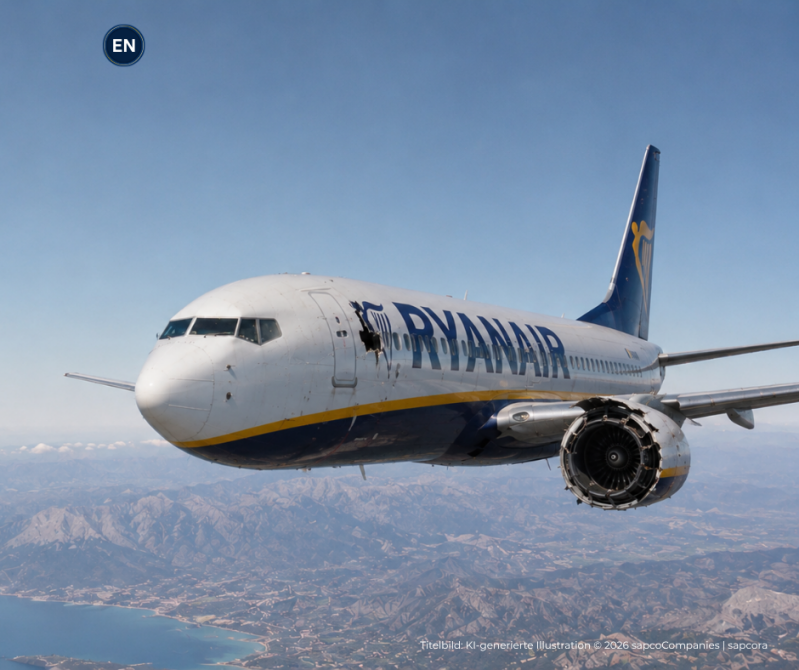
A fractured fan blade, debris penetrating the fuselage, a missing cabin window and a seriously injured passenger have turned Ryanair Flight 1879 into a major aviation safety investigation. The NTSB’s preliminary findings add two technically important elements: evidence of fatigue in the failed blade and bird remains inside the engine. They also raise a broader question over Boeing 737 NG safety modifications that are not due for full implementation under US requirements until 2028.
A routine climb became a serious emergency
Ryanair Flight 1879, operated by Malta Air, departed Thessaloniki, Greece, for Memmingen, Germany, on July 10 with 149 passengers and six crew members aboard. The Boeing 737-800, registration 9H-QEU, was climbing through approximately 16,000 feet near Polykastro when the flight crew received a high vibration indication from the No. 2, or right, engine.
The pilots reduced engine power and began the appropriate abnormal procedure. The vibration initially decreased, but later rose sharply. The crew then heard a loud bang, the cabin altitude warning activated, and an emergency descent was initiated.
What happened outside the cabin was more serious than a conventional engine shutdown. A fan blade in the right CFM56-7B26 engine fractured and separated, with resulting fragments striking the aircraft, penetrating the pressurized fuselage and damaging the right horizontal stabilizer.
Inside the cabin, the consequences were immediate. The passenger window at row 11 was lost, the cabin depressurized and oxygen masks deployed. A passenger seated at 11F was found partially lodged in the damaged window opening before other passengers managed to pull him back into the cabin.
The passenger suffered serious injuries and was treated by a doctor traveling on the flight. After descending below 10,000 feet, the pilots shut down the damaged engine and returned safely to Thessaloniki.
The failed fan blade is now at the center of the investigation
The most consequential technical finding concerns fan blade No. 10. Investigators found that it had fractured through the dovetail, the section at the root of the blade that secures it to the rotating fan disk.
Laboratory examination identified fatigue characteristics across approximately 37 percent of the fracture surface. The NTSB said the observed striations were consistent with high amplitude fatigue, a form of cyclic loading occurring at frequencies greater than a normal flight cycle and at comparatively high stress levels.
Heavy fretting damage was also observed close to the fatigue origin area. Two additional fan blades had lost portions of their outer tips, while the remaining blades showed varying degrees of impact deformation.
The finding is significant because it provides physical evidence of a fatigue process in the blade that failed. It does not, however, establish why that fatigue developed or what event ultimately triggered the separation.
Bird remains complicate the picture
Investigators also recovered bird remains, including feathers, from several locations inside the damaged engine. Samples were sent to the Smithsonian Institution’s Feather Identification Lab in Washington for further examination.
Maintenance records introduce an additional layer of complexity. Flight crews had reported four suspected bird strikes involving the same No. 2 engine during the 12 months before the accident. Bird remains had reportedly been found after two of those events, but subsequent maintenance actions identified no damage.
That history makes bird ingestion an obvious investigative issue, but it does not establish causation. The NTSB has not concluded that a bird strike caused the July fan blade failure, nor has it determined that previous bird strikes created damage that later developed into the fatigue observed in blade No. 10.
The distinction is critical. Bird remains may prove central to the failure sequence, they may reflect an earlier event, or they may ultimately be only one element in a more complicated mechanical history.
A recent inspection found no crack
Another question now facing investigators concerns the engine’s inspection history. The fan blades underwent ultrasonic inspections in November 2025 and again on May 24, 2026, only 253 flight cycles before the accident.
Those inspections were conducted under a CFM service bulletin designed specifically to detect cracking in the fan blade dovetail. According to the preliminary report, no findings were recorded during either inspection.
This does not by itself indicate an inspection failure or maintenance error. Investigators will need to determine whether the fatigue was present but below detectable limits, developed after the latest inspection, or arose through a mechanism that existing inspection procedures were not designed to identify at that stage.
That question could prove more important than the spectacular cabin damage itself. Aviation safety systems depend not only on preventing component failures, but also on detecting the conditions that precede them.
The 2028 deadline now attracts attention
The investigation has also placed Boeing 737 NG nacelle protection measures back under scrutiny. Following earlier fan blade failures involving Boeing 737 aircraft, the FAA issued three airworthiness directives in 2025 addressing the engine inlet cowl, fan cowl and exhaust nozzle.
The measures are intended to strengthen parts of the nacelle and reduce the danger that components can separate and strike the aircraft following a fan blade failure. The FAA established July 31, 2028, as the relevant deadline for the principal fan blade out modifications.
The NTSB found that enhancements specified in those directives had not yet been incorporated on several areas of the Ryanair aircraft involved in the July event. That finding does not mean the aircraft had missed the stated FAA deadline, and the preliminary report does not conclude that the modifications would have prevented the fuselage penetration or the passenger injury.
Still, the timing is difficult to ignore. A safety modification created in response to earlier fan blade failures is being phased into the fleet while another aircraft has now experienced a fan blade separation followed by nacelle damage, fuselage penetration and cabin depressurization.
Why this matters beyond one Ryanair aircraft
The wider safety issue therefore concerns containment in the broad sense of the word. The NTSB found no evidence that the engine core suffered radial uncontainment through its cases, yet the fan blade failure still produced damage outside the engine sufficient to penetrate the aircraft.
That distinction matters because the hazard does not end when the engine itself remains largely structurally contained. The inlet, fan cowl and other nacelle structures must also withstand the forces generated by a blade separation without creating a second and potentially more dangerous debris event.
The FAA directives cover Boeing 737-600, 737-700, 737-700C, 737-800, 737-900 and 737-900ER aircraft under their applicable regulatory framework. The Ryanair event does not establish that those aircraft share a new fleetwide defect, but it gives investigators a current real world case against which the effectiveness and timing of existing safety measures can be assessed.
The unanswered questions are now the most important ones
The NTSB investigation remains preliminary, and assigning responsibility at this stage would go beyond the evidence. There is no official finding that a bird strike caused the failure, no determination of a maintenance error by Ryanair or Malta Air, and no conclusion that Boeing or CFM International is responsible for a design defect.
The investigation must now connect several facts that are individually significant but not yet proven to form a single causal chain. Investigators have a blade with high amplitude fatigue characteristics, a history of suspected bird strikes, a recent ultrasonic inspection with no findings, substantial nacelle damage and safety modifications that had not yet been incorporated.
That combination makes Flight 1879 more than an isolated engine emergency. The decisive question is whether the investigation reveals an unusual sequence unique to one engine or exposes a vulnerability that requires regulators, manufacturers and operators to reconsider how quickly existing protections should reach the wider 737 NG fleet.
For now, the evidence establishes what failed and how serious the consequences became. It does not yet establish why the failure occurred. The difference between those two conclusions will determine whether this remains a rare accident investigation or develops into a broader aviation safety issue.
Ryanair 737 Engine Failure: NTSB Findings Raise Safety Questions. NTSB findings on Ryanair Flight 1879 reveal fan blade fatigue, bird remains and pending 737 NG safety modifications, raising wider aviation safety questions.
Kommentar hinzufügen
Kommentare