

Section: Geopolitics
Format: Special Report
Author: Sinisa Brkic (sb)
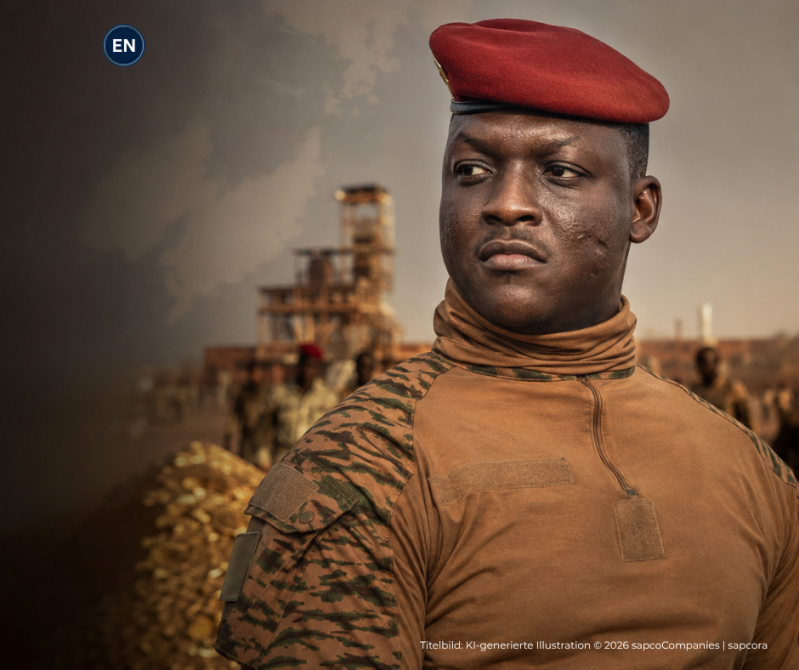
Ibrahim Traoré has turned Burkina Faso into one of the most closely watched political experiments in Africa. His government has pushed France out, expanded state control over gold, joined forces with Mali and Niger, and embraced a language of sovereignty that resonates far beyond the Sahel. But behind the symbolism lies a harder question: can a military revolution deliver genuine independence while political freedom contracts at home?
A small country at the center of a much larger struggle
Burkina Faso does not look like an obvious arena for a global contest over power. It is landlocked, economically vulnerable and has spent much of the past decade fighting jihadist insurgencies that have killed thousands, displaced communities and weakened the reach of the state. Yet under Captain Ibrahim Traoré, the country has become something larger than its geography.
Traoré, who seized power in September 2022, has built his political project around a blunt proposition: Burkina Faso should control its security, resources and development without accepting the political hierarchy inherited from its former colonial relationship with France. That message has turned the 38 year old military leader into a symbol for supporters across Africa who see him as an expression of a long delayed demand for sovereignty.
The confrontation has since moved well beyond rhetoric. French military operations ended in Burkina Faso in February 2023 after the transitional authorities terminated the agreement governing the presence of French forces. In June 2026, Ouagadougou went further and severed diplomatic relations with France altogether, accusing Paris of interference and conduct incompatible with national sovereignty. France rejected those accusations as unfounded.
What is unfolding in Burkina Faso is therefore not merely a quarrel between two governments. It is a test of whether a state that has long depended on foreign security partnerships, external financing and raw material exports can reorganize itself on different terms.
The shadow of Thomas Sankara
To understand why Traoré carries such symbolic weight, it is necessary to go back almost four decades. Thomas Sankara, the revolutionary leader who renamed Upper Volta as Burkina Faso in 1984, remains one of the most powerful political figures in the country’s collective memory.
Sankara promoted agricultural self reliance, vaccination, literacy, public integrity, women’s participation and a rejection of excessive dependence on foreign aid. His government lasted only four years. He was killed during the 1987 coup that brought Blaise Compaoré to power, beginning a presidency that would last 27 years.
Traoré has never needed to formally declare himself Sankara’s successor for the comparison to take hold. The military uniform, the language of national dignity, the suspicion of foreign dependency and the emphasis on production rather than consumption all evoke a political tradition that Sankara helped define.
That historical connection matters because Traoré is selling more than a government program. He is offering a national narrative. Burkina Faso, in this telling, is not condemned to remain poor despite its resources. Its condition is political, not natural, and can therefore be changed.
It is an argument that has found an audience far beyond Ouagadougou. The source material behind this report repeatedly returns to precisely that theme: Traoré’s appeal rests on his promise that Africans should stop seeing dependency as permanent and begin treating sovereignty as an economic project rather than a ceremonial word.
Gold is where sovereignty becomes measurable
The strongest part of Traoré’s case is also the easiest to test.
Burkina Faso is deeply dependent on gold. World Bank figures showed the metal accounting for roughly 77 percent of exports, 16 percent of GDP and 22 percent of government revenues in 2023. That concentration makes mining policy central to almost every serious discussion about the country’s economic independence.
Traoré’s government has moved aggressively to increase state control. Burkina Faso revised its mining framework and created the state mining company Société de Participation Minière du Burkina. In June 2025, five gold mining assets were formally transferred to the state owned company, part of a broader effort to capture a greater share of mining revenue domestically.
This is where the argument over Traoré becomes more substantial than speeches about colonialism. Resource sovereignty can be measured. The test is whether larger state participation produces higher public revenues, stronger local processing, more productive investment and broader improvements in living standards.
There are signs of economic momentum. The IMF reported that Burkina Faso’s economy expanded by 5.3 percent in 2025, helped by stronger mining activity and the international gold price boom. The fiscal deficit also fell sharply, from 5.8 percent of GDP in 2024 to 1.8 percent in 2025.
Those numbers matter, but they do not prove that Burkina Faso has discovered a new development model. High gold prices can improve an economy without transforming it, and nationalization alone does not guarantee competent management. The harder challenge is converting mineral wealth into productive capacity.
Produce, do not merely consume
One of the most striking elements of Traoré’s rhetoric is that his criticism does not stop at France, Europe or foreign corporations. Some of his harshest language is directed at Africans themselves.
He has repeatedly attacked the dependence of African economies on imported consumer goods, asking why countries rich in labor and raw materials manufacture so little of what their citizens use every day. His argument is uncomfortable by design. Colonial history may explain the origins of dependency, but in his telling it cannot indefinitely excuse the failure to develop productive capacity.
That distinction is important. Anti colonial rhetoric can easily become politically convenient if every failure is attributed to an external enemy. Traoré tries to avoid that trap by coupling his attack on foreign dependence with a demand for domestic discipline, technical knowledge, agriculture, processing and industrial production.
His political message is therefore not simply that outsiders took too much. It is that Burkina Faso must learn to make more.
The idea helps explain why his message travels so effectively across a young African population frustrated by the contradiction between enormous natural wealth and limited economic opportunity. The promise is not prosperity delivered from abroad. It is the recovery of agency.
Whether the state can turn that language into an industrial transformation remains uncertain. Building factories, power networks, transport systems, skilled workforces and competitive companies requires more than revolutionary confidence. It requires functioning institutions, capital and years of consistent execution.
France leaves, Russia enters
Traoré’s break with France is frequently presented as proof that Burkina Faso has escaped foreign influence. The reality is more complicated.
After French forces departed, Burkina Faso expanded its military relationship with Russia. Russian military personnel arrived in significant numbers in early 2024, and Moscow later pledged additional equipment and instructors to support the fight against armed groups.
That creates an unavoidable question for a government built around sovereignty. Replacing one foreign security partner with another is not necessarily independence.
There are meaningful differences. France operated in the Sahel within a network shaped by colonial history, long standing defense relationships and considerable political influence. Russia enters with a different model and without France’s historical baggage in Burkina Faso. But Moscow is not an altruistic actor. It has strategic interests of its own.
For Traoré, the distinction appears to be choice. His government argues that sovereignty means deciding which partnerships Burkina Faso accepts and under what conditions, rather than having those relationships embedded in an inherited order.
That is a defensible definition of sovereignty. It is also one that must be judged over time. A country is not strategically autonomous simply because the flag on a foreign uniform has changed.
The Sahel begins to reorganize
Burkina Faso’s shift would be less consequential if it were happening alone. Mali, Burkina Faso and Niger created the Alliance of Sahel States in 2023, first as a security pact and later as a broader political project. In January 2025, the three countries formally left the Economic Community of West African States, or ECOWAS.
That split has altered the political architecture of West Africa. Three military led governments facing similar insurgencies, similar grievances toward former Western partners and similar demands for greater control over natural resources are attempting to build an alternative center of power.
For supporters, the alliance represents regional emancipation. For critics, it risks becoming a bloc of military governments protecting one another from democratic pressure. Both readings contain part of the truth.
The AES is strategically significant because it turns isolated national rebellions against the old order into a regional project. Its future will depend on whether it can deliver practical integration, collective security, infrastructure and trade rather than merely political solidarity among its leaders.
If it succeeds, ECOWAS will face a serious competitor in the Sahel. If it fails, the alliance may ultimately be remembered as an expression of political frustration rather than the foundation of a new regional order.
The war Traoré cannot avoid
All of Traoré’s ambitions eventually collide with the same reality: security. Burkina Faso has been fighting armed groups linked to al Qaeda and Islamic State for years. The violence predates Traoré, helped destroy confidence in the civilian government and contributed directly to the coups of 2022. The military leadership therefore has an unusually clear standard against which it can be judged. It came to power arguing that the existing system had failed to protect the country. Its legitimacy is tied to doing better.
There have been claims of recovered territory and improved security in some areas, and the World Bank attributed part of the stronger 2024 economic performance to an improved security environment. Yet the wider Sahel remains the global center of jihadist violence, and armed organizations continue to demonstrate the ability to attack state forces and move across borders.
The conflict also carries another burden. International rights organizations and media investigations have documented serious allegations involving Burkinabè security forces and auxiliary fighters, including violence against civilians and the use of military conscription against critics. The government has disputed or rejected a number of accusations directed against its security policies.
A state fighting a brutal insurgency faces genuine security choices. But the distinction between defending the state and placing the state beyond accountability remains fundamental. Military success purchased through systematic abuse would weaken the very national project Traoré claims to defend.
The democracy problem
This is the point at which the mythology surrounding Traoré meets its most serious contradiction. He came to power through a coup, not an election. Burkina Faso initially committed to restoring constitutional civilian government, but the transition was extended in 2024 for another five years, potentially keeping Traoré in power until 2029. The government later dissolved the independent electoral commission, and in January 2026 it dissolved the country’s political parties.
Then came the language that removed much of the ambiguity. In April 2026, Traoré told journalists that people should “forget about democracy” and argued that democracy was not suitable for the country in its current revolutionary phase.
The remark matters because sovereignty cannot logically apply only to relations between states. If Burkina Faso has the right to determine its future free from foreign control, Burkinabè citizens also have a claim to political agency inside their own country.
Traoré’s defenders argue that conventional democratic institutions failed while jihadist violence consumed large parts of the country. They see elections held under insecurity as a ritual that can preserve weak elites without producing an effective state. That criticism cannot simply be dismissed. Elections alone do not create capable government, and a ballot box cannot substitute for security, functioning institutions or economic opportunity.
But the opposite danger is equally real. A government can use national emergency as a reason to postpone accountability indefinitely. Once opposition parties disappear, electoral institutions are abolished and critical voices face coercion, the distinction between temporary revolutionary authority and permanent authoritarian rule becomes increasingly difficult to maintain.
Why Traoré resonates
The intensity of Traoré’s appeal cannot be understood through Burkina Faso alone. Across parts of Africa, there is deep frustration with governments that formally inherited sovereignty decades ago but remain economically dependent, institutionally fragile and vulnerable to decisions made elsewhere. The continent exports minerals and agricultural commodities while importing much of the value added production created from them. Traoré speaks directly into that frustration. He talks about dignity rather than aid, production rather than charity, future generations rather than donor cycles, and national purpose rather than administrative management.
That is powerful political language because it addresses something statistics often miss. Development is not only a question of income. It is also a question of whether people believe their country possesses agency over its own future.
Social media has magnified that image enormously. Traoré has become a global Pan African symbol, sometimes attached to claims about his achievements that are exaggerated, misleading or entirely fabricated. The digital legend can therefore run ahead of the measurable record. That distinction matters. Admiration for what Traoré represents should not become evidence for what his government has actually accomplished.
Neither savior nor caricature
Western analysis has often struggled with figures such as Traoré because it tends to force them into familiar categories. He can be portrayed as either an authoritarian military ruler drifting toward Moscow or as an anti colonial revolutionary finally confronting a system of exploitation. Neither description is sufficient. Traoré does govern through a military system that has sharply reduced political competition and civic space. Those facts cannot be erased by his popularity or by legitimate criticism of Western policy.
At the same time, reducing his appeal to propaganda misses the political substance underneath it. France’s influence in its former African colonies is a historical reality. Extractive economic structures are real. The imbalance between African raw material wealth and domestic industrial capacity is real. The frustration with decades of foreign security intervention that failed to defeat jihadist movements is also real. Traoré did not invent those grievances. He found a political language capable of concentrating them. That is why his significance extends beyond the record of one government.
The real test has only begun
Burkina Faso is now attempting something unusually ambitious. It wants greater control over its minerals, greater capacity to produce at home, greater military autonomy, deeper cooperation with its Sahel neighbors and a political identity less dependent on approval from former Western partners. None of those objectives is inherently anti Western. They become confrontational because they challenge relationships that have structured economic and political power for decades. The harder question is what comes next.
If Traoré can turn gold revenue into infrastructure, education, energy and productive industry, restore state authority without normalizing abuse, and eventually construct institutions capable of surviving beyond one man, Burkina Faso could become evidence that the political order of the Sahel is genuinely changing.
If sovereignty instead becomes a language for concentrated power, if Russia replaces France without increasing real autonomy, if the insurgency remains entrenched and if economic gains fail to reach ordinary citizens, the revolution will face the same judgment as the system it rejected. That is what makes Burkina Faso important. The country is no longer simply asking whether the West should have less power in Africa. It is confronting the much more difficult question of what Africans build when that power recedes.
For Ibrahim Traoré, that is the opportunity. It is also the test.
Traoré vs. The West: Burkina Faso’s Fight for Sovereignty. Ibrahim Traoré is reshaping Burkina Faso through resource nationalism, a break with France and a new Sahel alliance. A special report on power, gold, security and democracy.
Kommentar hinzufügen
Kommentare