

Section: International
Format: Special Report
Author: Sinisa Brkic (sb)
Japan has just reinforced the male line at the heart of its imperial succession system. Now Crown Prince Akishino, the next man in line to the throne, has publicly acknowledged mixed feelings about the reform, reopening a question Parliament appeared to have settled only weeks ago.
A rare intervention from the next heir
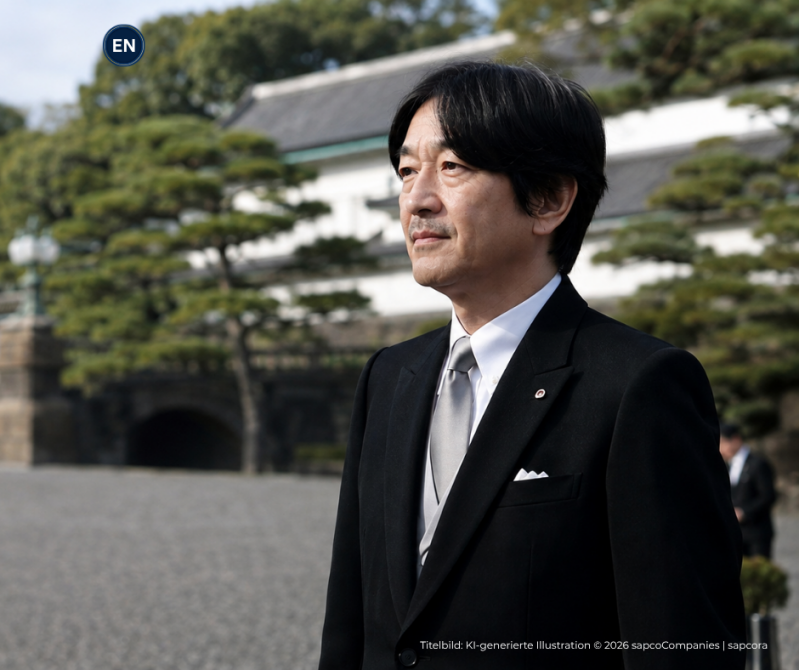
Japan’s imperial succession debate has returned with unusual force, and this time the intervention has come from inside the family most directly affected by it. Crown Prince Akishino, the younger brother of Emperor Naruhito and first in the current line of succession, has said he has “mixed feelings” about the recent revision of the Imperial House Law.
Speaking at a news conference ahead of an official visit to Paraguay, Akishino also said he believed there was no difference between men and women in their ability to perform the duties expected of members of the Imperial Family. He described the wider question as difficult and made clear that there were limits to what he could publicly discuss.
That qualification is essential. Akishino did not call for Princess Aiko to become empress, did not demand female succession and did not challenge the government in explicit political terms. What made his remarks significant was their source and timing.
Parliament had just settled the question
On July 17, Japan’s Parliament approved a major reform intended to address the shrinking size of the Imperial Family. The legislation created new mechanisms to preserve the institution while leaving its central succession principle intact.
Female members of the Imperial Family can now retain their imperial status after marrying commoners, allowing them to continue performing official duties. Their husbands and children do not become members of the Imperial Family.
The reform also creates a route for unmarried male descendants of former imperial branches to be adopted into the Imperial Family. Those branches lost their imperial status in the aftermath of World War II. The adopted men themselves are not placed directly into the succession line, but the system is designed to preserve the possibility of future male heirs through the paternal line. What Parliament did not do was equally important. It did not open the Chrysanthemum Throne to women.
Why Princess Aiko still cannot become empress
Princess Aiko is the only child of Emperor Naruhito and Empress Masako. Under an ordinary system of succession based on birth order, she would occupy the most obvious position after her father. Japan does not use such a system. Article 1 of the Imperial House Law reserves succession to male descendants in the male line of the imperial lineage.
That excludes Aiko despite her being the emperor’s daughter. The succession instead passes first to Crown Prince Akishino, then to his son Prince Hisahito. After Hisahito comes Prince Hitachi, Emperor Naruhito’s elderly uncle. The distinction is not merely ceremonial. It determines whether the imperial institution continues through the emperor’s own child or moves sideways through the male branch of the family.
A female emperor is not unprecedented
Japan has had women on the throne before. Eight women have reigned as emperor in Japanese history, with Empress Go Sakuramachi, who ruled from 1762 to 1770, the most recent. The historical precedent does not completely resolve the modern argument. Those rulers belonged to the imperial paternal line, and their reigns did not establish a permanent system in which succession could pass through a female line to her descendants.
This distinction remains central to the political dispute. Allowing Aiko herself to become emperor and allowing the children of a female emperor to inherit are separate legal questions. Support for one does not automatically imply support for the other. Japan’s current law rejects both possibilities by limiting succession from the outset to men in the paternal line.
The demographic problem has not disappeared
The July reform was driven by a problem that no amount of ceremonial continuity can conceal. Japan’s Imperial Family has become exceptionally small, and the pool of men capable of sustaining the existing succession system is narrower still.
Prince Hisahito, now 19, is the only young male member positioned to carry the present line into another generation. That places extraordinary institutional weight on a single person and, eventually, on whether another eligible male heir is born.
The adoption mechanism seeks to create additional room without abandoning the paternal principle. In practical terms, Parliament chose to broaden the supply of men who can sustain the system rather than broaden eligibility for the throne itself. That may ease one problem while leaving the larger question intact. A succession system that requires increasingly elaborate legal mechanisms to avoid considering the emperor’s own daughter inevitably invites scrutiny over whether the rules are preserving stability or merely postponing a more fundamental decision.
Public opinion points elsewhere
The political settlement also sits uneasily beside Japanese public opinion. Recent surveys have repeatedly found clear majority support for allowing a woman to become emperor. A Mainichi Shimbun poll conducted in June found 73 percent of respondents in favor of a female emperor and only 6 percent opposed. Other surveys have produced different figures, but the broader pattern has remained remarkably consistent: public acceptance of a woman on the throne is substantially greater than the willingness of the political establishment to change the succession law.
Princess Aiko gives that abstract debate a highly visible human focus. She is not a hypothetical future candidate but the emperor’s adult daughter, already carrying out public responsibilities while remaining legally barred from succeeding him. That gap between public preference and political action is one reason the succession issue has proved so difficult to close.
Why Akishino’s words matter
Members of Japan’s Imperial Family operate under unusually strict constitutional restraints. The emperor is defined as the symbol of the state and the unity of the people and possesses no powers related to government. The wider family consequently avoids becoming entangled in partisan political disputes. Akishino’s language reflected those boundaries. He did not prescribe legislation or present himself as an opponent of the government’s policy.
Yet his comments still carry unusual weight because he is not a distant observer. He is the man the present law places ahead of Aiko and immediately behind his brother in the succession.
When that person acknowledges mixed feelings about the new arrangement and publicly stresses that men and women are equally capable of performing imperial duties, the statement becomes difficult to dismiss as routine commentary. It exposes the personal dimension of rules that are normally discussed as matters of lineage, history and constitutional design.
The law can be changed again
The July vote does not make the current arrangement permanent. Japan’s Constitution states that succession to the throne is governed by the Imperial House Law passed by the Diet. A future Parliament could therefore reopen the question and amend the succession rules again. Allowing Princess Aiko to inherit would require changing the statutory restriction to male descendants and revising the order of succession accordingly.
The harder political decision would come immediately afterward. Lawmakers would have to determine whether reform applied only to women born into the paternal imperial line or also permitted succession through their descendants.
That is where arguments over a female emperor and a female line emperor separate, and where much of the conservative resistance has historically been concentrated.
A settlement that has not settled the debate
Japan’s Parliament attempted in July to stabilize the Imperial Family without surrendering its male succession principle. Less than a month later, the next heir to the throne has demonstrated why the matter remains more complicated than the legislation suggests.
Akishino has not launched a campaign for Aiko, nor has he staged a royal revolt against the government. Presenting his words that way would turn a carefully limited intervention into something he did not say.
Their significance is subtler and potentially more lasting. Japan has built a new legal structure to protect the male line, yet the demographic pressures remain, public support for a female emperor remains strong, and the emperor’s own daughter remains outside the succession.
The July reform answered the question Parliament was prepared to answer. Akishino’s remarks have brought back the one it was not.
Japan’s Imperial Succession Debate Returns After Akishino Remarks. Crown Prince Akishino’s rare comments have revived Japan’s imperial succession debate weeks after Parliament preserved the male line and kept Princess Aiko from the throne.
Kommentar hinzufügen
Kommentare