

Rubric: Economics
Format: Special Report / Policy & Technology Explainer
Author: Sinisa Brkic (sb)
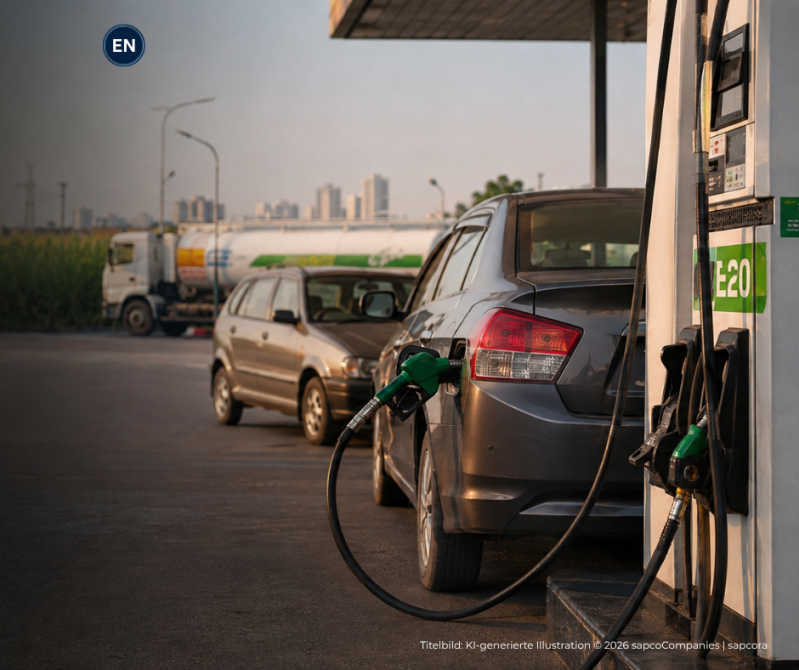
India made E20 the nationwide petrol standard on 1 April 2026, leaving drivers without a conventional E10 alternative at the pump. Now one of the government’s most senior economic advisers is calling for E10 to return for older vehicles, turning a technical dispute over mileage and compatibility into a much larger argument about consumer choice, energy security, agriculture and the limits of India’s ethanol strategy.
A challenge from inside the government
India’s transition to E20 petrol has entered a more difficult political phase. Chief Economic Adviser V. Anantha Nageswaran has argued that petrol containing 10 per cent ethanol should again be offered alongside E20, particularly for millions of older vehicles that were designed around lower ethanol concentrations. His intervention matters because it does not come from an opposition party, an automotive pressure group or an online campaign, but from one of the country’s most senior economic policy advisers.
Nageswaran and Department of Economic Affairs consultant Akash Poojari presented the proposal as their personal view, rather than an official change in policy. Even so, the recommendation directly challenges the government’s position, stated in Parliament only weeks ago, that there was no proposal to restore either ethanol free petrol or E10. The argument has therefore shifted from whether E20 can function as a fuel to whether consumers, especially owners of older vehicles, should have been left with no alternative.
That distinction is important. India is not debating whether to abandon ethanol. The dispute is increasingly about how quickly a country with an enormous and highly varied vehicle fleet should force a single blend across every petrol pump.
Why India made E20 the national standard
The economic case behind ethanol blending is substantial. India imports much of the crude oil it consumes, making transport fuel a persistent source of exposure to international energy prices and foreign exchange pressures. Replacing part of every litre of petrol with domestically produced ethanol allows the country to substitute some imported crude with fuel derived from Indian agricultural and industrial production.
The policy has been developed over many years rather than introduced suddenly. India reached 10 per cent ethanol blending in 2022, launched E20 at selected filling stations in February 2023, expanded availability across the country and reached the 20 per cent blending target in 2025, several years ahead of the original timetable. From April 2026, petrol sold nationwide was mandated to contain 20 per cent ethanol.
For New Delhi, this is simultaneously an energy, agricultural and industrial policy. The government says the ethanol programme has cumulatively saved more than ₹1.97 trillion in foreign exchange, substituted roughly 31.6 million tonnes of crude oil and transferred more than ₹1.66 trillion to farmers. It also reports approximately 95.2 million tonnes of avoided carbon dioxide emissions through the programme.
Those figures explain why E20 has become much more than a fuel specification. An entire domestic supply chain now sits behind it.
Does E20 actually damage cars?
This is where the public argument requires considerably more precision than much of the online debate has allowed. There is no credible evidence that E20 routinely destroys modern engines, and the Indian government says it has received no evidence of widespread engine failures or vehicle breakdowns attributable to the blend. Automobile manufacturers have likewise reported large service populations without identifying widespread E20 related engine damage.
That does not mean every petrol vehicle on Indian roads was originally designed in precisely the same way for E20. The automotive industry’s transition occurred in stages. Manufacturers said vehicles introduced from April 2023 would use materials compatible with E20, while engines specifically tuned for the blend were scheduled from April 2025. More recent regulatory requirements have tightened that transition further.
The distinction between engine damage and material compatibility is crucial. A vehicle may continue to run without catastrophic engine failure while certain older seals, hoses or fuel system components remain less suitable for prolonged exposure to higher concentrations of ethanol. Nageswaran has specifically highlighted older two wheelers, estimating that roughly 75 million to 80 million such vehicles remain in India and noting concerns over older rubber seals that were not designed for higher ethanol exposure.
The safest conclusion is therefore neither that E20 is harmless in every vehicle nor that it destroys engines. Compatibility depends on vehicle design, model year, fuel system materials, calibration and maintenance history.
The mileage penalty is real, but not as dramatic as claimed
Ethanol contains less energy per litre than petrol, so some reduction in fuel economy is physically unsurprising when the ethanol share increases. Earlier government planning documents estimated that vehicles designed for E10 could experience a measurable efficiency loss when operated on E20, although engine optimisation could reduce the difference.
More recent Indian government assessments put the reduction for certain vehicles designed around E10 at roughly 3 to 5 per cent. Maruti Suzuki has offered a similar real world illustration, saying that a vehicle previously delivering 20 kilometres per litre might lose about 0.6 kilometres per litre, equivalent to approximately 3 per cent.
Nageswaran has framed the underlying energy penalty at around 6 to 7 per cent, while rejecting far larger claims circulating publicly. These figures are not necessarily contradictory because theoretical energy content, laboratory fuel economy and real world consumption are different measurements. Vehicle calibration, traffic, driving behaviour, temperature and maintenance can all influence the final result seen by an owner.
What is difficult to defend is the suggestion that all drivers should expect enormous losses in range simply because their petrol contains 20 per cent ethanol. The evidence supports a moderate efficiency effect, with its size depending on the vehicle.
Older vehicles remain the difficult part
India’s policy problem is concentrated in the legacy fleet. Vehicles manufactured during the transition to E20 increasingly incorporate compatible materials, while newer engines can be calibrated specifically for the fuel. Older cars and motorcycles may have been developed when E10, or still lower ethanol concentrations, were the expected operating environment.
That does not automatically make them unsafe to operate on E20. The Automotive Research Association of India has tested E20 in older BS III, BS IV and BS VI two wheelers and four wheelers, examining fuel economy, emissions, durability and material compatibility. The government also points to extensive manufacturer servicing data as evidence against claims of systemic failures across older vehicles.
Yet the absence of systemic failure does not eliminate the possibility of model specific compatibility problems. This is precisely why blanket claims on either side are unhelpful. Owners of older vehicles need manufacturer specific information, not assurances or warnings that treat several generations of Indian vehicles as mechanically identical.
A separate fuel quality problem complicates the debate
There is another issue that should not be confused with the ethanol concentration itself. Internal communications reviewed by Reuters showed that Indian carmakers had investigated samples containing elevated levels of contaminants including chloride and moisture, raising concerns about fuel quality in parts of the distribution network. The industry body SIAM subsequently withdrew a complaint after saying its data were incomplete, while Mahindra disputed interpretations of internal discussions and government authorities continued to defend the overall quality of E20 supplies.
This distinction matters because contaminated E20 and correctly manufactured E20 are not the same technical question. If a vehicle problem results from water, chloride or another contaminant entering fuel during storage or distribution, that cannot automatically be presented as evidence that a 20 per cent ethanol blend is inherently destructive.
The government says ethanol and blended petrol are subject to fuel quality standards throughout the supply chain and has instructed state authorities to act against adulteration or other breaches. The controversy nevertheless demonstrates why consumer confidence depends not only on the chemistry of E20, but also on consistent quality control between the distillery, depot, tanker and filling station.
The economic winners from India’s ethanol strategy
India’s ethanol programme deliberately redirects part of the value previously spent on imported oil into the domestic economy. Sugar producers, maize growers, distilleries, dedicated ethanol plants, fuel distributors and associated agricultural supply chains all gain from the creation of a large guaranteed market for ethanol.
Government policy has actively supported that market. Measures have included administered ethanol procurement prices, reduced taxation on ethanol supplied for fuel blending, financing support for production facilities and long term purchasing arrangements between oil marketing companies and dedicated ethanol plants. These are not incidental effects of E20. They are part of the policy architecture designed to make domestic ethanol production commercially viable at national scale.
Production capacity has expanded accordingly. Government material published in 2026 put Indian ethanol production capacity at close to 20 billion litres, comfortably above the roughly 11 billion litres required to sustain E20 blending. That capacity makes the policy increasingly difficult to view simply as an environmental measure because significant agricultural and industrial investment now depends on continued ethanol demand.
Sugar, maize and the food versus fuel question
The strongest challenge to the next stage of India’s ethanol strategy may therefore come not from engines, but from agriculture. Indian ethanol can be produced from sugarcane juice, molasses, maize, damaged grain, broken rice and other approved feedstocks. The government has deliberately expanded the range of raw materials to reduce dependence on any single crop.
Maize has become increasingly important, accounting for 37 per cent of ethanol feedstocks by 2025 and 2026 according to figures presented by the government. This reduces reliance on water intensive sugarcane, but it introduces another policy question because maize also serves food, animal feed and industrial markets.
Nageswaran and Poojari have now placed that trade off directly into the public debate. Their argument is that India should assess the consequences for food, feed, land and water before pursuing ethanol concentrations beyond E20. The warning is significant because changes in crop incentives, irrigation demand and land use can persist long after a fuel mandate itself could theoretically be changed.
The government says food security, water sustainability and farmer interests remain central to its policy and that crop diversion is calibrated according to availability and other market conditions. The tension nevertheless remains inherent: ethanol creates valuable domestic demand for agriculture, but that same demand competes for crops, land and water that have other uses.
Could India simply bring E10 back?
Technically, India knows how to supply E10 because it was the national blending benchmark only a few years ago. The more difficult question is whether the government is willing to rebuild a parallel retail system in which different vehicles can purchase different blends.
New Delhi has already made its objection clear. The Petroleum Ministry told Parliament in July that supplying E0, E10 and E20 simultaneously across more than 100,000 retail outlets would increase storage, inventory, transport and handling complexity. Its stated position was that once E20 had been validated and adopted, fuel policy should advance rather than return to an earlier standard.
Nageswaran’s proposal attacks that reasoning from another direction. If millions of older vehicles remain better suited to a lower blend, then additional logistical complexity may be the price of protecting consumers during a transition that will inevitably take years.
Both arguments have merit. A single national fuel simplifies the supply system, but simplicity for the distribution network does not necessarily mean optimal treatment of every vehicle already on the road.
What owners of older cars and motorcycles should check
For motorists, the most important question is the specification of the individual vehicle. Owners should check the manufacturer’s fuel recommendation, model year and E20 compatibility guidance rather than assuming that age alone determines whether a vehicle will experience difficulties. Vehicles produced during and after the industry’s E20 transition are progressively more likely to have compatible fuel system materials and dedicated calibration.
Owners of substantially older vehicles who experience deterioration of hoses, seals, fuel system components or an unusual change in running behaviour should have the vehicle inspected rather than attributing the problem automatically to E20. Fuel contamination, maintenance, component ageing and ethanol compatibility are separate possible causes and require different remedies.
For now, however, consumer choice at the filling station remains limited. The policy question is whether that will continue.
The dispute is no longer about ethanol alone
The government has strong reasons to defend E20. It reduces exposure to imported oil, supports domestic agriculture, sustains a rapidly expanded ethanol industry and forms part of India’s broader attempt to lower the carbon intensity of transport fuels. The evidence available so far also does not justify the sweeping claim that E20 is systematically destroying the country’s modern vehicle fleet.
But the criticism can no longer be dismissed simply as misinformation. There are legitimate questions about older vehicle components, measurable fuel economy losses, quality control in the distribution system and the agricultural consequences of creating ever greater demand for fuel ethanol. India’s own Chief Economic Adviser has now brought those distinctions into the centre of the policy debate.
As of 18 August 2026, the government has not adopted his proposal and its formal position remains that E10 will not return. That position may hold, but the political calculation has changed. What began as a programme to replace imported oil with domestic ethanol has become a test of whether a national energy strategy can remain economically compelling while still giving millions of consumers confidence that the transition is being designed around the vehicles they actually own.
India E20 Petrol: Why Drivers Want E10 Back. India’s E20 petrol policy faces pressure as its Chief Economic Adviser calls for E10 to return for older vehicles amid mileage and compatibility concerns.
Kommentar hinzufügen
Kommentare