

Rubrik: Business
Format: Special Report
Autor: Sinisa Brkic (sb)
The U.S. Army has selected Hanwha Defense USA to supply prototypes for its Mobile Tactical Cannon program, giving South Korea’s largest defense company its first major U.S. Army contract. The initial award is worth about $100.3 million and could rise to $262.9 million, but the significance extends well beyond the contract value. Washington is testing whether a Korean rooted artillery platform, produced through an increasingly American industrial network, can help reshape how selected U.S. formations fight.
A prototype award with consequences far beyond $100 million
The U.S. Army has chosen Hanwha Defense USA to develop prototypes for the Mobile Tactical Cannon program, placing the South Korean defense group inside one of the most consequential current efforts to modernize American cannon artillery. Under the agreement, Hanwha is expected to deliver six systems on an accelerated schedule, with an option covering another 12.
The immediate contract action is valued at $100.3 million. If all options are exercised, the cumulative value can reach approximately $262.9 million, with prototype development, testing and soldier experimentation expected to run over an estimated four year period.
That distinction is crucial. The Army has not ordered a new artillery fleet, and it has not decided to replace the M777 across the force. It has selected Hanwha for a prototype and operational experimentation phase whose results will determine whether the Mobile Tactical Cannon proceeds toward fielding.
If the Army ultimately approves the system for operational use, the new cannon could replace M777 towed howitzers in selected formations. No final production quantity has been announced as part of the current award.
The commercial value of the decision therefore lies less in the first six guns than in what comes after them.
Why the U.S. Army went looking beyond traditional American artillery
Hanwha’s selection did not emerge from a conventional procurement cycle in which the Army designed a new weapon domestically and then searched for a manufacturer. It followed a major reassessment of American artillery modernization.
The Army closed its Extended Range Cannon Artillery rapid prototyping effort after concluding that the ambitious 58 caliber cannon required additional maturation and redesign before it could move into an acquisition pathway. Instead of starting another lengthy development program from the beginning, Army leadership shifted toward mature systems that already existed in the United States or allied markets.
That decision changed the competitive landscape. American defense groups were no longer the only natural candidates for the next generation of Army cannon artillery. European, Israeli and South Korean systems could compete if they offered sufficient maturity, mobility, survivability, ammunition compatibility and a credible path toward domestic production.
The Army’s earlier modernization demonstrations included systems associated with BAE Systems, American Rheinmetall Vehicles, General Dynamics Land Systems, Elbit Systems USA and Hanwha Defense USA. What followed was not simply a contest over gun performance. It became a test of which industrial partner could combine an existing artillery architecture with the speed, support network and production capacity the Army now considers essential.
Hanwha has emerged from that process with the prototype award.
The K9 connection is real, but this is not simply a U.S. purchase of the K9 Thunder
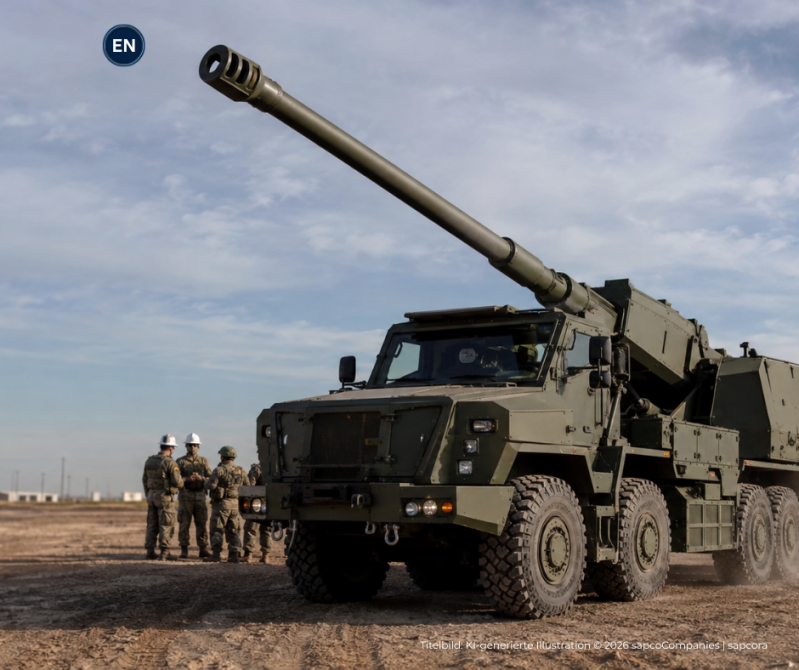
The distinction between Hanwha’s famous K9 self propelled howitzer and the system selected for the Mobile Tactical Cannon program matters. The standard K9 Thunder is a tracked self propelled artillery system that has become the centerpiece of South Korea’s global artillery business. The U.S. Army award, however, concerns the K9 Mobile Howitzer, known as K9MH, a wheeled configuration developed for the American Mobile Tactical Cannon requirement.
Hanwha describes the K9MH as a wheeled member of the broader K9 family. It draws upon an artillery ecosystem that has been produced and fielded at large scale, but it should not be presented as a straightforward American acquisition of the standard tracked Korean K9.
That difference is more than semantic. The Army is evaluating a configuration tailored to a specific American operational requirement, and the prototype process exists precisely to establish whether that configuration can deliver the performance, reliability and supportability demanded by U.S. soldiers.
Hanwha says the system is compatible with the Army’s existing family of 155 mm ammunition. The company has also positioned the K9MH as a platform that can accommodate future capability upgrades rather than as a static, finished design. In procurement terms, the Army is buying evidence before it buys a fleet.
The M777 is not disappearing tomorrow
The prospect of replacing the M777 is the most visible part of the Army announcement, but it is also the easiest part to overstate.
The M777 remains a highly transportable 155 mm towed artillery system whose low weight has long been one of its defining advantages. It can be moved by tactical trucks, transported by aircraft and carried externally by heavy lift helicopters, giving commanders options that a substantially larger self propelled platform cannot simply reproduce in the same way.
The Mobile Tactical Cannon is intended to address another problem. Modern battlefields are saturated with drones, sensors, precision weapons and counterbattery systems, making artillery units increasingly vulnerable if they remain stationary after firing.
A self propelled cannon can move under its own power, enter a firing position, deliver rounds and relocate without depending on a separate towing vehicle for every movement. The Army is explicitly seeking greater mobility, reliability, survivability and lethality for formations that must operate under persistent observation and rapid enemy targeting. That makes the MTC concept less a direct mechanical substitute for the M777 than a change in how selected artillery formations are expected to survive and fight. The Army has been careful about the scope. If fielding is approved, Mobile Tactical Cannon systems would replace M777s only in selected formations. The current prototype contract does not authorize a service wide retirement of the M777.
The irony of replacing the M777 with foreign rooted technology
The nationality question surrounding Hanwha also contains an important historical irony. The M777 itself was not born from a purely domestic American design lineage. Its development drew heavily on British lightweight howitzer technology before the program moved through American acquisition, technology transfer and domestic production. The Army and Marine Corps deliberately evaluated existing foreign technology rather than reinventing an entire system when they were searching for a lighter replacement for the M198.
The current Mobile Tactical Cannon strategy follows a different program history, but a familiar procurement logic. When an allied industrial base already possesses mature technology that can answer an urgent military requirement, the Pentagon does not necessarily gain by spending years recreating the same capability from scratch.
What has changed is the industrial scale of the proposition. Hanwha is not seeking merely to ship finished Korean weapons into the United States. It is attempting to establish itself as part of the American defense manufacturing base.
Alabama is becoming the bridge between the Korean system and the U.S. Army
Months before the Army announced the prototype award, Hanwha Defense USA began establishing an integration and test facility in Opelika, Alabama.
The company signed a three year lease and committed more than $2 million to the initial phase of the site, which is intended to support the K9 Mobile Howitzer program and a broader American artillery supply chain. Hanwha has said the first phase should create roughly 40 jobs, with later phases dependent on the development of its U.S. business. Those numbers are modest compared with a mature defense production plant. Their importance lies in the direction of travel.
Hanwha is offering Washington a localization model that has become central to its international expansion. Rather than relying entirely on exports from South Korea, the company has repeatedly combined Korean technology and production expertise with local assembly, manufacturing, suppliers and sustainment in customer countries.
The U.S. strategy follows that model. Hanwha says it wants an American anchored manufacturing network capable of supporting eventual Mobile Tactical Cannon production, long term maintenance and future technology insertion. What remains unknown is equally important. Neither the Army award nor Hanwha’s public announcements establish a final percentage of U.S. content, a complete production footprint or the industrial structure that would apply to a future full scale order. Those questions will matter if the prototype program progresses.
A Korean defense company is moving deeper into the American industrial base
The artillery award should also be read alongside Hanwha’s broader American expansion. The group has been moving into U.S. shipbuilding, munitions and land systems rather than treating the American market as a destination for occasional exports. Its acquisition of Philadelphia’s shipyard operations gave Hanwha a direct industrial presence in U.S. maritime manufacturing, while the company has separately announced major investment plans for munitions production in Arkansas.
Artillery now adds another pillar. This creates the outline of a Korea and United States defense industrial cluster that would have been far harder to imagine when South Korean defense companies were largely viewed as regional suppliers. Hanwha increasingly wants to be judged not as a Korean exporter selling into America, but as a defense group able to manufacture, integrate, employ American workers and support U.S. military requirements from inside the country.
The distinction is politically important. Foreign technology can attract interest in Washington, but major U.S. defense programs ultimately depend on secure supply chains, domestic manufacturing, sustainment capacity and confidence that production can continue during a crisis. Hanwha appears to understand that winning the platform competition and winning the industrial argument are now inseparable.
South Korea’s export model is becoming difficult to dismiss
The U.S. breakthrough comes after several years in which South Korea’s defense industry has moved from an ambitious exporter to a significant supplier across multiple allied markets. Its appeal has rested on a combination that has become particularly valuable since Russia’s full scale invasion of Ukraine: mature weapons, existing production capacity, comparatively rapid delivery and a willingness to negotiate local production or technology cooperation.
Europe has been central to that expansion. South Korean systems have entered NATO markets at a time when European governments are trying to rebuild inventories, increase readiness and shorten procurement timelines after decades of relatively limited production capacity.
The shift is visible in the data. During the 2021 to 2025 period, South Korea accounted for 8.6 percent of major arms imported by European NATO members, placing it behind the United States but ahead of other major suppliers including Israel and France.
Hanwha has been one of the principal beneficiaries. Its K9 artillery family has built a broad international user base, and the company now says more than 2,500 K9 howitzers have been fielded globally. The U.S. Army award gives that export story a different level of credibility. Selling to states seeking rapid reinforcement is one achievement. Winning a competitive prototype program inside the U.S. Army, while accepting American production requirements and American soldier evaluation, is another.
Washington is buying speed, not surrendering its industrial base
The Hanwha decision will inevitably raise a broader question: why should the world’s largest defense market need South Korean artillery technology? The answer is not that the United States has lost the ability to build artillery. The U.S. still possesses an enormous defense industrial base and fields the M109A7 Paladin, while American companies remain deeply involved in cannon, ammunition, vehicle and fire control production.
The problem is more specific. The Army wants new capabilities faster than traditional development cycles have recently delivered them, and its experience with the ERCA program reinforced the risk of attempting to solve every requirement through a new American platform designed from the ground up.
Buying and adapting mature allied technology can shorten that path. Requiring domestic production can then pull a portion of the manufacturing capability into the United States. That is the model Hanwha is attempting to make attractive. Korean engineering becomes the starting point, not necessarily the permanent location of production. If the formula works, the outcome is not simply greater South Korean access to the American market. It also changes the definition of what the American defense industrial base can include.
The stock market immediately understood the optionality
Investors reacted quickly to the Army announcement. Hanwha Aerospace shares rose as much as roughly 9.5 percent in early trading after the selection became public.
That reaction should not be confused with the value of the contract itself. A $100.3 million prototype award is meaningful, but it is small relative to the potential economics of a mature U.S. Army production program.
The market is therefore pricing possibility as much as present revenue. If Hanwha performs successfully in soldier testing and the Army decides to field the system at scale, the company could gain access to a long term program involving production, sustainment, upgrades, ammunition integration and a wider American supplier network. None of that has been awarded yet. The present contract opens the door. It does not determine what lies behind it.
Europe will be watching the American trial closely
A successful U.S. Army evaluation would strengthen Hanwha’s position far beyond the United States. European artillery procurement is increasingly shaped by interoperability, production capacity, ammunition availability and the ability to replenish equipment during prolonged conflict. A platform that survives U.S. Army soldier experimentation would acquire an additional layer of validation in markets already familiar with Korean artillery.
For Hanwha, that could reinforce a network effect around the K9 family. More operators can mean larger production volumes, broader supplier networks, deeper ammunition compatibility and stronger incentives for countries to participate in common sustainment arrangements.
For European manufacturers, the competitive message is equally clear. South Korean companies are no longer competing only on price or delivery time. They are seeking entry into the same demanding procurement systems that have traditionally favored American and major Western European defense groups. The U.S. decision does not settle that contest, but it moves Hanwha closer to its center.
What the Army will actually decide next
The next phase will be determined by performance rather than headlines. The Army expects the first six Mobile Tactical Cannon prototypes to support operational experimentation, with another 12 available through the contract option. Soldiers will evaluate how the systems perform under realistic conditions, including their reliability, supportability and effectiveness in the type of operations for which the Army is redesigning its artillery force.
Those results will inform a later decision on whether the system should be fielded. Only then would the question of a larger production program become concrete. There is therefore no basis yet to describe Hanwha as the future supplier of hundreds of U.S. Army howitzers. There is no announced fleet quantity, no broad M777 replacement order and no guarantee that successful prototype delivery will automatically lead to production.
But neither should the award be dismissed as an ordinary test contract. Hanwha has gained something that defense companies can spend decades trying to obtain: a place inside a major U.S. Army modernization pathway.
A contract that could redraw the map of defense procurement
The Mobile Tactical Cannon decision captures a larger change underway across the allied defense economy.
The United States needs faster modernization and more resilient production. Europe needs larger inventories and shorter delivery schedules. South Korea has spent years building an industrial model designed around precisely those pressures, combining established weapons with production capacity and a willingness to localize manufacturing.
Hanwha is now attempting to bring that model into the center of the American defense market. Whether the K9MH ultimately replaces any meaningful portion of the M777 fleet will depend on soldier testing, Army requirements, industrial execution and future procurement decisions. The current award settles none of those questions. What it does establish is that South Korean artillery technology is no longer standing outside the gates of U.S. procurement.
It is being tested from within.
Hanwha Wins U.S. Army Mobile Tactical Cannon Prototype Award. The U.S. Army has selected Hanwha Defense USA for its Mobile Tactical Cannon prototype program. What the $262.9 million opportunity means for the M777, U.S. artillery modernization and South Korea’s expanding defense industry.
Kommentar hinzufügen
Kommentare