

Rubrik: Geopolitik
Format: Spezialbericht
Autor: Sinisa Brkic (sb)
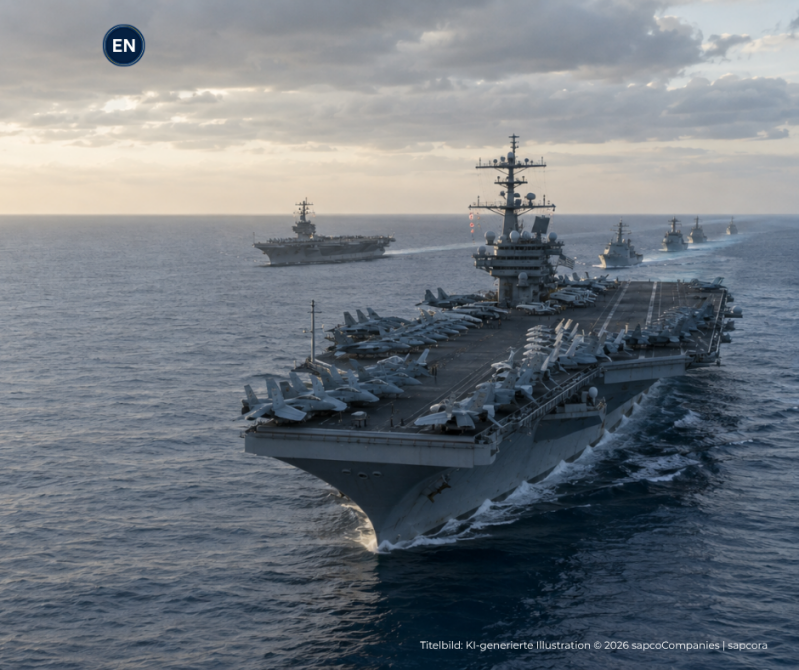
The USS George Washington has arrived in the Middle East to relieve the USS Abraham Lincoln after one of the most punishing carrier deployments in recent U.S. Navy history. But the rotation solves one problem by exposing another. Washington has moved its only forward deployed aircraft carrier based in Japan away from the western Pacific, revealing how the war with Iran is beginning to compete directly with America’s long declared strategic priority in Asia.
A relief mission with consequences far beyond the Middle East
The arrival of the USS George Washington in the Middle East closes one of the most uncomfortable chapters of the current Iran war for the U.S. Navy. The carrier is there to relieve the USS Abraham Lincoln, whose deployment has stretched beyond 250 days and placed its crew, logistics system and maintenance cycle under extraordinary pressure. For the sailors aboard the Lincoln, the rotation represents the prospect of finally going home. For the Pentagon, however, it represents something much larger: another major military asset has been pulled from the Indo Pacific to sustain operations around Iran.
That distinction matters. The George Washington is not simply another carrier drawn from the American fleet. It is the Navy’s only permanently forward deployed aircraft carrier in Japan and a central element of the U.S. military presence in the western Pacific. Its movement toward the Middle East therefore changes the strategic equation in two theaters at once.
The Lincoln deployment became a warning sign
The USS Abraham Lincoln left San Diego in late 2025 for what was initially expected to be a conventional deployment cycle. Instead, the carrier was redirected as tensions with Iran escalated and became deeply involved in U.S. military operations after the war began on February 28.
What followed was an unusually long period at sea with limited opportunities for the crew to leave the ship. By August, the deployment had become the subject of growing scrutiny from military families, members of Congress and U.S. media organizations.
Reports described shortages or declining availability of some food, hygiene products and other supplies, along with deteriorating morale and significant psychological strain among some personnel. Families of sailors also raised concerns about exhaustion, limited communication and the cumulative effects of prolonged service in a combat environment.
The Navy and Pentagon have challenged parts of that portrayal. Military leaders have maintained that the ship remained supplied, operational and capable of performing its mission, while also acknowledging that an extended deployment places exceptional demands on sailors and their families.
That distinction is important. There is no credible basis to describe the Lincoln as combat ineffective. The more serious question is whether maintaining that level of combat effectiveness for so long imposed a human and material cost that should never have been required in the first place.
A carrier can keep fighting long after the deployment model begins to fail
Aircraft carriers are designed for sustained operations, but sustained does not mean indefinite. A nuclear powered carrier can remain at sea for long periods without refueling its reactors, yet virtually everything else that makes the ship function depends on an enormous logistics system.
Food, aviation fuel, ammunition, spare parts, medical supplies and thousands of everyday items must continually reach the strike group. Aircraft require maintenance. Ship systems require repair. Sailors require sleep, recovery, contact with their families and a reasonable degree of certainty about when they will return home.
Combat complicates every one of those requirements. Port access can become restricted, replenishment routes become longer, equipment is used more intensively and operational commanders become reluctant to release an asset they may need again within hours.
The Lincoln became a visible example of that pressure. The carrier continued to operate, but its deployment increasingly illustrated the difference between what a Navy can technically sustain and what it can sustain without creating consequences elsewhere.
George Washington solves the Lincoln problem and creates an Asia problem
The George Washington was the obvious answer only in one respect: it was available and already operating forward. In virtually every other respect, sending it westward exposes the strategic cost of the decision.
Homeported at Yokosuka, Japan, the carrier is the centerpiece of the Navy’s only continuously forward deployed carrier strike group. Its location gives Washington the ability to place substantial air power in the western Pacific without first waiting for a carrier to cross thousands of miles from the continental United States.
That presence has particular value around Japan, Taiwan, the Korean Peninsula, the East China Sea and the South China Sea. It also gives U.S. allies something less measurable but strategically significant: the visible presence of American combat power in a region where China’s military capabilities continue to expand.
For now, that carrier is no longer there.
The United States still maintains formidable military forces across the Indo Pacific. Submarines, destroyers, amphibious ships, land based aircraft, bombers, Marines, Army units and major installations in Japan, South Korea and Guam remain available, and a temporary absence of a carrier does not amount to a withdrawal from Asia.
But carriers have a particular political and military value. When Washington wants to demonstrate rapidly deployable American power without moving land forces into another country, the carrier strike group remains one of its most visible instruments.
The carrier gap is temporary, but the timing is difficult
Carrier absences from the western Pacific are not unprecedented, and the Navy can eventually move another ship into the theater. The more difficult question is how quickly that can happen without simply transferring the same readiness problem to another crew.
The U.S. fleet officially has eleven aircraft carriers, but fleet size is not the same thing as immediate availability. At any given moment, some ships are undergoing major maintenance, others are in training, some have only recently returned from deployment and others are preparing for their next operational cycle.
That leaves commanders with a much smaller number of genuinely deployable carriers than the headline fleet figure suggests. A decision to accelerate one carrier into service can therefore create consequences months or years later through deferred maintenance, disrupted training or another extended deployment.
Several U.S. based carriers could eventually become available to reinforce the Pacific. The Navy, however, does not publicly disclose detailed future movements for operational security reasons, and there is currently no announced timetable showing precisely when another carrier will replace the George Washington in the western Pacific.That uncertainty is itself part of the story.
Iran is consuming forces intended for a different strategic era
For years, American defense strategy has increasingly described China as the most consequential long term military challenge to the United States. The logic behind that assessment is straightforward: China possesses the economic scale, industrial capacity, technological base and rapidly expanding military forces required to challenge American power across an entire region.
The Iran war is forcing Washington to confront a different reality. Long term priorities do not eliminate immediate crises, and immediate crises consume the same ships, aircraft, munitions and personnel that planners intended to preserve for the larger strategic competition.
The George Washington deployment makes that contradiction unusually visible. A carrier stationed in Japan to reinforce deterrence in Asia is now being used to sustain combat operations thousands of miles away because another carrier has reached the limits of an already extended mission. This is what military overstretch looks like before a force actually runs out of ships. The first sign is not necessarily defeat or operational collapse. It is the growing necessity to solve one theater’s problem by accepting additional risk in another.
More than 750 wounded underline the scale of the war
The pressure is not limited to ships. Pentagon casualty data now show that more than 750 U.S. service members have been wounded since the conflict with Iran began at the end of February, while 18 have been killed.
The Defense Department’s reporting places the number of wounded at 757, with Army personnel accounting for the majority. Detailed public information about many of those injuries remains limited, making it difficult to assess the precise operational circumstances behind the full total.
Even with that limitation, the number is significant. It demonstrates that the Iran conflict has developed into a substantial and sustained military commitment rather than a short period of limited strikes that could be absorbed without broader consequences for American force planning. Those consequences accumulate. Personnel losses, aircraft usage, missile expenditure, maintenance demands, ship deployments and logistics requirements all compete with the resources Washington needs to sustain deterrence elsewhere.
Two carriers in the Middle East reveal the scale of the commitment
Once the Lincoln leaves the theater, the George Washington is expected to operate alongside the USS George H.W. Bush, preserving a powerful two carrier presence around the Middle East. That represents an exceptional concentration of American naval aviation at a time when the same fleet is being asked to maintain credible deterrence across several other regions. A two carrier force provides enormous capability. It also reveals how demanding the mission has become.
The United States is using assets designed for global crisis response to sustain what has evolved into an open ended regional military commitment. The longer that commitment continues, the harder it becomes to treat extraordinary deployments as temporary exceptions. The relevant question is therefore no longer whether the Navy can put two carriers near Iran. It clearly can. The question is how many times it can repeat that decision before readiness elsewhere begins to erode.
Beijing does not need to exploit the gap for the gap to matter
The absence of an American carrier in the western Pacific does not mean China is preparing to exploit the situation militarily, and there is no basis for suggesting that the deployment makes an immediate Chinese attack more likely. Strategic risk is subtler than that.
Deterrence depends partly on what an adversary believes the United States can do quickly. If American forces are increasingly committed in the Middle East, Beijing can observe not merely American intentions but the physical limits of American availability.
That information has value. China can study how long Washington requires to rotate forces, which ships are available, how quickly carrier groups can move between theaters and how much pressure sustained combat places on crews and maintenance schedules. U.S. allies are watching the same indicators. Japan, South Korea and the Philippines do not need to conclude that America is abandoning the Indo Pacific to become concerned about the growing competition between Washington’s security promises and its finite military resources. For American strategy, perception therefore becomes part of readiness.
The real shortage is not carriers but usable carrier time
Counting aircraft carriers can create a misleading impression of overwhelming capacity. Eleven carriers on the Navy register do not produce eleven carriers that can be deployed simultaneously for extended combat operations.
Every deployment consumes time before and after the mission. Crews must train, aircraft must certify, ships require maintenance and complex nuclear carriers eventually need lengthy periods in shipyards that cannot simply be eliminated by political instruction.
Extended deployments distort that cycle. They delay maintenance, increase wear, complicate family life, reduce predictability and can place additional pressure on retention among highly trained sailors whose skills are difficult and expensive to replace. The Lincoln controversy is therefore not merely a story about conditions aboard one ship. It raises the more consequential question of whether the United States is demanding more operational presence from its carrier fleet than the force structure can sustain comfortably over time.
Sailor welfare is a readiness issue, not a public relations issue
The reports surrounding the Lincoln have produced an increasingly political debate in Washington. Administration officials and Navy leaders have pushed back against descriptions they believe portray sailors as helpless or imply that the ship could not perform its mission, while lawmakers and military families have demanded greater transparency about conditions aboard the carrier.
Both issues should be separated. A crew can continue to perform at a high level while also being placed under excessive strain.
Military readiness is not measured only by whether an aircraft launches or a reactor remains online. It also depends on whether experienced personnel remain willing to serve, whether families can tolerate repeated deployment extensions and whether commanders can preserve the physical and psychological resilience of crews over years rather than weeks. If extended deployments become normalized, those costs will eventually appear elsewhere. They can emerge in retention, recruiting, maintenance errors, health problems and the loss of experienced specialists whom the Navy cannot replace quickly.
There is no simple replacement for George Washington
The most obvious solution to the Pacific gap would be to deploy another carrier. In practice, that solution depends on whether another ship is sufficiently trained, maintained and available without creating yet another unsustainable rotation.
The USS Carl Vinson has been conducting operations and preparation activity off the U.S. West Coast. The USS Theodore Roosevelt is also part of the West Coast carrier cycle, while the USS Ronald Reagan is moving back toward operational availability after maintenance. The newest carrier, USS Gerald R. Ford, entered a scheduled maintenance period after returning from its own exceptionally long deployment.
That inventory illustrates the constraint. America possesses enormous naval power, but much of that power exists inside a rigid cycle of preparation, deployment and repair. Carriers cannot be moved around a strategic map like pieces that instantly reset once they change theaters.
Washington is discovering the cost of simultaneous deterrence
For decades, U.S. strategy has assumed that a globally deployed military can manage crises in more than one region while retaining sufficient power to deter a larger conflict elsewhere. That assumption remains possible, but the margin is becoming more visible.
Iran is demanding naval forces in the Middle East. China remains the central long term focus in the Pacific. North Korea continues to require attention, Europe still depends heavily on American military capacity, and the United States is simultaneously trying to repair ships, replenish munitions and modernize forces for future wars.
Each commitment may be defensible in isolation. The strategic problem appears when all of them draw from the same limited pool of highly deployable assets.
The movement of the George Washington is therefore more revealing than a routine carrier rotation. It shows exactly where global ambition meets finite military capacity.
The Lincoln is going home, but the warning remains
The USS Abraham Lincoln can finally begin the journey back toward the United States after a deployment that placed extraordinary demands on thousands of sailors. Its replacement means the Navy can relieve a crew that had become a symbol of the human cost of prolonged operations.
But the underlying problem has not left with the ship. The George Washington has simply moved the pressure point. What was previously a question about how long one carrier could remain near Iran has become a question about how much strategic risk the United States is prepared to accept in Asia to keep the Middle East force structure intact.
That is the larger significance of this rotation. America has not run out of aircraft carriers, and it has not lost control of the western Pacific. What it has lost, temporarily and visibly, is the luxury of pretending that every theater can be treated as the highest priority at the same time. The Iran war is forcing the United States to make choices that its global military posture was designed to postpone. The USS George Washington has now made one of those choices impossible to hide.
Iran War Pulls America’s Last Aircraft Carrier Out of Asia. The USS George Washington has reached the Middle East to relieve the exhausted USS Abraham Lincoln, leaving the western Pacific temporarily without a U.S. aircraft carrier as the Iran war puts growing pressure on Navy readiness.
Kommentar hinzufügen
Kommentare