

Section: Finance
Format: Special Report
Author: Sinisa Brkic (sb)
Status: 21.08.2026 11:55 MEZ
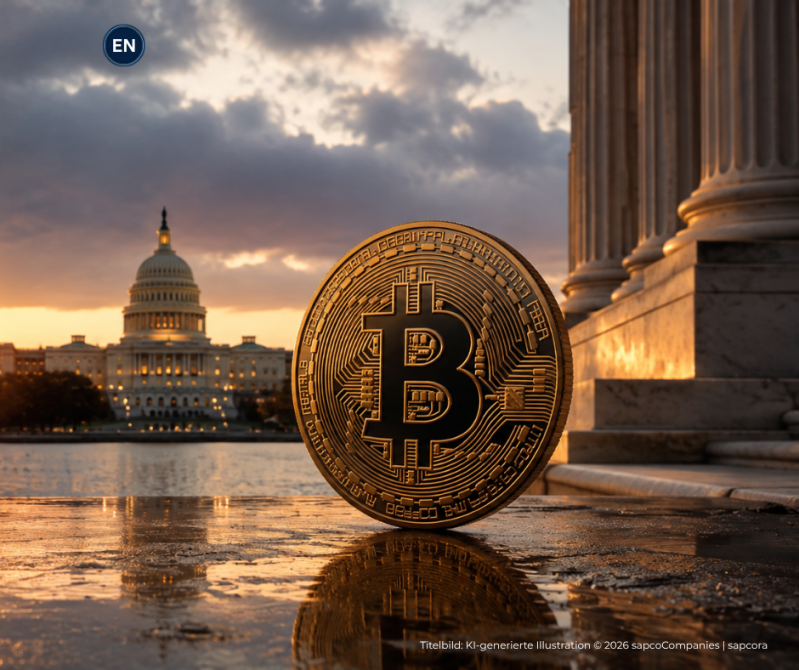
Bitcoin has surged roughly 20 percent in a week and moved above $75,000, producing its strongest weekly advance in more than two years. The move is being driven by an unusually powerful combination of forces: a weaker dollar, intervention in the US Treasury market, renewed institutional demand, massive short liquidations and fresh political pressure from President Donald Trump for Congress to advance comprehensive crypto legislation. What makes the rally more significant than another speculative burst is the role Bitcoin is beginning to occupy across very different investment narratives. It is being bought as a high volatility risk asset when financial conditions appear to improve, while at the same time attracting capital from investors looking for alternatives to the dollar and traditional US assets.
The rally changed character in a matter of days
Bitcoin entered August in a very different position. The cryptocurrency had spent months under pressure, remained far below its previous record and had failed to generate the kind of sustained institutional momentum that characterized earlier stages of the cycle.
Then several forces aligned almost simultaneously. The US Treasury moved to expand its purchases of longer dated government securities, the dollar weakened, institutional money returned to spot Bitcoin exchange traded funds and heavily positioned bearish traders were forced out of the market as prices accelerated upward.
That combination transformed what might otherwise have remained a technical rebound into a much broader financial market event. Bitcoin did not simply rise because crypto sentiment improved. It rose as investors began reassessing the relationship between government debt, the dollar, liquidity and scarce financial assets.
Washington gave the market an unexpected catalyst
One of the most immediate triggers came from a market that appears, at first glance, far removed from cryptocurrency. The US Treasury announced an expansion of its buyback operations for longer dated government bonds after yields had risen sharply amid concerns about inflation, federal borrowing and the scale of American debt.
The Treasury said it would at least double liquidity support buybacks in parts of the 10 to 30 year maturity range. The move was intended to improve market functioning after severe pressure in long term government debt, where yields had reached levels not seen in nearly two decades.
For Bitcoin traders, however, the signal carried a second meaning. Treasury intervention created expectations that authorities were becoming increasingly uncomfortable with the level of long term borrowing costs, while the initial reaction in currency markets pushed the dollar lower.
That matters because Bitcoin remains highly sensitive to global liquidity and dollar conditions. A softer dollar can improve the relative attractiveness of assets priced in dollars, while easing financial conditions can encourage investors to take more risk. The Treasury’s action therefore reached far beyond the bond market. It altered the immediate macroeconomic environment in which Bitcoin trades.
A weaker dollar is reviving the alternative asset trade
Bitcoin and gold are often placed in completely different categories. Gold is one of the world’s oldest defensive assets, while Bitcoin remains highly volatile and strongly influenced by speculative positioning. Yet both can benefit from the same underlying concern.
When investors become uneasy about the purchasing power of the dollar, the trajectory of government borrowing or the credibility of long term fiscal policy, assets that exist outside conventional sovereign liabilities can become more attractive. Gold has occupied that role for centuries. Bitcoin increasingly competes for part of the same capital, particularly among investors willing to tolerate far greater volatility.
The current market provides a striking example. Gold has advanced alongside Bitcoin as the dollar weakened and investors reassessed US financial conditions. That does not make the two assets equivalent, but it reveals a common driver.
Bitcoin is therefore trading inside two narratives at the same time. It benefits when investors become more willing to own risk, but it can also attract buyers when confidence in traditional dollar based assets becomes less secure. That contradiction is not a weakness in the current rally. It may be one of its most important characteristics.
The return of institutional money matters
The structure of the Bitcoin market has changed significantly since the introduction of US spot Bitcoin exchange traded funds. Large investors can now gain exposure through familiar regulated financial products rather than dealing directly with crypto exchanges, wallets and custody infrastructure.
Those funds recorded more than $500 million in net inflows in a single session this week, their strongest daily intake in more than three months. BlackRock’s Bitcoin fund accounted for more than half of that amount, while several other major products also attracted fresh capital.
The timing matters. ETF flows had previously been inconsistent, reflecting months of weaker sentiment and declining enthusiasm across parts of the crypto market. A sudden return of several hundred million dollars in net demand suggests that institutional investors were not merely observing the rebound from the sidelines.
That does not mean every dollar entering an ETF represents a long term strategic allocation. Flows can reverse quickly, especially in volatile markets. But they provide evidence that the rally is not being driven exclusively by retail speculation. Institutional demand has become a meaningful part of Bitcoin’s market structure, and that makes ETF activity one of the most important indicators to watch if the rally continues.
The short squeeze turned a rally into an acceleration
Institutional buying alone does not explain the speed of the move.
The crypto derivatives market had accumulated substantial bearish positioning before Bitcoin began its sharp advance. When prices moved through levels at which leveraged short positions could no longer remain open, exchanges began liquidating those positions automatically.
Those liquidations force traders or trading systems to buy Bitcoin to close bearish exposure. That buying pushes prices higher, which can trigger additional liquidations, creating a self reinforcing cycle.
Billions of dollars in bearish crypto positions were wiped out as the rally accelerated. The resulting short squeeze helped Bitcoin move through several major price levels far more quickly than ordinary spot demand alone would normally suggest.
This distinction is critical when assessing the durability of the move. A short squeeze can create extraordinary momentum, but liquidation driven buying eventually exhausts itself. Once the weakest bearish positions have disappeared, the market requires fresh capital to continue moving higher. The question is therefore no longer whether short sellers helped create the rally. They clearly amplified it. The more important question is what remains after the forced buying is finished.
Trump has returned crypto legislation to the center of the market
The second major catalyst comes directly from Washington. President Donald Trump has publicly urged Congress to pass the CLARITY Act, placing renewed political pressure behind legislation intended to establish a broader federal market structure for digital assets. The initiative seeks to resolve one of the industry’s most persistent problems: uncertainty over which digital assets fall under securities law, which should be treated as commodities and which regulator has authority over different parts of the market.
For years, American crypto companies operated in an environment defined by overlapping jurisdiction, litigation and shifting interpretations between federal regulators. The result was costly uncertainty for exchanges, token issuers, investors and financial institutions attempting to enter the sector. The CLARITY Act is designed to replace part of that uncertainty with a statutory framework.
Its significance for Bitcoin itself should not be overstated. Bitcoin has long occupied a comparatively clearer regulatory position than many other digital assets. The greater impact would fall on the infrastructure surrounding the broader market, particularly trading venues, intermediaries and digital assets whose regulatory classification remains disputed.
For institutional finance, that distinction matters enormously. Capital is often willing to tolerate market risk. It is considerably less comfortable with legal uncertainty that cannot be reliably priced.
The CLARITY Act is not law
Political momentum should not be confused with legislative certainty.
The CLARITY Act remains unfinished business in Congress and has faced significant resistance in the Senate. Supporters argue that the legislation would finally give the United States a coherent digital asset market structure and reduce the dependence on regulation through enforcement actions.
Critics have raised concerns over investor protection, financial stability, illicit finance and the relationship between crypto businesses and traditional banking. A particularly sensitive dispute surrounds ethics rules and the ability of senior political figures to benefit financially from digital asset ventures while participating in decisions that shape the industry’s regulatory environment.
Those concerns have become especially politically charged because Trump’s family has substantial business interests connected to cryptocurrency. The administration says the president does not manage those operations, but the issue has become part of the congressional battle surrounding broader crypto legislation.
The outcome is therefore far from guaranteed. Markets may be pricing a higher probability of regulatory progress, but they are not pricing a completed law. That difference could become important if negotiations stall again.
Regulation may now be a valuation factor
For years, regulation was treated primarily as a threat to cryptocurrency prices. Enforcement actions, exchange lawsuits and warnings from regulators regularly triggered selloffs. The relationship is beginning to change. A credible regulatory framework could increase the number of banks, asset managers, trading firms and corporations willing to interact with digital assets. That could expand market depth and strengthen the financial infrastructure surrounding Bitcoin and other cryptocurrencies.
This does not require regulators to become permissive. In fact, large financial institutions often prefer clear restrictions to unresolved ambiguity because defined rules allow risk departments, compliance teams and boards to make decisions with greater confidence.
If Washington succeeds in establishing durable market rules, regulatory clarity itself could become part of the valuation framework for US crypto businesses. That helps explain why the current political discussion has affected not only Bitcoin, but also publicly traded companies connected to the sector.
Crypto stocks are confirming the broader trade
The rally has spread beyond digital tokens.
Shares of Coinbase, Strategy and other crypto related companies advanced as Bitcoin strengthened and regulatory expectations improved. Companies whose revenues, balance sheets or business models are closely tied to crypto activity effectively provide equity market exposure to the same underlying theme.
Their reaction is important because it shows that investors are not treating the move solely as a Bitcoin price event. They are also repricing businesses that could benefit from higher trading volumes, stronger institutional participation and a more favorable regulatory environment.
The effect is particularly powerful for companies with large Bitcoin holdings because rising cryptocurrency prices immediately alter the market value of their balance sheet exposure. Exchanges can benefit from increased trading activity, while mining companies gain sensitivity to Bitcoin prices through the economics of producing new coins.
This creates a broader financial ecosystem around the rally. Bitcoin may remain at its center, but the market impact now extends through ETFs, listed companies, derivatives and increasingly traditional financial institutions.
The Treasury trade contains a major contradiction
There is, however, a difficult question beneath the enthusiasm. The Treasury’s expanded buybacks were designed to improve conditions in the government bond market, but they do not solve the structural reasons investors demanded higher yields in the first place. Federal debt has exceeded $40 trillion, inflation remains a concern and the United States continues to finance exceptionally large borrowing requirements.
Buybacks can improve liquidity and reduce temporary market stress. They cannot erase fiscal deficits or eliminate the long term supply of government debt. That creates an uncomfortable dynamic for markets. If investors interpret Treasury intervention as evidence that authorities will repeatedly step in whenever long term yields rise sharply, risk assets may benefit in the short term.
But if the same intervention increases concern about fiscal credibility or political pressure on financial markets, the dollar may face additional questions. In that environment, Bitcoin can benefit for a completely different reason. This is where the asset’s dual identity becomes especially visible.
Bitcoin is becoming both a liquidity trade and a credibility trade
Bitcoin’s traditional reputation is that of an extreme risk asset. When liquidity expands, speculative appetite rises and investors become willing to move further out on the risk curve, Bitcoin frequently performs strongly. That remains true.
But another investor base increasingly approaches Bitcoin through a different lens. For those buyers, the attraction lies in an asset with a predetermined supply structure that does not represent a claim on a government, central bank or corporate balance sheet. That argument resembles the logic behind gold more than the logic behind technology stocks.
The two motivations can coexist even though they originate from opposite instincts. One investor buys Bitcoin because financial conditions are becoming easier. Another buys it because confidence in the financial architecture itself has weakened. When both groups arrive at the same trade, price movements can become unusually powerful.
Gold and Bitcoin are rising together, but they are not the same trade
The simultaneous rise in gold and Bitcoin has encouraged comparisons between the two assets, but those comparisons require discipline.
Gold has centuries of monetary history, deep physical markets and a well established role in central bank reserves. Bitcoin has a much shorter history, substantially greater volatility and a market structure still heavily influenced by leverage and speculative flows. A dollar driven move can lift both without making their risk profiles remotely equivalent.
Gold tends to attract defensive capital when investors are concerned about inflation, geopolitics or currency weakness. Bitcoin can respond to the same concerns, but it remains capable of falling sharply during periods of forced deleveraging or severe risk aversion. The current parallel therefore says more about the dollar and investor psychology than it does about Bitcoin becoming a substitute for gold. Both assets are benefiting from questions surrounding conventional financial markets. They simply express those questions in very different ways.
What would make the rally more durable
A 20 percent weekly gain inevitably raises the question of whether the market has moved too far too quickly. The answer cannot be determined from price momentum alone. The durability of the rally will depend on whether the forces that created it continue after the initial short squeeze loses intensity.
Sustained ETF inflows would provide one important signal. Continued institutional demand would suggest that investors are building exposure rather than merely chasing a short term move. Dollar conditions will matter as well. A renewed strengthening of the US currency or another sharp rise in Treasury yields could remove part of the macroeconomic support that helped create the rally.
Washington is another variable. Progress on the CLARITY Act or other regulatory initiatives could reinforce expectations of a more stable US market structure, while another legislative breakdown could reverse some of the optimism now reflected in crypto related assets.
Finally, Bitcoin will have to absorb the consequences of its own success. A move of this magnitude creates profits that investors may choose to realize, while higher prices attract leverage back into the system. The market can therefore remain fundamentally stronger while still becoming vulnerable to violent corrections.
What could break the momentum
The greatest risk to the current rally is the assumption that every positive catalyst will persist. Treasury yields could resume their rise if investors conclude that buybacks are insufficient to address deeper fiscal concerns. A stronger inflation signal could reinforce expectations of tighter Federal Reserve policy and strengthen the dollar.
ETF demand could also fade after the initial burst of institutional buying. If that happens at the same time as short liquidations diminish, Bitcoin would lose two sources of incremental demand almost simultaneously. Regulatory optimism remains vulnerable to Washington as well. The CLARITY Act still faces political, ethical and financial industry objections, and the legislative calendar leaves little room for complacency.
The most dangerous interpretation would therefore be that the rally proves Bitcoin has entered a permanently different market regime. It proves only that several unusually powerful forces have aligned at the same time. Whether they remain aligned is another question.
A more consequential Bitcoin market is emerging
The most important development may not be the move above $75,000 itself. Bitcoin is increasingly connected to the same forces that dominate the world’s largest financial markets: Treasury yields, dollar liquidity, institutional portfolio allocation, federal legislation and political decisions in Washington. What was once largely an isolated speculative market now reacts directly to signals from the Treasury Department, Congress, regulators and major asset managers.
That integration cuts both ways. Greater institutional participation can make the market deeper and more durable, but it also exposes Bitcoin more directly to macroeconomic shocks, policy reversals and changes in global liquidity. The current rally captures that transformation unusually clearly.
Bitcoin is rising because traders are being forced out of bearish positions, because institutions are returning, because the dollar has weakened and because Washington appears more willing to construct a permanent legal framework for digital assets. At the same time, investors questioning the sustainability of US debt and the long term credibility of traditional financial assets are looking toward alternatives. Those forces do not normally belong to a single trade. Right now, they do.
That is why Bitcoin’s move above $75,000 matters far beyond the cryptocurrency market.
Why Bitcoin Is Surging Above $75,000 as Washington Reshapes the Crypto Market. Bitcoin has jumped roughly 20 percent and moved above $75,000 as Treasury buybacks, a weaker dollar, ETF inflows, short liquidations and Trump’s push for the CLARITY Act transform the crypto market.
Kommentar hinzufügen
Kommentare