

Rubrik: Security
Format: Special Report
Autor: Sinisa Brkic (sb)
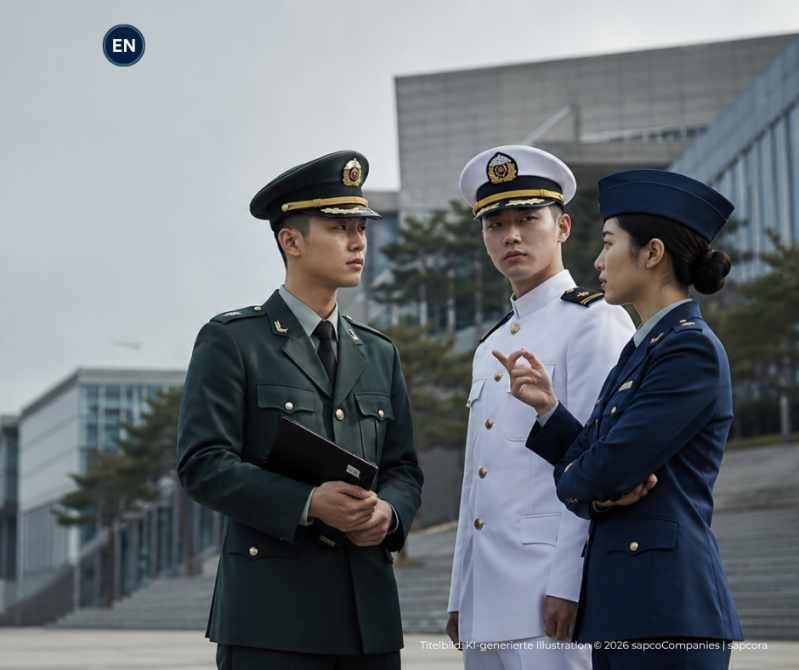
South Korea wants to replace its separate Army, Navy and Air Force academies with a new four year National Military Academy in Daejeon. The government says the overhaul is necessary for joint operations, demographic pressure and a military increasingly shaped by artificial intelligence, cyber capabilities and space. But questions over specialized training, a price tag above 3 trillion won and growing institutional resistance are converging ahead of a critical public hearing on August 26.
A reform that reaches far beyond the classroom
South Korea is preparing one of the most consequential changes to its officer education system in decades. The government and the ruling Democratic Party have agreed to pursue a four year National Military Academy at Jaundae in Daejeon, bringing the Army, Navy and Air Force academy systems under a single institutional structure.
The stated objective is larger than administrative consolidation. Seoul wants officers who understand joint operations earlier in their careers, can work across traditional service boundaries and are better prepared for a battlefield increasingly shaped by artificial intelligence, autonomous systems, cyber operations, space capabilities and integrated command networks.
That logic is difficult to dismiss. Modern warfare has made coordination between land, air, maritime, space and digital forces far more important than it was when many traditional military education systems were designed. South Korea also faces a shrinking pool of young people from which the armed forces must recruit future officers. Yet the same reform raises a harder question. How much integration can a military introduce before it begins weakening the specialized cultures and professional expertise that make individual services effective? That question is now moving from policy papers into public confrontation.
Why Seoul wants one academy
South Korea currently maintains separate institutions for its three principal services. The Korea Military Academy educates future Army officers, while the Republic of Korea Naval Academy and Republic of Korea Air Force Academy perform the corresponding role for the Navy and Air Force.
The government’s argument is that this structure encourages separation at precisely the point when future commanders need a deeper understanding of how other services operate. A single academy is intended to create a common professional foundation before cadets move into more specialized education.
Earlier concepts considered a model in which cadets would spend their first two years together and then move to the existing service academies for their final two years. The government ultimately shifted toward a four year integrated institution in Daejeon. Under the emerging concept, the first years would emphasize common education, while the later stages would introduce service specific instruction and practical training.
Important details remain unresolved. It is not yet clear how much specialized training would take place at Daejeon itself, how heavily the new academy would depend on existing service facilities, or precisely how the professional development of pilots, naval officers and Army officers would be protected. Those are not secondary questions. They go to the operational credibility of the entire project.
Daejeon is part of the strategy
The choice of Jaundae is central to the government’s vision. The military complex in Daejeon already contains a concentration of defense education and training institutions and sits inside one of South Korea’s strongest science and technology regions.
The government has specifically pointed to the surrounding research environment, including major universities and aerospace and scientific institutions. The longer term ambition extends beyond creating a replacement for three undergraduate academies. Officials have discussed developing Jaundae into a broader national defense education hub that could eventually connect additional military institutions, advanced technology education and graduate level defense programs.
Seen from that perspective, the project is not simply an academy merger. It is an attempt to reorganize part of South Korea’s military education infrastructure around a single geographic and institutional center. That could create advantages in research, technology transfer and joint education. It could also concentrate enormous influence in one institution. The governance structure of the new academy, the balance between civilian and military faculty, and the authority retained by individual services will therefore matter almost as much as the curriculum itself.
The specialization problem
The strongest military objection is also the most practical. An Army officer, naval officer and Air Force officer may all require strategic judgment, leadership skills and an understanding of joint warfare. Their professional environments, however, remain fundamentally different.
Naval education requires familiarity with ships, navigation, maritime operations and life at sea. Air Force education must prepare officers for an organization built around aviation, air defense, aerospace systems and highly technical operational disciplines. Army officers require a different relationship with ground maneuver, field operations, logistics and command at scale. An integrated academy can teach all cadets to think jointly. It cannot eliminate these differences without consequences.
The government appears to recognize the problem and has indicated that cadets would receive service focused education during the latter part of the four year program. Existing academy facilities or nearby military units could also remain relevant for practical training. What remains unclear is whether that arrangement will merely preserve specialist training or preserve the deeper service cultures that develop through four years of immersion in a distinct professional environment. That distinction explains much of the resistance.
Resistance has moved beyond symbolic protest
Alumni organizations from all three service academies have opposed the merger and demanded that the government reconsider the plan. Their argument is not simply based on institutional nostalgia. They contend that each academy produces an officer culture adapted to a different operational domain and that forcing those systems into one institution could weaken professional identity and expertise.
The opposition has widened. Former senior military leaders have publicly called for reconsideration, while civic and reserve groups have organized against the closure or effective replacement of the existing academies. The conflict became sharper after Defense Minister Ahn Gyu-back met the leaders of the three alumni associations on August 12. The two sides subsequently offered conflicting accounts of what the minister had said about preserving the current system.
The alumni representatives maintained that Ahn had indicated the existing three academy structure could remain among the options under consideration. The Defense Ministry rejected that interpretation. Ahn later made clear that maintaining the current arrangement was fundamentally difficult to reconcile with a policy built around integration. The dispute damaged trust at a particularly sensitive moment. Alumni groups initially considered boycotting the public hearing scheduled for August 26 before deciding to participate.
A reform about warfare and institutional power
The government has presented the merger as a response to future warfare, demographic decline and the need for stronger joint operations. President Lee Jae-myung has added another dimension.
Lee has publicly linked military academy reform to South Korea’s history of military coups and the concentration of influence among Army elites. He has argued that the Korea Military Academy has historically produced figures involved in military takeovers and questioned whether a system that reinforces powerful service based networks should remain untouched. That argument places the reform inside a much broader political debate about the relationship between the armed forces, civilian authority and South Korea’s democratic institutions. It also makes the project more controversial.
A military education reform designed principally around operational requirements can be judged against recruitment, training standards, battlefield effectiveness and cost. A reform that is simultaneously intended to alter institutional power structures carries a different political burden. The government must demonstrate that it is improving military effectiveness rather than allowing historical grievances or political calculations to determine the architecture of officer education. The two objectives are not necessarily incompatible. They are, however, not identical.
More than 3 trillion won and major unanswered questions
The projected cost exceeds 3 trillion won, approximately $2.1 billion at recent exchange rates. Officials have considered financing options that could combine government funding with proceeds from the sale of military property made redundant by the reorganization. For a project of this scale, the headline figure is only the beginning.
A new academy would require academic facilities, cadet housing, training infrastructure, laboratories, command facilities, security systems and potentially extensive new technology capabilities. If existing academy locations continue to support specialized education, part of the old infrastructure may also have to remain operational. That creates an obvious cost question. Consolidation does not automatically produce savings if the new central campus is built while substantial parts of the existing system must still be maintained.
The future of the current sites therefore matters financially as well as politically. The Korea Military Academy is located in Seoul, the Naval Academy in Jinhae and the Air Force Academy in Cheongju. Their eventual roles have not yet been defined with sufficient precision to determine whether they would be closed, repurposed, reduced or retained as specialized training locations. Until that is settled, the true cost of the reform cannot be understood simply from the construction budget in Daejeon.
What other countries show
International experience suggests that joint education and service specialization do not have to be treated as opposing choices. The United States continues to operate distinct academies for the Army, Navy and Air Force. The model preserves strong service identities from the beginning of an officer’s professional education, while joint experience is developed elsewhere in the career system.
India provides a different example. Its National Defence Academy brings Army, Navy and Air Force cadets together for three years of common training. Cadets then proceed to their respective service academies for additional professional preparation before commissioning.
That structure is particularly relevant to the South Korean debate because it demonstrates a hybrid model. Joint identity is created early, but service specific education remains institutionally distinct before officers enter active service. South Korea is contemplating a more concentrated approach. The proposed academy would keep cadets within one four year institution while introducing specialized education in the later years. Whether that model can reproduce the depth of service specific preparation offered by separate institutions is one of the questions the government has yet to answer convincingly. The international lesson is therefore not that integration is inherently superior or inferior. It is that successful systems tend to make a deliberate choice about where jointness ends and specialization begins. South Korea has not fully defined that boundary.
Ahn’s absence will draw attention, but it should not be overread
The public hearing on August 26 is intended to provide a formal venue for experts, supporters, opponents and members of the public to challenge the government’s basic plan. Ahn is not expected to attend personally, according to current reporting on the ministry’s internal arrangements. Defense policy chief Kim Hong-cheol is expected to oversee the hearing instead.
The minister’s absence is politically notable because Ahn has been one of the most visible advocates of the reform. It comes after weeks of increasingly direct conflict with academy alumni and at a hearing specifically designed to collect criticism of the government’s proposal.
That does not, by itself, indicate that Ahn is retreating from the policy. There is currently no factual basis for treating his expected absence as evidence that the government is abandoning the integration project. The more relevant question is whether the hearing will function as genuine consultation or merely as a procedural step before decisions that have already been made. If the government wants the process to carry institutional legitimacy, it will need to show where criticism can still change the plan.
The reform is not yet a finished decision
Political agreement should not be confused with completed implementation. The government and ruling party have agreed on the direction of the reform and on Daejeon as the location of the proposed academy. The Defense Ministry is preparing the project and has committed itself publicly to integration.
But the final structure is not yet complete. Detailed plans are expected later, with the ministry previously indicating October as a target for a more developed concept. Legislation will also be necessary before the new institution can be fully established. The timetable for the first integrated class remains dependent on those steps. Earlier consideration of a 2028 intake has highlighted another complication because changes to military academy admissions also interact with South Korea’s rules and expectations surrounding advance notice for university entrance procedures. The result is a reform that is politically advanced but institutionally unfinished. That distinction matters. The existing academies have not already disappeared, their sites have not been conclusively reassigned and the final education model is not yet settled.
August 26 is the first real test of the government’s case
The coming hearing will not decide the future of South Korean military education in a single afternoon. It may, however, reveal whether the government can answer the questions that have accumulated around its plan. Why is a four year unified campus superior to a model that combines common education with separate service academies? How will naval and aviation specialization be protected? Which current facilities will remain necessary? What exactly accounts for a budget above 3 trillion won? How much of the plan can still be changed after public consultation? Those questions are more important than the institutional loyalties surrounding them.
South Korea has legitimate reasons to reconsider how it prepares officers for future war. Artificial intelligence, cyber operations, space capabilities and increasingly integrated military commands make the traditional boundaries between services less absolute than they once were. A shrinking population also forces the armed forces to compete harder for a smaller pool of talent. But modernization is not achieved simply by putting different uniforms on the same campus.
The success of the National Military Academy project will depend on whether Seoul can create a generation of officers who think jointly without becoming professionally generic. If the reform strengthens cooperation while preserving the depth of Army, Navy and Air Force expertise, it could become one of the most important changes in South Korean defense education in decades. If that balance is misjudged, the government could spend more than 3 trillion won replacing three established institutions only to discover that the distinctions it removed were part of what made them valuable.
South Korea Military Academy Merger: Costs, Risks and Reform. South Korea plans to merge its Army, Navy and Air Force academies in Daejeon. The reform faces resistance over cost, expertise and political control.
Kommentar hinzufügen
Kommentare