

Rubrik: International
Format: Spezialbericht
Autor: Sinisa Brkic (sb)
Joshua Aviles has spent more than nine months deployed aboard the USS Abraham Lincoln, serving through one of the most demanding carrier deployments in the modern U.S. Navy. While he remained thousands of miles from home, U.S. Border Patrol detained his father in Florida and transferred him into federal immigration custody. The case brings an increasingly consequential question into sharp focus: what protection does military service actually provide when immigration enforcement reaches a service member’s own family?
A sailor at sea, his father in immigration custody
For more than nine months, Joshua Aviles has been deployed aboard the USS Abraham Lincoln. The aircraft carrier spent much of that deployment supporting U.S. military operations connected to the conflict with Iran and had been deployed for 274 days by August 22, an extraordinary stretch even by the demanding standards of carrier operations.
Then Aviles received news from home. His father, 48 year old Luis Manuel Aviles Roa, originally from Nicaragua and a longtime resident of Key West, Florida, had been arrested by U.S. Border Patrol and placed into federal immigration custody. The Department of Homeland Security says Border Patrol officers detained Aviles Roa following a vehicle stop in Key West. According to DHS, he originally entered the United States unlawfully and is now being held in Immigration and Customs Enforcement custody while the government pursues removal proceedings.
His family describes a man whose life in the United States had long since become established. Aviles Roa has lived in the country for approximately 19 years, works as a handyman and, according to his family, possesses a work permit, Social Security card and driver’s license. The family also says he had been waiting for approval of a Green Card. Those facts make the case politically striking. Legally, however, they do not answer the most important question.
A work permit does not establish permanent legal status
One of the central misunderstandings surrounding immigration cases is the assumption that a work permit means a person has lawful permanent status in the United States. It does not. An Employment Authorization Document allows a noncitizen to work legally while a particular immigration process, protection or category remains valid. It can be issued in circumstances where the person has not become a lawful permanent resident and may still be vulnerable to immigration enforcement.
A Social Security card carries a similar limitation. It can be issued to certain noncitizens authorized to work in the United States, but it does not function as proof of permanent residency. A driver’s license is likewise an identification document governed largely by state law, not a federal determination that its holder cannot be removed from the country. That distinction is crucial in Aviles Roa’s case. His family says he was pursuing a Green Card, but the precise legal basis of that process, its procedural stage and any additional immigration protections available to him have not been fully established in the public record.
The existence of a pending application also does not automatically prevent detention. Depending on a person’s immigration history and the legal process involved, federal authorities may continue removal proceedings while another application remains unresolved.
Can the father of an active duty sailor be deported?
Yes, potentially. The parent of an active duty member of the U.S. military does not receive an automatic exemption from American immigration law. DHS has made that position explicit. The military service of a relative, according to the department, does not erase immigration violations or prevent the government from enforcing the law.
But that is only part of the legal picture. The United States has also maintained specific immigration mechanisms designed to recognize the unusual burdens placed on military families, including circumstances in which a service member’s parent, spouse or child lacks conventional immigration status. The most important of those mechanisms is Military Parole in Place.
Military Parole in Place can help families, but it is not immunity
Military Parole in Place allows certain relatives of active duty members of the U.S. armed forces, members of the Selected Reserve and some veterans to seek discretionary immigration relief while remaining inside the United States. Parents are among the family members who may qualify.
The program can be particularly significant for individuals who entered the country without being formally inspected and admitted. If granted, parole can provide a period of authorized stay and, in some circumstances, remove a procedural obstacle to applying for lawful permanent residence when the person is otherwise eligible. But the protection is not automatic. USCIS evaluates requests individually, and being the parent of a service member does not guarantee approval.
Nor does Military Parole in Place erase every potential immigration problem. Prior removal orders, criminal history, other grounds of inadmissibility and the specific circumstances of an individual’s case can affect what relief is available. There is currently no public confirmation that Aviles Roa had already received Military Parole in Place, had a pending application for it or would qualify for the benefit. That distinction is important because military service can create immigration options for a family without creating immunity from enforcement.
The case is part of a much larger shift
Aviles Roa’s detention is not occurring in isolation. An Associated Press investigation published earlier in August identified more than 50 parents and spouses of active duty U.S. service members who had been detained since President Donald Trump returned to office. At least six relatives had been deported and another had left the country voluntarily, according to that investigation. Some family members were detained while attempting to resolve their immigration status through processes specifically available to military families.
That represents a significant change in enforcement practice. For years, immediate relatives of active duty personnel often received considerable discretion because military leaders and policymakers recognized that immigration crises at home could directly affect readiness, deployments and the welfare of service members. The current administration has taken a more restrictive position. Military service may be relevant when an individual seeks discretionary relief, but it is not treated as a reason to suspend immigration enforcement by itself.
That distinction has consequences far beyond immigration court. A sailor deployed overseas may have limited ability to assist a detained parent, manage legal proceedings, support relatives at home or respond to a rapidly developing removal case.
The USS Abraham Lincoln makes the contrast unusually stark
Joshua Aviles is not serving during a routine period aboard a ship operating close to its home port. His father’s detention came during an exceptional deployment that has already placed the USS Abraham Lincoln and the strain on its crew under national scrutiny. The carrier departed San Diego in November 2025. By August 22, its strike group had been deployed for 274 days and the ship had spent more than eight months at sea since its last publicly declared port visit in Guam in December.
Its prolonged deployment included almost seven months in the Middle East. Reports of shortages, maintenance problems, deteriorating morale and mental health concerns prompted questions from military families and members of Congress about how long the Navy could reasonably sustain such an operation. The USS George Washington has since arrived in the region to relieve the Lincoln, which has begun the long journey away from the Middle East. For the thousands of sailors aboard, however, departure from the operational theater does not mean an immediate return home. For Joshua Aviles, that journey now carries an additional uncertainty. The father he expected to return to remains in federal immigration custody.
Military service and immigration law operate on different tracks
The case exposes an uncomfortable institutional reality. The federal government can require extraordinary service from one member of a family while another branch of the same government pursues the removal of that service member’s parent. There is no legal contradiction in that alone. The Department of Defense does not control immigration enforcement, and DHS does not surrender its statutory authority because someone’s son or daughter wears a military uniform. The Navy can support a sailor through command structures, legal assistance and documentation of military service. It cannot order ICE to release a detainee, cancel removal proceedings or grant a Green Card.
Congressional offices can make inquiries, request case reviews and bring political pressure to bear. They cannot simply override an immigration court or substitute themselves for the agencies responsible for determining immigration benefits. The result is a system in which military service can matter significantly without necessarily deciding anything.
What happens now depends on details that remain unknown
The immediate legal future of Aviles Roa will depend on the procedural posture of his immigration case. His lawyers may examine whether he can challenge removal, seek release where the law permits it, pursue the Green Card process described by his family or request another form of immigration relief. Much will depend on facts that have not yet been made public. Those include the precise circumstances of his original entry, whether he has previously faced immigration proceedings, whether a removal order exists, the legal foundation of his work authorization and the basis of the permanent residency application his family says was pending.
Those details are not technical footnotes. They determine whether the government possesses a straightforward path toward removal or whether Aviles Roa has viable legal mechanisms to remain in the United States. For now, the strongest conclusion is also the narrowest one. A work permit does not guarantee protection from deportation, and the parent of an active duty sailor is not automatically shielded from immigration enforcement. At the same time, military families do have specific immigration options that can become highly relevant once lawyers establish the precise facts of an individual case.
A case that reaches beyond one family
The political significance of the Aviles case lies precisely in that gap between service and protection. The United States asks military personnel to accept deployments, separation from their families and risks that most civilians will never face, while its immigration system increasingly applies enforcement measures to some of those same families. That does not make every detention unlawful. It does raise a legitimate policy question about whether the government’s treatment of military families is consistent with the sacrifices it asks of the people serving in uniform.
More than 50 military spouses and parents have reportedly been detained during the current enforcement campaign. Aviles Roa therefore enters a debate that was already developing before Border Patrol stopped him in Key West. His son’s circumstances give that debate an unusually vivid form. Joshua Aviles has spent more than nine months serving aboard an American aircraft carrier through an exceptionally demanding military operation. While he remains at sea, the country he serves is deciding whether his father will be allowed to remain in it.
The law may ultimately provide a clear answer to Luis Manuel Aviles Roa’s case. The larger question is political, and considerably harder: what does a nation owe the families of those it sends to serve?
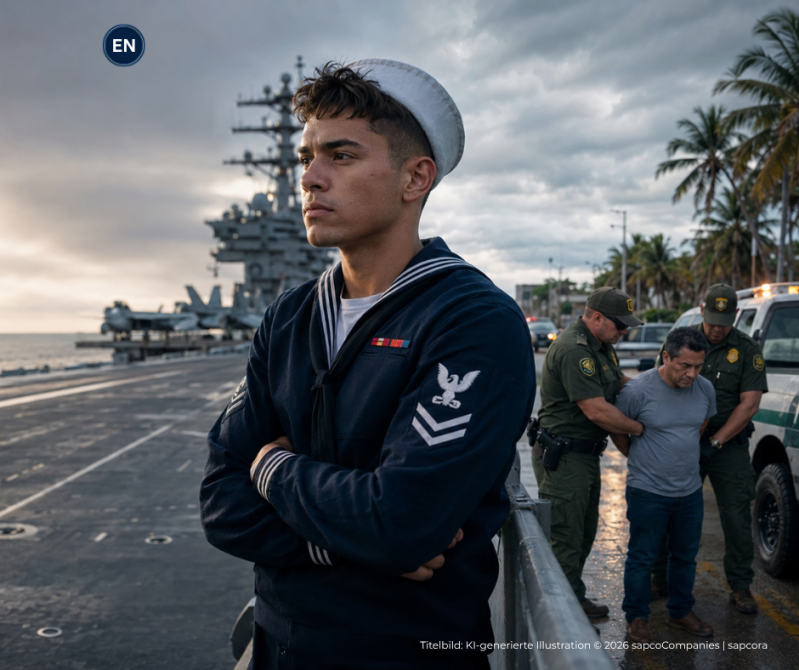
USS Abraham Lincoln Sailor’s Father Detained by U.S. Border Patrol. U.S. Border Patrol detained the father of a Navy sailor serving aboard the USS Abraham Lincoln. The case raises difficult questions about deportation, work permits and immigration protections for military families.
Kommentar hinzufügen
Kommentare