

Section: Technology & AI
Format: Special
Author: Sinisa Brkic (sb)
South Korea is approaching a record year for traffic fines, but the more consequential change is taking place far beyond police cameras. Thousands of drivers now submit dashcam and smartphone footage of other motorists every day, turning ordinary citizens into an increasingly important part of traffic enforcement. What appears at first to be a question of road discipline is becoming a broader debate about surveillance, privacy and the changing boundary between citizen and state.
A record bill is only part of the story
South Korea is heading toward what could become a record year for traffic related fines and administrative penalties. The amount imposed in 2026 is projected to reach roughly 1.5 trillion won if the pace recorded during the first seven months of the year continues.
Between January and July, authorities imposed 812.1 billion won in administrative fines and another 45.1 billion won in traffic penalties, bringing the combined total to 857.2 billion won. That was approximately 5.7 percent more than during the corresponding period a year earlier.
The figures are striking, but they do not fully explain why the issue has gained such public attention. The deeper change lies in how violations are being detected. Traffic enforcement is no longer confined to police patrols, fixed cameras or official monitoring systems. A growing part of the process begins with footage recorded by ordinary motorists.
Drivers are increasingly policing other drivers
South Korean police receive roughly 10,000 public reports of traffic violations each day. The submissions can include dashcam or smartphone footage showing dangerous driving, signal violations, illegal lane changes and other suspected offences.
The effectiveness of those reports is also increasing. In 2024, about 60 percent of citizen submissions resulted in a fine or comparable administrative action. The rate rose to 65.2 percent in 2025 and reached 66.3 percent during the first seven months of 2026.
That does not mean a video sent by a citizen automatically produces a penalty. Police must review the evidence and determine whether the violation is sufficiently clear, whether the vehicle can be identified and whether the material meets the requirements for enforcement.
That distinction is essential. Citizens provide evidence, but the authority to determine whether an offence has occurred and whether a sanction should follow remains with the state.
The dashcam is becoming more than an insurance device
Dashcams became widespread largely because they offered motorists evidence after accidents, insurance disputes and conflicting accounts of events on the road. Their function is now expanding.
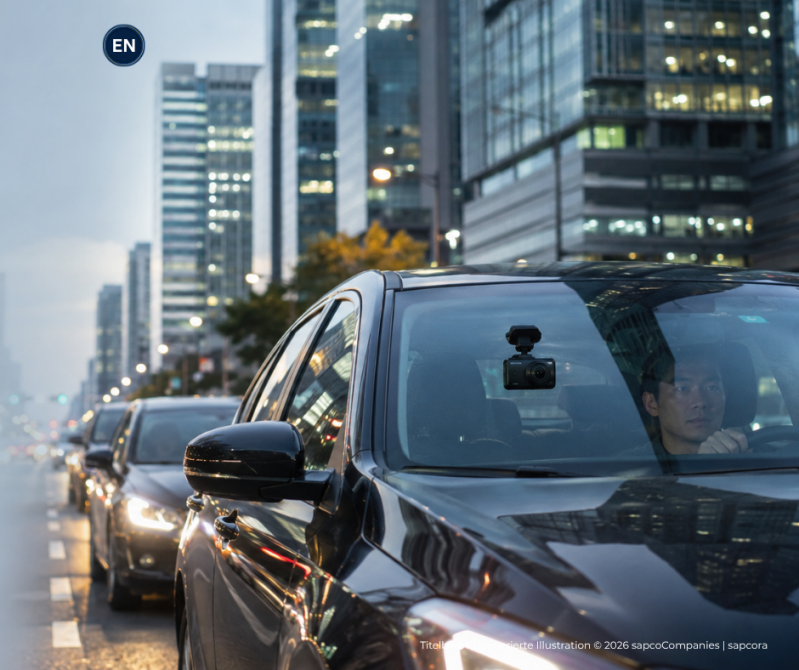
A camera installed primarily for personal protection can also document the behaviour of everyone nearby. When that footage can be transmitted to authorities and used in official proceedings, the device becomes part of a much broader enforcement environment.
This changes the practical experience of driving. A motorist no longer needs to see a police vehicle or pass a government camera to know that a violation might be documented. The car behind, beside or approaching from the opposite direction may already be recording.
The possible deterrent effect is considerable, but so is the social transformation behind it. Surveillance becomes decentralised, routine and difficult to perceive because the recording devices belong not to the state, but to other citizens.
Citizen reporting changes the meaning of enforcement
There is a fundamental difference between a government installing surveillance cameras and citizens voluntarily submitting evidence. The first is an organised form of state observation. The second depends on thousands of individual decisions to record, review and report the conduct of others.
Once privately generated footage becomes a significant source of official sanctions, however, the two systems begin to intersect. Citizens collect the evidence, public authorities assess it and state power determines the consequence.
That model can substantially increase the probability that dangerous conduct will be detected. It also reduces the geographical limits of conventional enforcement because an offence no longer needs to occur in front of an officer or within the range of a fixed camera.
The result is a different kind of public space. Roads remain governed by formal traffic rules, but compliance can increasingly be documented by almost anyone who happens to be nearby.
The crucial safeguard begins after the upload
The difference between observation and punishment is not merely technical. It is the central safeguard of the system.
For citizen footage to support enforcement, the alleged violation and the vehicle involved must be sufficiently identifiable. Police guidance requires enough information to establish the circumstances of an incident, including relevant details about time, place and what occurred before and after the suspected violation.
Unclear or incomplete material may therefore fail to produce any administrative action. The reporting citizen is not a judge, and the video itself is not a penalty.
The rising share of reports that result in sanctions nevertheless suggests that citizens are becoming increasingly effective at supplying evidence authorities consider usable. Better cameras, clearer footage and greater familiarity with reporting procedures may all be contributing to that development.
A surveillance network the state does not have to build
One of the most significant features of the South Korean system is that much of its observational capacity does not need to be installed or maintained by the government. The hardware already belongs to private individuals.
Privately owned dashcams can create a degree of observational coverage that would be extraordinarily difficult for the state to replicate through fixed infrastructure alone. Smartphone recordings add another layer of potential evidence.
This produces a distinctive form of distributed enforcement. The state does not have to observe every road continuously if citizens can record incidents and provide evidence afterward.
From an administrative perspective, that can be remarkably efficient. From the perspective of civil liberties, the same feature deserves scrutiny because the surveillance infrastructure is dispersed across private hands while its consequences can ultimately be imposed through public authority.
Privacy becomes harder to define
The central privacy question is not simply whether a dashcam can record a public road. The more difficult issue is what happens to the recording afterward.
Footage retained for accident documentation serves one purpose. Material uploaded to authorities, distributed to third parties or published online can involve very different questions about personal information, vehicle identification and the rights of those who appear in the recording.
The fact that an event occurs in public does not eliminate every question about how personal data is processed, stored or shared. As dashcams evolve from passive recording devices into tools that can contribute to enforcement, those distinctions become increasingly important.
Regulators therefore face a broader challenge than determining whether citizen reports are useful. They must preserve legitimate evidentiary value without allowing routine recording to become a justification for unnecessary exposure or misuse of personal information.
The state is also extending the use of existing data
The enforcement debate does not end with cameras. South Korean authorities have also clarified how personal information already held by the state can be used to pursue unpaid traffic penalties.
In an administrative consultation on August 11, the Board of Audit and Inspection concluded that police may use telephone numbers collected through other official duties, including driver licence administration, for the collection of overdue traffic fines. The position also allows such information to be processed by the National Tax Service for that purpose when the requirements of South Korea’s Personal Information Protection Act are satisfied.
The development is separate from citizen dashcam reporting, but it reinforces the same broader governance trend. Traffic enforcement is becoming more dependent on the ability to connect information gathered in different parts of the administrative system.
The scale of outstanding debt explains the pressure behind that effort. At the end of 2025, overdue traffic related penalties amounted to approximately 1.1447 trillion won across about 16.11 million outstanding cases involving roughly 2.55 million debtors.
Detection and collection are becoming more connected
Taken together, these developments point to a traffic enforcement system that is becoming more comprehensive at both ends of the process. Private cameras can help authorities detect violations that might otherwise remain unseen, while government databases can make it easier to pursue penalties after they have been imposed.
That does not automatically amount to a single unified surveillance system. The legal basis, purpose and actors involved remain different. Yet from the perspective of the individual driver, the practical effect is a growing capacity to identify, document and follow up on violations.
This is where the significance of South Korea’s experience extends beyond traffic administration. Modern enforcement increasingly depends not only on the powers granted to public institutions, but also on how effectively private technology and existing state data can be brought into the same administrative process.
Safety, revenue and surveillance are not the same thing
Supporters of stronger citizen reporting have a straightforward argument. If drivers know that unlawful or dangerous behaviour can be recorded almost anywhere, compliance may improve even when no police officer is present.
The more difficult question is whether that produces measurable improvements in road safety. A rise in reports, penalties or collected revenue does not by itself demonstrate fewer collisions, fewer injuries or better driving behaviour. Those outcomes require separate evidence.
This distinction matters because enforcement systems can easily be judged by the volume of activity they generate. More reports and more sanctions may show that violations are being detected more effectively, but they are not automatically proof that roads have become safer.
If citizen reporting is to become a lasting part of traffic policy, its success should ultimately be measured not only by enforcement statistics but also by whether it reduces the behaviour that makes enforcement necessary in the first place.
When everyone carries evidence
South Korea is offering an unusually clear view of what traffic enforcement can become in a society where cameras are widespread but much of the recording capacity is privately owned.
The traditional model was comparatively simple. The state watched the road, identified violations and imposed penalties. The emerging model is more complex. Citizens observe one another, digital systems transmit evidence and public authorities decide which recordings justify official intervention.
That can make enforcement broader, faster and more responsive. It can also create an environment in which being observed is no longer associated primarily with an official camera because another citizen may be recording at any moment.
The real significance of South Korea’s rising traffic penalties therefore lies beyond the record totals. The country is demonstrating what happens when surveillance becomes participatory and when ordinary technology begins to function as part of the machinery of enforcement.
The question is no longer simply whether the police are watching the roads. It is how traffic rules, privacy and individual behaviour change when drivers know that everyone around them might be watching too.
South Korea’s Roads Under Citizen Watch as Dashcam Reporting Surges. South Korea’s traffic enforcement increasingly relies on citizen dashcam reports. Record penalties, mass reporting and expanded use of personal data are raising questions about surveillance, privacy and road policing.
Kommentar hinzufügen
Kommentare