

Section: Economics
Format: Special
Author: Sinisa Brkic (sb)
A new connection into Delhi and fresh progress in western India are pushing the Delhi-Mumbai Expressway into a more consequential phase. The highway is not yet a fully continuous Delhi-to-Mumbai route, but its expanding network of operational sections is beginning to change the economics of freight, industrial development and investment across western and central India.
Delhi finally reaches the expressway
For years, the Delhi-Mumbai Expressway has been presented primarily as one of India’s largest road construction projects. That description is becoming increasingly incomplete. The more important question now is whether the emerging network can function as an integrated economic corridor rather than a collection of isolated highway sections.
The latest step came at the northern end of the project. A roughly nine-kilometre section between the DND Flyway and Jaitpur has entered trial operation, giving motorists from Delhi direct access towards Faridabad, Sohna and the operational sections of the Delhi-Mumbai Expressway network. Most of the new section is elevated and forms the final Delhi component of the wider DND-Faridabad-KMP connection.
The distinction between trial operation and full opening remains important. Traffic arrangements are still being tested, safety modifications are continuing and individual carriageways or access points may remain subject to temporary restrictions. Delhi is therefore connected to the expressway system, but this should not be confused with the completion of the entire Delhi-Mumbai route.
That distinction matters because the economic value of the project depends less on symbolic openings than on continuous connectivity. The real test is whether the network can support reliable long-distance movement at scale.
From megaproject to transport system
The Delhi-Mumbai Expressway is designed as an access-controlled high-speed corridor linking India’s political capital with its largest financial and commercial centre. Including associated spurs, the wider project extends for approximately 1,386 kilometres across Delhi, Haryana, Rajasthan, Madhya Pradesh, Gujarat and Maharashtra.
Its significance extends far beyond the two cities in its name. The corridor connects or approaches major economic centres including Jaipur, Kota, Ratlam, Vadodara and Surat while integrating with a broader transport system serving industrial zones, airports, ports and logistics facilities.
The original promise was straightforward: shorten the road distance between Delhi and Mumbai, cut travel times significantly and create a faster north-southwest transport axis. The economic proposition is more ambitious. Faster and more predictable road transport can alter warehouse locations, supply-chain structures, industrial investment decisions and the competitive position of regions along the route.
That transformation becomes credible only when enough sections operate as a connected network. A long expressway has limited strategic value if critical gaps continue to interrupt the flow of freight and passenger traffic.
Gujarat becomes the critical bridge
Recent progress in Gujarat illustrates both the opportunity and the remaining weakness of the project. Traffic has begun using a roughly 55-kilometre section between Limkheda and Godhra while smaller works and installations are still being completed. Other portions of the expressway in Gujarat have already entered operation through earlier phases.
The state is crucial because it is not merely another segment on the route. Gujarat links the long operational network across Haryana, Rajasthan and Madhya Pradesh with the industrial and port economy of western India. A gap in Gujarat therefore limits the value of completed infrastructure on both sides.
This is why delayed packages in the state have attracted disproportionate attention. The project’s completion timetable has already slipped substantially, with government statements placing final completion around 2027 and parliamentary disclosures indicating that some remaining work could extend into 2027-28.
At the same time, another important milestone is approaching in the west. Maharashtra has targeted the end of August for the opening of a major section of the Vadodara-Mumbai corridor, a development expected to reduce road travel time between Mumbai and Vadodara significantly once the route is fully usable under normal operating conditions.
Even if that timetable is met, it will not mean that motorists can immediately drive the entire new expressway continuously from central Delhi to Mumbai. Remaining gaps will continue to determine when the corridor becomes genuinely end to end.
Freight is where the economics become serious
Passenger travel attracts much of the public attention around new expressways, but freight is where the longer-term economic consequences become more significant. India’s logistics system still depends heavily on road transport, and time lost to congestion, inconsistent road quality and urban bottlenecks translates directly into higher operating costs.
An access-controlled corridor changes that equation. More predictable transit times allow trucking companies to schedule vehicles more efficiently, reduce uncertainty around delivery windows and potentially increase the distance a vehicle can cover within a given operating cycle.
For manufacturers, reliability can matter as much as outright speed. A factory that can depend on more predictable road transport may require less buffer inventory, serve a wider supplier network and reach distribution centres more consistently. Across thousands of daily freight movements, incremental improvements in reliability can translate into meaningful economic gains.
This is why the Delhi-Mumbai Expressway increasingly needs to be viewed alongside India’s broader logistics and industrial strategy. Its value will ultimately be measured not by engineering scale alone, but by the commercial activity it enables.
A new economic geography around the corridor
The corridor has been planned with connections to major economic nodes and transport assets. Government infrastructure planning includes links to ports, airports and multimodal logistics facilities, while separate industrial development programmes are expanding manufacturing and investment zones across many of the same states.
These projects should not be treated as a single scheme. The Delhi-Mumbai Industrial Corridor, for example, is a separate development programme with its own industrial nodes and infrastructure planning. Yet the interaction between industrial zones, freight rail, ports, airports and high-capacity roads is precisely what can turn individual projects into a broader production network.
The strongest effects are unlikely to be distributed evenly along the route. Interchanges near established industrial centres, logistics clusters and port connections are positioned to capture more immediate value than locations that merely sit close to the highway.
Haryana and Rajasthan could benefit from stronger access between the National Capital Region and western markets. Madhya Pradesh gains a faster road position between northern consumption centres and Gujarat, while Gujarat itself sits at the intersection of manufacturing, chemicals, ports and export logistics. Maharashtra represents the final gateway into the Mumbai metropolitan economy and one of India’s most important port regions.
The road can connect those economies physically. Whether it integrates them commercially will depend on the quality of the infrastructure, logistics capacity and industrial investment built around it.
Warehouses, industrial parks and land values
The next phase of the expressway story is therefore likely to unfold beyond the carriageway itself. Warehousing, distribution centres, truck terminals, industrial estates and service infrastructure tend to follow major transport improvements where demand, planning rules and land availability support them.
That creates opportunity, but also room for speculation. Land near proposed interchanges can rise in value long before traffic volumes justify the increase, especially when infrastructure expectations become detached from actual commercial demand.
Access is also decisive. A site located physically close to an access-controlled road is not necessarily well connected to it. Commercial value depends on interchange location, feeder roads, utilities, labour availability and proximity to suppliers or customers.
For real estate markets along the corridor, the expressway may therefore create concentrated winners rather than a uniform increase in values across every district it crosses. The most successful locations are likely to be those where transport access and existing economic activity reinforce each other.
Delhi access changes the northern equation
The new DND-Jaitpur connection is significant for the same reason. Its value is not limited to reducing travel time between Delhi and Faridabad. It improves the way the expressway plugs into the wider National Capital Region.
Direct access from Delhi can also improve connectivity for parts of Noida and Ghaziabad heading towards Haryana and Rajasthan while reducing dependence on heavily congested existing approaches. The wider road programme also includes additional links intended to connect the expressway more effectively with major transport infrastructure in the region.
For logistics operators, these connections matter because an expressway that begins far outside a metropolitan market loses part of its advantage in the congested kilometres required to reach it. Bringing high-capacity infrastructure closer to major demand centres makes the entire corridor more commercially useful.
This is the point at which a road begins to function as a network rather than simply as a line on a map. The economics improve when access becomes easier at both ends of the journey.
The 12-hour promise still requires caution
The Delhi-Mumbai Expressway has long been associated with the prospect of reducing the journey between the two metropolitan regions to roughly 12 hours once the full corridor is operational. That remains a project objective rather than the travel experience available today.
Actual end-to-end journey times will depend on the completion of all major sections, traffic conditions at access points, speed regulations, stops and vehicle type. Freight operators will face additional variables including mandatory rest periods, loading schedules and rules applying to commercial vehicles.
The same caution applies to toll calculations. Until the entire route and its tolling structure are fully operational, there is no single practical Delhi-to-Mumbai toll figure that accurately represents a complete journey on the finished expressway.
For travellers and businesses planning around the corridor, the critical distinction is therefore between design potential and present-day availability. The project is moving closer to its promise, but it has not fully reached it.
Delays remain part of the story
The growing economic relevance of the expressway should not obscure the record of delays. Earlier completion targets have repeatedly slipped, and the remaining packages mean that full operational continuity is still some distance away.
Large infrastructure projects of this scale inevitably face land, engineering, contractual and construction challenges. But delays have economic costs of their own. A completed section has less network value when a missing section prevents continuous movement, particularly on a corridor designed around long-distance freight.
This is why progress measured purely in kilometres can be misleading. Completing one strategically located gap may create more economic value than opening a much longer section elsewhere.
For the Delhi-Mumbai Expressway, the final unfinished links could therefore prove disproportionately important. They are the pieces that will determine whether the project functions as one system or remains a sequence of partially connected achievements.
India is approaching the corridor test
The expressway is entering a phase in which success will be measured less by construction statistics and more by commercial use. Freight volumes, travel-time reliability, logistics investment, industrial occupancy and connections to ports and airports will eventually reveal whether the project delivers the economic transformation envisioned for it.
Delhi’s new direct access is an important step, while progress in Gujarat and Maharashtra brings more of western India into the operational network. Yet the decisive threshold will come only when the remaining gaps cease to divide the route into separate sections.
That is the larger significance of the current openings. The Delhi-Mumbai Expressway is no longer merely a megaproject under construction. It is beginning to function as economic infrastructure, and the final stages will determine whether it becomes the integrated business corridor India has spent years building.
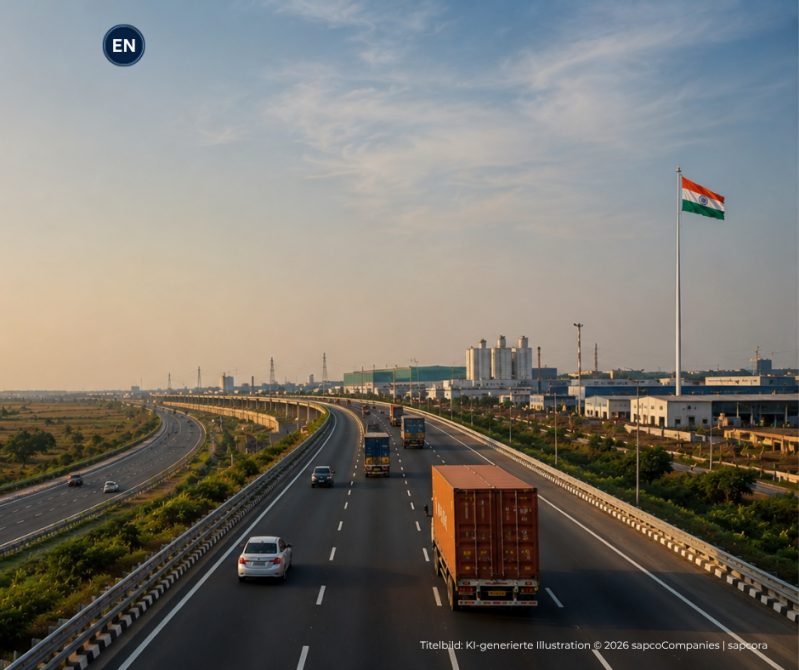
Delhi-Mumbai Expressway Becomes a Major Economic Corridor. Delhi gains direct access to the Delhi-Mumbai Expressway as new sections advance across India. The project is beginning to reshape logistics, industrial investment and regional connectivity, even as important gaps remain.
Kommentar hinzufügen
Kommentare