

Section: Geopolitics
Format: Special Report
Author: Sinisa Brkic (sb)
Jared Kushner has emerged as one of the most consequential intermediaries in Donald Trump’s foreign policy. He is involved in efforts to move negotiations over Ukraine forward, has sat across from Vladimir Putin in Moscow and has recently held talks with both Israel and Hamas over Gaza. The breadth of those assignments reveals more than Kushner’s return to diplomacy. It shows how strongly Trump is concentrating some of America’s most sensitive negotiations in the hands of people he trusts personally.
Ukraine puts Kushner back on the front line
Ukrainian President Volodymyr Zelenskyy said this week that he had held a detailed and constructive conversation with Kushner and U.S. envoy Steve Witkoff. The two sides are working to finalize dates for a visit to Ukraine as Washington tries to create new momentum around efforts to end Russia’s war. The timing is significant. Ukraine remains under sustained Russian attack, territorial disputes continue to block a settlement and neither Moscow nor Kyiv has indicated that the central political conditions for ending the war have been resolved. Russian strikes on Kyiv and the surrounding region killed 12 people on September 1, reinforcing how far the military reality remains from the language of peace negotiations.
For Kushner, the Ukraine mission is not a symbolic assignment. He has already been directly involved in negotiations with Russia and has met President Vladimir Putin at the Kremlin alongside Witkoff. A four hour meeting in Moscow in January focused on the possible framework for negotiations, with the Kremlin insisting that territorial questions remained central to any lasting agreement. That places Kushner in an unusually sensitive position. He has now been part of conversations with the leadership in Moscow, Washington and Kyiv as the United States attempts to construct a path toward negotiations that all three sides could accept.
Moscow remains the hardest test
Any American attempt to move the war toward a settlement faces a fundamental obstacle. Russia and Ukraine are not simply divided over the mechanics of a ceasefire. They remain separated by questions of territory, sovereignty, security guarantees and the future strategic position of Ukraine.
Moscow has repeatedly insisted that territorial issues must be resolved on terms acceptable to Russia. Ukraine, meanwhile, has sought credible security guarantees and has rejected arrangements that would leave the country vulnerable to renewed aggression. Those differences cannot be overcome through personal relationships alone.
Kushner’s access nevertheless matters because Trump’s negotiating structure places unusual weight on direct presidential channels. When Kushner and Witkoff enter a room, foreign governments understand that they are speaking with people who have immediate access to the president and who can carry proposals back to him without passing through the full hierarchy of the American diplomatic system. That can accelerate negotiations. It can also concentrate extraordinary responsibility in a very small circle.
Gaza shows the scale of Kushner’s mandate
Kushner’s diplomatic reach is not confined to Europe. In August, he traveled through the Middle East as part of the Trump administration’s effort to revive its stalled plan for Gaza, meeting Hamas leadership in Egypt and Israeli Prime Minister Benjamin Netanyahu in Israel.
The talks ended without a breakthrough. Israel and Hamas remained divided over the sequence of disarmament, Israeli withdrawal and the implementation of a broader American framework for Gaza. Netanyahu insisted that Hamas must fully disarm before Israeli forces withdraw, while Hamas demanded that Israel first comply with ceasefire commitments and begin withdrawing its forces. Kushner’s involvement is particularly striking because direct American engagement with Hamas represents a significant departure from Washington’s traditional approach toward the organization, which the United States designates as a terrorist group. Trump authorized Kushner and Witkoff to engage directly as Washington sought to secure a ceasefire, the release of hostages and a broader political arrangement.
Those contacts are not without precedent. Kushner and Witkoff also participated in talks with Hamas representatives in October 2025 that contributed to a ceasefire agreement and the release of remaining hostages. The current negotiations show that the White House continues to regard personal engagement as an important instrument even when dealing with actors Washington has traditionally kept at a distance.
From the Abraham Accords to crisis diplomacy
Kushner’s role did not begin with Trump’s second presidency. During Trump’s first term, he became one of the administration’s central figures on Middle East policy and played a major role in the diplomatic effort that produced the Abraham Accords between Israel and several Arab states.
At the time, critics questioned whether a presidential relative without a traditional diplomatic career should hold such influence over American foreign policy. Supporters argued that his direct access to Trump and relationships across the Middle East allowed him to operate in ways conventional diplomatic structures could not. That debate has returned in a more consequential form. Kushner is no longer dealing primarily with normalization agreements between states seeking closer relations. He is now operating around active wars, disputed territory, military withdrawals, disarmament and security guarantees. The difference is substantial. Negotiating political normalization is difficult. Negotiating the terms under which armed actors stop fighting is considerably harder.
Trump’s diplomacy is becoming deeply personal
Kushner’s expanding role also illustrates a broader feature of the Trump presidency. Foreign policy is increasingly being conducted through trusted individuals whose authority rests heavily on their relationship with the president. Steve Witkoff has become one of the clearest examples. Kushner now operates alongside him on issues that would traditionally involve several layers of the State Department, National Security Council, intelligence agencies and professional diplomatic corps. The logic is unmistakable. Trump values negotiators he knows, trusts and believes can speak directly on his behalf. Foreign leaders, in turn, know that access to those negotiators can provide a shorter route to the president.
There are advantages to such a system. It can reduce bureaucracy, accelerate communication and allow negotiators to test politically sensitive proposals discreetly. It may also create opportunities when formal diplomatic relationships have become too rigid to produce movement.
The risks are equally clear. Foreign policy conducted through a narrow personal network can become dependent on individual relationships, presidential confidence and informal channels. Complex agreements also require technical expertise, institutional memory and mechanisms capable of surviving beyond the personalities who negotiated them.
Access creates influence, not necessarily agreement
Kushner’s unusual strength is access. He can speak with Trump directly, has met Putin, communicates with Ukrainian leadership and has participated in negotiations involving Netanyahu and senior Hamas figures. Few people outside the formal leadership of the American government have operated across such a broad range of politically explosive relationships. That makes Kushner influential, but influence should not be confused with success.
The Gaza negotiations demonstrate the distinction. Kushner can bring opposing sides into a diplomatic process and establish channels that might otherwise remain closed. He cannot, however, eliminate the strategic calculations that keep Israel and Hamas apart. The same applies to Ukraine. Kushner and Witkoff may help define proposals, carry messages between capitals and test whether compromises are politically possible. They cannot manufacture agreement over territory, security and sovereignty where the principal parties remain fundamentally divided.
A foreign policy built around trust
Kushner’s return therefore tells a larger story about the way Trump exercises power internationally. The president is building a diplomatic architecture in which personal confidence can matter almost as much as formal office.
That approach is not entirely new in American history. Presidents have long relied on trusted advisers and private envoys for sensitive negotiations. What distinguishes the current model is the range and significance of the issues being entrusted to the same small group of intermediaries. Ukraine involves the future security architecture of Europe and the relationship between Washington and Moscow. Gaza involves Israel, Hamas, Arab governments, reconstruction, regional stability and the credibility of American influence in the Middle East. Kushner now operates across both theaters.
His position therefore goes far beyond the familiar description of Trump’s son in law. Family proximity may explain the foundation of his access, but years of negotiations have turned that access into political capital of its own.
The results will determine Kushner’s place
The coming weeks may show whether that capital can be converted into diplomatic progress. A visit to Ukraine would deepen Kushner’s direct involvement in negotiations at a moment when Washington is trying to determine whether a credible path toward ending the war still exists.
Gaza presents a parallel challenge. The Trump administration has a framework, working groups and direct channels to the principal actors, but the central dispute over disarmament and Israeli withdrawal remains unresolved. Kushner is therefore operating in a space where access is exceptional and expectations are high, but outcomes remain uncertain. His growing importance is already evident. Whether his diplomacy produces agreements durable enough to survive political pressure and continued violence is a much harder question.
For Trump, the experiment is equally consequential. His administration is placing extraordinary faith in personal diplomacy and in negotiators whose authority comes directly from presidential trust. Jared Kushner is becoming one of the clearest embodiments of that model. From Moscow to Kyiv and Gaza, the test is no longer whether Kushner can get into the room. He already can. The question is whether he can help change what happens once the doors close.
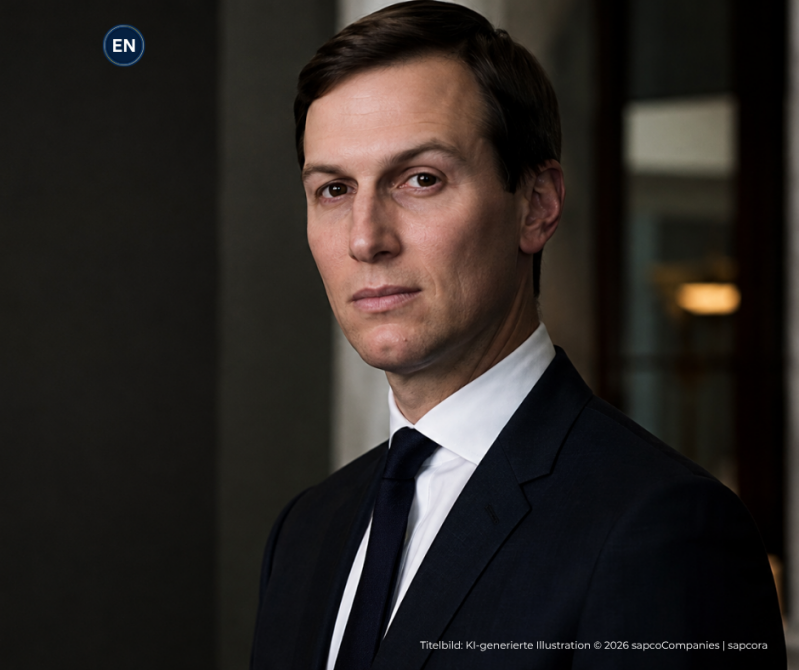
Jared Kushner at the Center of Trump’s Global Diplomacy. Jared Kushner is playing an expanding role in Trump’s diplomacy, from Ukraine and Moscow to Gaza, revealing a highly personal model of American foreign policy.