

Section: Energy
Format: Special Report
Author: Sinisa Brkic (sb)
Two very large crude carriers transporting a combined four million barrels of Saudi oil were struck by unidentified projectiles while sailing out through the Strait of Hormuz within minutes of each other. The attacks on the Sidr and Senegal Prosperity expose a new vulnerability in a shipping corridor already operating under extraordinary pressure. The immediate concern extends beyond damage to two vessels. If heavily loaded tankers carrying Saudi crude can be attacked during outbound passage, the question is no longer simply whether Hormuz remains technically navigable. It is whether major Gulf oil exports can move through the corridor with sufficient security and commercial predictability to sustain regular trade.
Two loaded VLCCs struck within minutes
The Saudi flagged Sidr and the Liberian flagged Senegal Prosperity were traveling outbound through the Strait of Hormuz when they were struck within minutes of one another near Khasab, Oman. Both vessels are very large crude carriers, or VLCCs, among the largest tankers used in international oil transportation. The Sidr was hit roughly 16.6 nautical miles northeast of Khasab. Minutes later, the Senegal Prosperity was reported struck by three projectiles approximately 17 nautical miles east of the Omani port.
Maritime security authorities separately confirmed a tanker had been hit by three projectiles in the same location. No crew casualties were reported, and there was no confirmed major environmental impact following the strikes. The proximity in time and location gives the incidents a significance beyond two isolated maritime attacks. Both vessels were carrying major crude cargoes, both were leaving the Gulf, and both were operating through one of the most strategically sensitive energy corridors in the world.
Four million barrels of Saudi crude at risk
Each tanker had loaded approximately two million barrels of Saudi crude at the Juaymah terminal before departure. Together, the two ships were carrying roughly four million barrels. That cargo is central to the importance of the incident. Saudi Arabia is one of the world’s largest oil exporters and remains a critical supplier to international crude markets, particularly in Asia. A security threat directed at vessels carrying Saudi oil therefore has consequences far beyond the value of the individual ships involved.
The attacks connect the military instability surrounding Hormuz directly with the reliability of Saudi export flows. Until now, the broader crisis has already constrained Gulf energy shipments severely. Successful strikes on two major outbound crude carriers introduce another level of commercial and strategic uncertainty.
Hormuz was already operating far below normal
The Strait of Hormuz entered the current crisis as one of the most important energy chokepoints on earth. In the fourth quarter of 2025, approximately 21.6 million barrels per day of crude oil and petroleum liquids moved through the waterway. By the second quarter of 2026, that figure had fallen to about 4.9 million barrels per day. The decline illustrates the extent to which military confrontation, restrictions on shipping and changing trade routes have already altered the energy geography of the Gulf.
Daily vessel movements remain exceptionally low. Preliminary tracking data for Monday showed only five vessels passing through the strait, compared with a recent ten day average of about 14. Ships operating without active transponders are not fully captured by such counts, but the broader decline in commercial traffic is unmistakable. The latest attacks therefore did not strike a normal shipping route suddenly disrupted by violence. They occurred inside a corridor that has already lost much of its traditional traffic and where every successful crude movement carries greater strategic significance.
This is a qualitative escalation
The importance of the attacks cannot be measured simply by adding two more vessels to a list of maritime incidents. What matters is what they demonstrate. Two loaded VLCCs were struck within minutes during outbound passage. If commercial operators conclude that major crude carriers can be identified and engaged even while using a closely monitored transit corridor, the calculation surrounding Hormuz changes materially.
Shipowners must consider whether the revenue from a voyage justifies the physical exposure of vessels worth tens of millions of dollars. Charterers must assess potential delays and cargo losses. Insurers must price the possibility that attacks are no longer exceptional events but part of a recurring operating environment. A waterway does not need to be formally closed for commercial traffic to collapse. Shipping can retreat because risk becomes too expensive, too unpredictable or simply unacceptable.
The attacker has not been identified
There is currently no verified public attribution for the attacks on the Sidr and Senegal Prosperity. No responsible assessment can present Iranian involvement, or the involvement of any other actor, as established fact without evidence directly connecting that actor to the strikes. The distinction is essential because the wider conflict has produced competing military claims, reports of separate maritime incidents and rapidly circulating allegations. Events occurring in the same region and within the same security crisis are not automatically part of the same operation.
The location of the attacks and the broader military confrontation inevitably raise questions about responsibility. Those questions remain open until credible evidence, weapons analysis, intelligence findings or a substantiated claim of responsibility establishes who carried out the strikes. That uncertainty does not make the threat less serious. For shipping companies, uncertainty can make risk harder to manage because operators do not know which vessels may be targeted, what criteria are being used or whether further attacks are planned.
Saudi Arabia has alternatives, but not immunity
Saudi Arabia is better positioned than several other Gulf producers to reduce its dependence on Hormuz. Its East West pipeline carries crude from the country’s eastern production system to Yanbu on the Red Sea and provides a major alternative route for exports. The system has capacity of about seven million barrels per day, with roughly five million barrels per day available for exports. Saudi Arabia has already increased use of the western route as Hormuz traffic has contracted.
That infrastructure gives Riyadh strategic flexibility, but it does not make disruption in the Gulf irrelevant. Saudi production, processing, storage and export systems remain deeply connected to the country’s eastern energy infrastructure, while long established commercial flows from Gulf terminals cannot simply be replicated elsewhere without logistical consequences. The attacks therefore expose a vulnerability Saudi Arabia has spent years attempting to reduce rather than eliminate. Alternative pipelines can absorb significant volumes, but they do not make maritime security around Hormuz strategically unimportant.
The market is pricing renewed danger
Oil markets responded sharply as the security situation deteriorated. Brent crude settled at $94.65 a barrel on Tuesday, an increase of 4.6 percent, while West Texas Intermediate rose 5.2 percent to $90.22. The price move reflected the wider renewal of hostilities between the United States and Iran as well as renewed concerns over shipping and energy supply through Hormuz. The tanker attacks added another tangible indication that the risk to physical crude movements is no longer theoretical.
Markets have had months to adjust to constrained Gulf exports. Alternative routes, changes in production, inventory management and altered trading patterns have prevented every individual security incident from producing an immediate supply shock. That resilience has limits. The longer severe disruption persists, the more important confidence becomes. A market can adapt to reduced flows more easily than it can adapt to a transport system in which the security conditions surrounding individual cargoes become impossible to predict.
Insurance could determine how open Hormuz really is
The practical status of the Strait of Hormuz is not determined by naval control alone. It is also determined by insurers, shipowners, charterers, crews and commodity traders deciding whether a voyage remains commercially viable. War risk premiums can rise rapidly after successful attacks. Vessel owners can reject charters, crews can become harder to secure, and contractual terms can become more restrictive even when naval forces continue to declare a route navigable.
This distinction is critical. Governments may be able to escort ships, patrol sea lanes or respond militarily to attacks, but they cannot force private companies to accept unlimited commercial risk. For global energy markets, the decisive measure of whether Hormuz is functioning is therefore not whether an occasional tanker can pass through. It is whether large numbers of commercial vessels can do so reliably, repeatedly and at a cost that keeps ordinary trade viable.
The Omani corridor is increasingly exposed
The location of the attacks near Khasab places additional focus on the Omani side of the Strait of Hormuz. Oman has traditionally occupied a distinctive diplomatic position in Gulf security and has repeatedly played an intermediary role during regional crises. Geography offers no comparable neutrality. Khasab sits directly beside the maritime approaches used by vessels entering and leaving the strait, placing waters near Oman at the center of any attempt to preserve commercial movement.
As traffic patterns adjust and vessels seek routes considered comparatively safer, the Omani corridor becomes more important and potentially more exposed. An attack does not need to occur inside the narrowest part of the strait to undermine confidence in the entire passage. The Gulf of Oman and the approaches to Hormuz are consequently becoming part of the same security environment. For tanker operators, the relevant risk zone now extends beyond the formal boundaries of the chokepoint itself.
The greater danger is a pattern
Individual attacks can be absorbed by the global shipping system. A sustained pattern of attacks on major energy carriers would be far more disruptive. If VLCCs carrying Gulf crude are repeatedly struck, commercial behavior will begin to change before governments formally acknowledge that the security environment has fundamentally deteriorated. Freight rates, insurance premiums, vessel availability and cargo scheduling would all adjust to a higher baseline of risk.
That would have consequences far beyond Saudi Arabia. Asian refiners remain heavily exposed to Gulf supplies, European markets remain sensitive to shifts in global crude and refined product flows, and producers outside the region gain additional strategic value when their exports do not depend on Hormuz. The result would not necessarily be a sudden disappearance of Gulf oil from world markets. It could instead be a slower and more durable transformation in which every barrel that depends on Hormuz carries a larger security premium.
A warning that requires no speculation
The significance of the attacks does not depend on identifying the attacker before the evidence permits it. The confirmed facts are serious enough. Two of the world’s largest classes of crude carrier, loaded with approximately four million barrels of Saudi oil, were struck within minutes while leaving a maritime corridor already operating at a fraction of its previous capacity. No crew members were reported killed, but the strategic message for the shipping industry is difficult to ignore.
The central question is now whether this remains an exceptional event or becomes part of a recognizable pattern. If attacks on major outbound crude carriers become repeatable, Hormuz could remain geographically open while becoming increasingly unreliable as a commercial energy artery. For the global oil market, that distinction is decisive. The real measure of an open Strait of Hormuz is not whether a ship can make it through, but whether the world’s energy system can continue to depend on that passage with confidence.
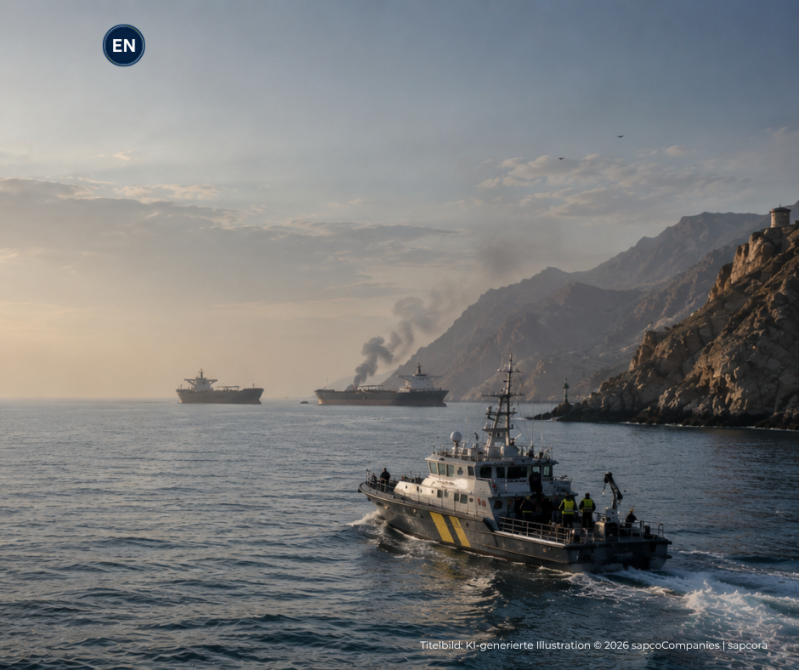
Saudi Crude Supertankers Hit Near Strait of Hormuz. Two supertankers carrying about four million barrels of Saudi crude were struck near the Strait of Hormuz, raising new concerns over shipping security, Saudi oil exports and global energy markets.