

Section: Geopolitics
Format: Special Report
Author: Sinisa Brkic (sb)
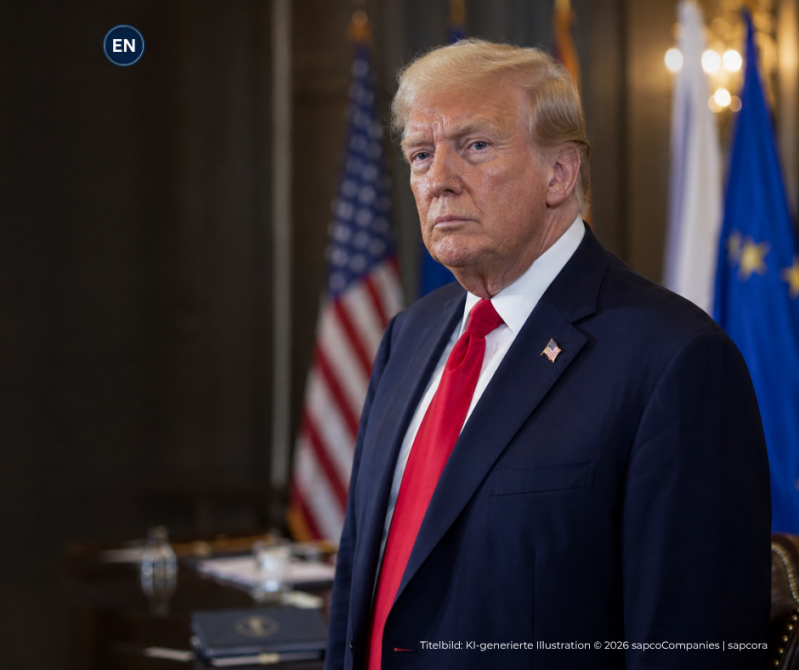
President Donald Trump wants Europe to reimburse the United States for military assistance and ammunition previously supplied to Ukraine, introducing a new financial dimension into an already strained transatlantic security debate. At the same time, Washington is giving priority to its own ammunition requirements as pressure on American inventories grows. No formal repayment demand, binding mechanism or established European obligation has yet been presented, but the political message is unmistakable: the White House wants to reopen the question of who ultimately pays for the security commitments of the past.
Trump turns the burden sharing debate backward
Donald Trump has spent years demanding that European governments assume a greater share of the cost of their own security. His latest intervention goes considerably further. Rather than focusing exclusively on future defense expenditure or new weapons deliveries, the U.S. president is now raising the possibility that Europe should compensate Washington for military assistance the United States has already provided to Ukraine. Speaking on September 3, Trump said the United States would ask European countries to pay for earlier American military assistance and ammunition. He referred to hundreds of billions of dollars that, in his account, had been supplied without payment and argued that European countries could have covered those costs.
The statement shifts the terms of the dispute. Until now, the central argument surrounding transatlantic burden sharing has largely concerned future responsibility, including how much European NATO members should spend, how much support they should provide to Ukraine and how rapidly Europe should expand its defense industrial capacity. Trump is now introducing retrospective financing into that equation.
A political demand, not yet a European debt
The distinction between asking for reimbursement and establishing a legal obligation is crucial. There is currently no publicly disclosed amount that individual European governments have formally been ordered to pay, nor has the administration announced how any retrospective reimbursement would be calculated or distributed.
There is also no publicly confirmed mechanism that automatically converts previously authorized American assistance to Ukraine into debt owed by European states. Earlier U.S. support was provided through American political decisions, congressional funding and established security assistance authorities, rather than through a publicly known arrangement under which European governments guaranteed subsequent repayment.
That makes the language surrounding Trump’s announcement particularly important. The president has opened the door to a demand for money, but he has not demonstrated that Washington is attempting to collect an existing European liability. At this stage, the move is better understood as a political attempt to redefine the financial balance of past support. Should the administration proceed beyond rhetoric, it would need to answer fundamental questions about legal authority, valuation, allocation and enforcement. Until those questions are addressed, the proposal remains politically significant but institutionally incomplete.
Europe is already carrying more of the cost
Trump’s intervention comes at a time when the financial structure of Western support for Ukraine has already changed substantially. European governments and Canada have assumed a much larger share of security assistance, while NATO has developed arrangements allowing allies to finance military equipment sourced from the United States for delivery to Ukraine.
Under NATO’s Prioritised Ukraine Requirements List, allies can fund packages of American weapons and ammunition identified as priorities for Ukraine. By June 2026, NATO allies had committed more than $6 billion for U.S. sourced military equipment through that mechanism.
At the NATO summit in Ankara in July 2026, alliance members also pledged €70 billion in military equipment, assistance and training for Ukraine during the year and committed to maintaining at least an equivalent level in 2027. NATO has explicitly stated that European allies and Canada now finance the vast majority of security assistance to Ukraine through bilateral and multilateral channels. Those developments matter because they show that the shift Trump has long demanded is already under way. Europe is paying more, procuring more and assuming a larger share of the financial burden. The new question raised by Washington is whether that rebalancing should apply only to present and future commitments or also be extended backward.
Retrospective payment would change the political logic
There is a fundamental difference between financing a weapons package before it is delivered and being asked to contribute to assistance after the political decision to provide it has already been made. The first is a negotiated transaction or burden sharing arrangement. The second risks reopening decisions that were previously understood as sovereign American contributions to a common strategic objective.
That distinction could have consequences far beyond Ukraine. Alliances depend not only on treaties and military capabilities, but also on predictability. Governments need to know whether commitments made during a crisis will remain politically settled or whether their financial terms may later be reconsidered by a new administration.
If Washington were to establish a practice of retrospectively reallocating the cost of security assistance, European governments would have to factor that possibility into future cooperation. Assistance presented at one moment as an American strategic contribution could potentially be treated at another as an expense to be recovered from partners. Such a transformation would not necessarily weaken the alliance by itself, but it would make its internal economics more explicitly transactional. That is precisely why Trump’s statement deserves attention even before any invoice is issued.
Ammunition is becoming part of the argument
The reimbursement proposal was accompanied by another important signal. Trump indicated that the United States is currently retaining a larger share of ammunition for its own armed forces instead of selling it to allied countries, although he said sales would resume later.
The immediate background is pressure on U.S. military inventories, including demands created by the conflict with Iran. American ammunition production is therefore no longer merely an industrial issue. It has become a strategic constraint affecting what Washington can supply, what it is prepared to sell and how it prioritizes its own military requirements against those of allies.
This adds a second dimension to the dispute with Europe. The question is no longer simply who has enough money to purchase weapons. It is increasingly about whether the weapons exist in sufficient quantities and whether Washington is prepared to release them. For European governments, that creates a more demanding security environment. Higher defense budgets can increase procurement capacity, but financial commitments cannot immediately solve production bottlenecks or replace industrial capacity that takes years to build.
Money alone cannot solve the weapons problem
The war in Ukraine has exposed the scale of the challenge facing Western defense industries. Ammunition expenditure in sustained high intensity warfare can exceed the assumptions around which peacetime production systems were designed, while advanced air defense missiles, precision weapons and other critical systems often require lengthy production cycles.
The additional demands placed on American inventories by conflict elsewhere underline a problem Europe can no longer treat as temporary. Dependence on U.S. military production provides access to some of the world’s most advanced weapons systems, but that access is ultimately constrained by American production capacity and American strategic priorities. Trump’s decision to emphasize domestic requirements makes that hierarchy explicit. When U.S. forces need scarce ammunition, allied demand may not come first.
That reality strengthens the argument for a larger European defense industrial base, but it also exposes the limits of rapid strategic autonomy. Europe can increase spending significantly faster than it can create factories, skilled workforces, supply chains and production volumes capable of replacing American capacity.
A difficult calculation for European capitals
If Washington eventually turns Trump’s statement into a formal request, determining what Europe should supposedly repay would be politically difficult. American military assistance to Ukraine has taken different forms, including equipment drawn from existing inventories, procurement of new systems and broader support connected to the U.S. military presence and operations in Europe. Assigning those costs retrospectively to European governments would require a formula that does not currently exist. It would also raise the question of which countries should pay and according to what measure, whether economic size, NATO membership, previous contributions to Ukraine or some other criterion.
Any such calculation would inevitably encounter Europe’s own record of assistance. European states and institutions have provided substantial military, financial and humanitarian support to Ukraine, while individual countries have carried sharply different burdens depending on geography, economic capacity and national policy. A narrow calculation based only on American expenditure would therefore become politically contentious almost immediately. European governments could reasonably insist that any discussion of burden sharing account for the broader allied contribution rather than treating U.S. assistance in isolation.
Trump is applying a commercial logic to strategic commitments
The announcement fits a broader feature of Trump’s approach to alliances. Security commitments are repeatedly examined through the language of costs, payments and measurable national return. Defense relationships that previous administrations often described primarily in strategic terms are more likely under Trump to be framed as transactions in which the distribution of financial responsibility becomes a central test of fairness.
That approach has already influenced NATO. European defense spending has risen sharply, governments have accelerated procurement and the political expectation that Europe must assume greater responsibility for its own security is now firmly established across the alliance.
The new element is the attempt to apply the same logic retrospectively. If Trump pursues reimbursement for assistance already provided, the administration would no longer be negotiating only the price of future American engagement. It would be seeking to revise the financial interpretation of earlier decisions. That would represent a meaningful change in the transatlantic conversation. The argument would move from how the alliance should divide tomorrow’s costs to whether yesterday’s costs can still be renegotiated.
The consequences could extend beyond Ukraine
For Ukraine, the immediate issue remains access to weapons and ammunition. Any dispute between Washington and European capitals over payment would become more consequential if it delayed procurement, complicated transfers or reinforced American reluctance to release scarce military stocks. For NATO, however, the larger issue is confidence in the rules governing allied cooperation. The alliance can accommodate intense disagreements over spending, procurement and strategic priorities. It becomes more difficult when governments are uncertain whether the terms surrounding past support can later be reopened.
Europe therefore faces two related pressures. It must finance a growing share of its own defense while also reducing vulnerabilities created by excessive dependence on American weapons and production capacity. Neither objective can be achieved quickly, even if the political decision to pursue them has already been made. Washington, meanwhile, faces its own calculation. Greater European responsibility can reduce the American burden, but an increasingly transactional alliance may also encourage European governments to build defense structures designed to depend less heavily on the United States.
The invoice does not exist yet, but the message does
Trump has not presented Europe with a formal bill for past Ukraine aid. No specific repayment figure, binding formula or confirmed legal obligation has been made public, and it remains unclear whether the administration will turn the president’s statement into a concrete diplomatic initiative. The significance of the announcement lies elsewhere. Washington is signaling that the financial terms of transatlantic security are open to negotiation on a scale that may no longer stop at future commitments.
Europe has already begun paying more for Ukraine, more for NATO and more for its own defense. Trump is now asking whether it should also pay for part of what America provided before that transition took place.
If the White House formalizes that demand, the dispute will no longer be about rhetoric. It will become a test of whether the United States and Europe still agree on what constitutes a shared security commitment, and where the account for that commitment ultimately ends.
Ukraine Aid: Trump Seeks European Repayment. Donald Trump wants Europe to reimburse the United States for earlier military aid to Ukraine, raising new questions over NATO burden sharing, defense financing and American weapons policy.