

Section: Energy
Format: Special Report
Author: Sinisa Brkic (sb)
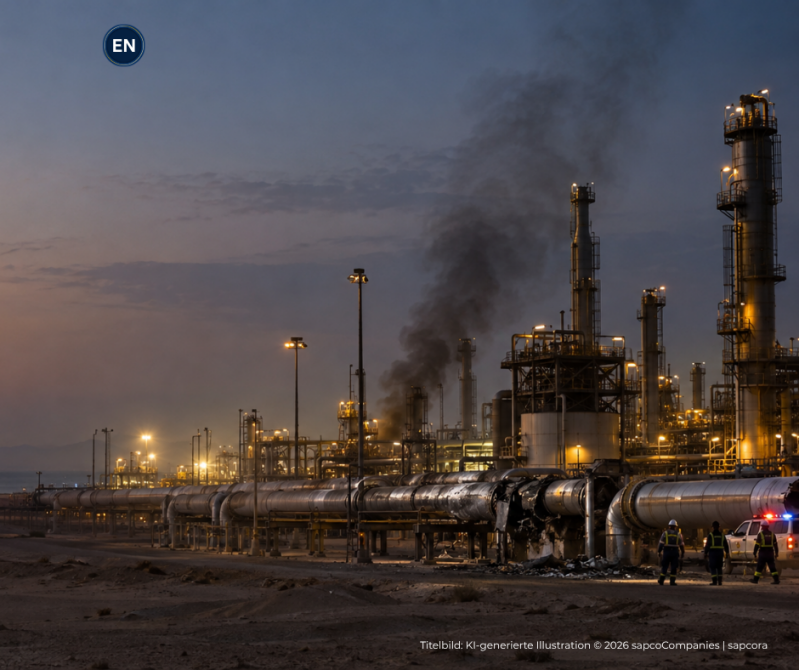
Saudi Arabia has temporarily shut down its strategic East West Pipeline after a drone attack struck infrastructure along the route, putting one of the most important alternatives to the Strait of Hormuz under pressure. The pipeline had become a critical route for millions of barrels of crude each day as the conflict severely disrupted Gulf shipping. At the same time, Houthi forces have strengthened their position around Bab el Mandeb, raising the risk that two vital energy corridors could come under serious pressure at once.
The route designed to bypass Hormuz has been hit
Saudi Arabia’s East West Pipeline, also known as Petroline, exists for precisely the type of strategic emergency now confronting the region. The roughly 1,200 kilometer route allows crude produced near the Persian Gulf to move across the kingdom toward the Red Sea, reducing dependence on the Strait of Hormuz. That function has become substantially more important during the current conflict. With normal shipping through Hormuz severely disrupted, Saudi Arabia has relied increasingly on its western infrastructure to keep crude moving toward international markets. The pipeline has recently transported approximately 4 million to 5 million barrels of oil per day. That volume is equivalent to roughly 4 to 5 percent of global oil supply and makes the route far more than a domestic Saudi infrastructure asset.
The drone attack therefore struck one of the mechanisms designed to prevent disruption around Hormuz from developing into an even more severe global supply crisis. Saudi Arabia says the pipeline was shut as a precaution while technical teams assess the damage and the security situation. There is currently no confirmed indication that the entire pipeline system has suffered permanent damage, and the duration of the shutdown remains uncertain. Even a temporary closure, however, demonstrates that the alternative route itself has become vulnerable.
Saudi Arabia and Iraq confirm where the drones came from
Saudi authorities say multiple drones launched from Iraqi territory struck facilities associated with the East West Pipeline, causing injuries and material damage. Iraq has also confirmed that the attack originated from its territory and has begun investigating how the operation was carried out. Baghdad has responded with security measures, including the dismissal of a military commander following the investigation into the launches. The Iraqi government now faces a serious political and security problem because attacks originating from its territory risk drawing the country further into a regional confrontation it has strong reasons to avoid.
What has not been publicly established is equally important. There is currently no publicly verifiable evidence proving that Iran directly ordered the attack. President Donald Trump has said Iran was probably responsible. That assessment goes beyond the evidence made public so far, even though armed groups aligned with Tehran operate inside Iraq and Iranian influence across regional militia networks remains substantial. Influence, affiliation and direct operational command are not interchangeable facts. The distinction is particularly important in a conflict where attribution could itself determine whether another military front opens.
Bab el Mandeb creates a second strategic pressure point
The pipeline attack would already constitute a significant energy security event on its own. Its importance rises sharply because it coincides with another escalation at the southern entrance to the Red Sea. Houthi forces aligned with Iran have advanced to the strategic island of Perim in the Bab el Mandeb Strait. Their position increases their leverage around a maritime passage connecting the Red Sea with the Gulf of Aden and the Indian Ocean.
Bab el Mandeb has not been confirmed as completely closed to international shipping. NEWSMEDIA therefore does not describe the route as subject to a general blockade. A waterway does not need to be formally closed before serious economic disruption begins. Missile threats, drone attacks, vessel seizures and the possibility of military confrontation can increase insurance costs, alter shipping decisions and convince commercial operators to avoid routes they consider too dangerous. For Saudi Arabia, this development is particularly consequential because the Red Sea has become more important precisely as the kingdom seeks alternatives to severely disrupted Gulf shipping. The result is an increasingly dangerous configuration in which the route designed to bypass one chokepoint now leads toward another maritime corridor facing its own security threat.
The real danger is the loss of alternatives
Global energy security depends on more than production volumes. Oil must also move from fields to terminals, from terminals to ships and ultimately from producing regions to consumers. Pipelines, ports, shipping lanes and alternative export routes provide redundancy. That redundancy allows the global system to absorb disruption in one location without immediately facing a systemic shortage.
Saudi Arabia’s East West Pipeline is one of the clearest examples of that principle. If Hormuz becomes unsafe, oil can move west across the kingdom, while Red Sea terminals provide another route into international markets. The current escalation places both parts of that strategy under pressure. If the pipeline remains unavailable while insecurity around Bab el Mandeb intensifies, Saudi Arabia’s ability to redirect exports becomes substantially more complicated. Production facilities could remain operational while the number of secure routes available to move that production toward customers continues to shrink. That is why the latest attack cannot be understood merely as another strike on energy infrastructure. The strategic question is whether alternative routes can continue functioning as alternatives when several critical corridors face pressure at the same time. Once redundancy begins to disappear, the resilience of the entire supply system weakens.
Four to five million barrels a day matter globally
The volumes normally moving through the East West Pipeline give the incident immediate international importance. Approximately 4 million to 5 million barrels per day are significant enough to command the attention of governments, traders, shipping companies and energy producers worldwide. The actual impact will depend heavily on how long operations remain suspended. A brief precautionary shutdown followed by a secure reopening would produce a very different outcome from repeated attacks, prolonged disruption or extensive infrastructure damage.
Duration is therefore one of the most important variables to watch. So is Saudi Arabia’s ability to protect the route against another attack once operations resume. Markets must assess not only whether damaged infrastructure can be repaired, but whether the pipeline can operate reliably in a security environment where further strikes remain possible. That uncertainty has economic consequences even before a physical shortage emerges. Oil markets price not only the barrels available today, but also the probability that future supplies may become less reliable. A major transportation route that can no longer be regarded as secure changes that calculation.
A global energy crisis is no longer a remote risk
A prolonged disruption across several major routes would not remain confined to crude oil trading. Energy runs through transportation, aviation, agriculture, manufacturing, chemicals and logistics, giving an oil shock the capacity to spread rapidly through the wider economy. If significant volumes become harder or more expensive to move, fuel prices can rise alongside freight, insurance and security costs. Businesses then face higher operating expenses, while households encounter the consequences through transportation, food, consumer goods and services.
What begins as a geopolitical oil shock can therefore evolve into a broader energy and inflation problem. The decisive issue is not one pipeline outage in isolation, but the possibility of simultaneous pressure across Hormuz, Saudi Arabia’s western pipeline system and the Red Sea. One disruption can often be compensated for through alternative routes, strategic inventories or spare capacity. Several overlapping disruptions can begin to remove those alternatives and reduce the system’s ability to absorb the next shock. That is the point at which the character of the crisis changes. The question is no longer only how high the price of oil may rise, but how reliably energy can continue moving through the global economy.
The inflation threat would spread far beyond oil
A sustained energy shock would arrive at an uncomfortable moment for governments and central banks. Energy costs move quickly through modern economies because transportation and logistics sit behind almost every physical product. Higher crude prices can increase fuel costs for trucks, aircraft, ships and agricultural machinery. Companies may absorb some of those costs temporarily, but persistent increases eventually move through supply chains and reach consumers.
Central banks face a particular problem under such conditions. Monetary policy can reduce demand, but it cannot repair a pipeline, secure a maritime chokepoint or guarantee the safe passage of tankers through a conflict zone. That creates the possibility of renewed inflation without the type of economic overheating that conventional interest rate policy is best equipped to control. Consumers and businesses could face higher prices precisely because the physical supply system has become less efficient, more expensive and more dangerous. A severe energy shock could therefore confront policymakers with an unpleasant combination of weaker growth and renewed price pressure. The greater the disruption to shipping and infrastructure, the harder that balance becomes to manage.
Europe would not remain insulated
Europe is not facing an immediate supply emergency simply because Saudi Arabia has temporarily shut one pipeline. The continent has diversified parts of its energy system since the crisis that followed Russia’s invasion of Ukraine, while governments maintain strategic reserves and emergency mechanisms. A prolonged Middle Eastern disruption would nevertheless create a different category of pressure. Oil remains essential to road transport, aviation, agriculture, logistics and large parts of industrial production.
Europe would therefore feel a severe oil shock through far more than gasoline and diesel prices. More expensive shipping could raise the cost of imported goods, aviation could face additional pressure, food distribution could become more expensive and industrial companies could encounter another period of severe uncertainty. The larger concern appears when separate disruptions begin interacting. An energy crisis does not automatically cause a blackout, and an oil shortage does not automatically shut down telecommunications, supermarkets or electricity networks. Those distinctions must remain clear. Serious crises can nevertheless place several systems under pressure simultaneously and reduce the capacity available to absorb unrelated technical, cyber or infrastructure failures. Transport problems can affect supply chains, fuel shortages can complicate logistics and extreme costs can alter industrial behavior. When the wider system is already under strain, disruptions that would normally be manageable can become much harder to contain.
PreparedEuropeSystem.com addresses the household side of resilience
At this point, the debate moves from strategic energy security to practical resilience. Governments, utilities and emergency services are responsible for stabilizing public systems, but households still need to remain capable of functioning during periods in which normal services become unreliable. PreparedEuropeSystem.com addresses that private layer of preparedness. It does not attempt to solve an energy shortage, stabilize electricity grids or replace the responsibilities of governments, network operators and emergency organizations.
Editorial disclosure: PreparedEuropeSystem.com belongs to Prepared Europe by sapcoCompanies. The author of this Special Report, Sinisa Brkic, is also responsible for the Prepared Europe project, so NEWSMEDIA is explicitly identifying the connection rather than presenting the following section as an independent third party product recommendation.
Prepared Europe develops physical preparedness systems for households. The concept focuses on organizing information, responsibilities, emergency procedures and individual household planning before a serious disruption occurs. The underlying principle is straightforward. A household should not have to begin planning only after electricity, communications, transportation or ordinary supply chains have already become unreliable.
A physical system when digital access cannot be assumed
Prepared Europe follows a physical first approach. Central information, immediate action cards, checklists, household data and planning structures are kept in a physical format that does not depend entirely on a functioning internet connection, cloud service or continuously charged device. That approach reflects a basic vulnerability of modern emergency planning. Digital information is extremely useful while electricity and communications remain available, but a preparedness system intended for infrastructure disruption should not rely exclusively on the same infrastructure that may be affected.
The Prepared Europe concept is designed to move important decisions forward in time. Households can determine responsibilities, identify missing resources and organize essential information before a crisis places them under pressure.
Its purpose is therefore organizational rather than technical. The system does not generate electricity, store water, provide food, replace medication or substitute for emergency equipment. It also does not replace official warnings, professional medical advice, technical expertise or instructions from public authorities. A physical preparedness system can structure decisions, but actual resilience still depends on appropriate supplies, individual circumstances and the practical preparation of the household itself.
From an energy shock to a household emergency
A global energy crisis does not automatically become a household emergency. Higher oil prices alone do not cause electricity grids, supermarkets or communications networks to stop functioning. The risk increases when several disruptions begin reinforcing each other. Fuel shortages can affect transportation, transportation problems can affect deliveries and widespread infrastructure stress can make secondary disruptions harder to manage.
For households, the consequences of a serious emergency are often highly practical. Questions quickly shift toward drinking water, food, medication, lighting, communication, heating, vulnerable family members, pets and access to reliable information. PreparedEuropeSystem.com is designed around that point of transition. Its role begins where a broad systemic crisis becomes a concrete organizational problem inside a household. This does not make private preparedness a substitute for functioning public infrastructure. It makes it a second layer of resilience when normal public and commercial systems temporarily cannot provide their usual level of service.
Preparedness does not mean predicting catastrophe
The attack on Saudi Arabia’s pipeline does not prove that Europe is heading toward a blackout or a severe household supply emergency. Neither NEWSMEDIA nor Prepared Europe makes such a prediction. Preparedness follows a different logic. A serious emergency does not need to be inevitable before preparation becomes rational.
Governments maintain strategic reserves without claiming shortages are certain. Companies establish continuity plans without predicting exactly when a failure will occur, while critical infrastructure operators prepare emergency procedures because complex systems cannot be guaranteed against every possible disruption. Household resilience follows the same principle on a smaller scale. Preparing for an interruption is not the same as predicting one. PreparedEuropeSystem.com therefore belongs in this debate as a household preparedness instrument, not as a promise of protection and not as a solution to the geopolitical crisis itself. Its purpose is to increase organizational readiness if a wider disruption eventually reaches everyday life.
Saudi Arabia shows why redundancy matters
The current crisis offers an unusually clear illustration of the value of alternatives. Saudi Arabia’s East West Pipeline was not built because the Strait of Hormuz was expected to fail every day, but because dependence on a single strategic route creates vulnerability. When Hormuz came under severe pressure, the pipeline became substantially more valuable. Now that the pipeline itself has been attacked, attention shifts toward the security of the Red Sea route it supports.
The principle applies at different scales. A country needs alternative export routes, a company needs continuity plans and a household needs ways to remain functional when one or more systems it normally depends on become unavailable. Resilience is not the ability to guarantee that nothing will fail. It is the ability to prevent one failure from immediately becoming a complete loss of function. That is where strategic energy security and private preparedness meet. Both depend on alternatives being established before they are urgently needed.
Saudi Arabia faces a narrowing strategic corridor
The attack also exposes a difficult geopolitical reality for Riyadh. Saudi Arabia has invested heavily in positioning itself as a stable economic, energy and logistics center while attempting to limit its direct exposure to regional conflict. Its energy infrastructure is central to that strategy. The kingdom’s ability to supply global markets reliably provides enormous economic value and significant geopolitical influence.
The current conflict challenges that position from several directions. Pressure around Hormuz affects access to the east, Houthi gains increase risk around the Red Sea to the west and drone attacks originating from Iraqi territory introduce another security problem from the north. Saudi Arabia cannot solve such a configuration merely by redirecting tankers. The problem increasingly concerns the security of the transport network itself. That represents a more complex challenge than the temporary loss of a single facility. Protecting production is no longer enough if the routes required to move that production become progressively more exposed.
Washington faces another escalation dilemma
The developments also sharpen the choices confronting the United States. Washington has major interests in protecting freedom of navigation, preventing another severe energy shock and limiting attacks against strategic Saudi infrastructure. Direct military involvement against the Houthis or other forces aligned with Iran would carry substantial risks of its own. A wider intervention could deepen an already dangerous regional confrontation and create additional opportunities for retaliation. The economic consequences of restraint could also grow if energy routes become progressively less secure. Washington therefore has to balance the desire to contain the conflict against the possibility that deteriorating security around major energy corridors will impose increasingly severe costs on the global economy.
That calculation becomes harder as more alternative routes come under pressure. Protecting one chokepoint is fundamentally different from stabilizing a network of pipelines, ports and shipping lanes across a widening conflict zone.
Iran remains the most dangerous unanswered question
The temptation to connect the Saudi pipeline attack, armed groups inside Iraq and Houthi operations around the Red Sea into a single centrally directed Iranian strategy is understandable. Iran maintains important relationships with armed actors across the region, and its influence remains a central element of the conflict. The evidence currently available does not justify collapsing those relationships into a proven chain of direct command. The drones that struck Saudi infrastructure originated from Iraqi territory, while forces aligned with Iran operate in Iraq and the Houthis have simultaneously strengthened their position around Bab el Mandeb.
Those facts do not publicly prove that Tehran directly ordered the Saudi pipeline attack. Any assertion of direct Iranian responsibility therefore requires evidence beyond regional affiliation and political influence. The distinction is not semantic. If Saudi Arabia or the United States were to establish direct Iranian responsibility and respond militarily, the political and security consequences could become considerably greater than those arising from the infrastructure damage itself. Attribution may therefore become one of the most consequential elements of the next phase. A mistake in that assessment could accelerate an already dangerous escalation.
Markets now have to price geography
Oil markets usually focus on production, inventories, refinery capacity and consumption. The current crisis is forcing them to price geography and military vulnerability just as seriously. Hormuz is under severe pressure, Saudi Arabia’s principal bypass route has been temporarily shut after an attack and the Red Sea corridor connected to that bypass faces a growing security challenge around Bab el Mandeb. None of those developments alone guarantees a global energy crisis.
Together, however, they reduce the margin for error. The more alternatives that become uncertain, the greater the economic consequences of the next disruption. The first development to watch is whether Saudi Arabia can restore secure operations through the East West Pipeline. The second is whether the security situation around Bab el Mandeb begins producing substantially greater disruption to commercial shipping. The third is whether attacks on Saudi energy infrastructure continue. The fourth is attribution, because evidence establishing direct state involvement could transform an energy security crisis into another stage of military escalation.
The crisis is no longer only about Hormuz
For months, one question has dominated the energy consequences of the Middle East conflict: what happens if the Strait of Hormuz can no longer function normally? The attack on Saudi Arabia’s East West Pipeline changes that calculation because the kingdom’s western route exists in large part to reduce precisely that vulnerability. The alternative route is now temporarily shut while the maritime corridor it serves faces an increasingly serious security challenge. The immediate issue is therefore larger than the physical damage to one piece of Saudi infrastructure.
It concerns the gradual erosion of the alternatives designed to keep energy moving when the primary route becomes unreliable. A crisis at one chokepoint can often be mitigated, but pressure on a chokepoint and its principal alternative at the same time is considerably more dangerous.
If those pressures persist, repeat or spread, the world could move beyond an oil price shock toward a broader energy crisis with consequences for inflation, industry, transportation, supply chains and economic stability. Europe cannot prevent that geopolitical escalation on its own, and individual households certainly cannot solve it. What governments, companies and citizens can influence is their resilience when normal assumptions stop holding. At the strategic level, that means diversified energy routes, reserves and secure infrastructure. At household level, it means preparation that remains usable when ordinary systems are temporarily unavailable.
That is the specific gap PreparedEuropeSystem.com is designed to address. It cannot prevent the crisis, but it can structure household preparation for the point at which a systemic disruption begins to affect everyday life. The attack on Saudi Arabia’s oil lifeline is therefore more than another event in an expanding Middle Eastern conflict. It is a warning about what happens when the systems created to provide alternatives begin losing their own margin of safety, and in a global energy system dependent on a small number of critical routes, that margin may now matter more than ever.
Global Energy Crisis Risk Rises After Saudi Pipeline Attack. Saudi Arabia shuts a key oil pipeline after a drone attack as pressure on Hormuz and the Red Sea raises the risk of a wider global energy crisis.