

Section: Security
Format: Report
Author: Sinisa Brkic (sb)
NATO fighter jets have shot down a drone that entered Lithuanian airspace overnight, marking the first reported interception of its kind over the Baltic country. Lithuanian authorities say the aircraft most likely entered from Belarus, but its origin, operator and purpose have not been established. Investigators are examining the wreckage as officials seek to determine whether the incursion was accidental, deliberate or connected to military activity in the region.
Italian fighters intercept drone over Lithuanian territory
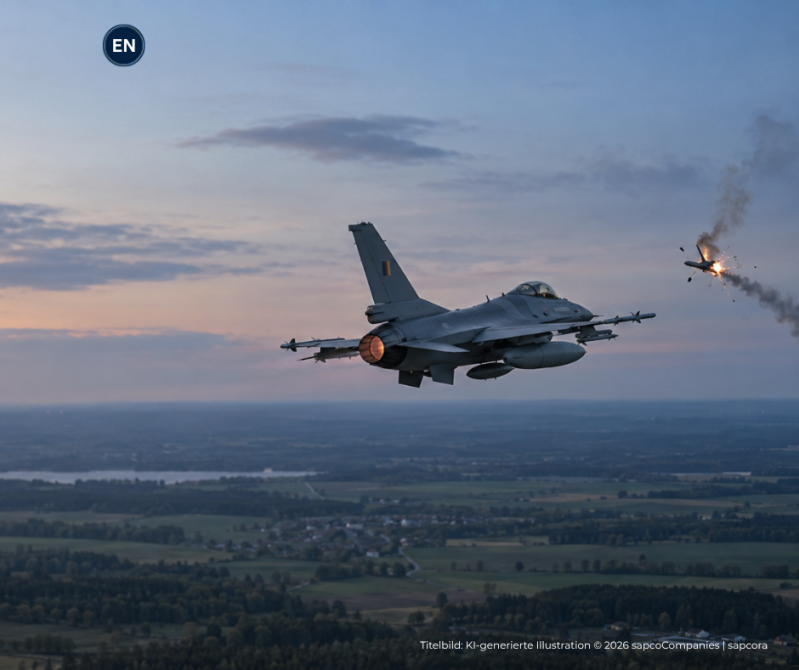
The incident unfolded shortly after midnight on September 15, when Lithuanian authorities detected an object moving toward the country and activated air defense procedures. Warning messages were issued in Vilnius and surrounding areas as NATO aircraft were sent to intercept the unidentified aircraft. According to the Lithuanian military, Italian fighter jets operating from Šiauliai Air Base destroyed the drone at around 12:20 a.m. local time. The aircraft were deployed as part of NATO’s Baltic Air Policing mission, which provides continuous protection of the airspace of Lithuania, Latvia and Estonia. The drone was brought down near the village of Pratkūnai in the Kaišiadorys district, west of Vilnius. Lithuanian military police, national police and specialist teams secured the area after debris was located and began examining the wreckage. No casualties or damage to civilian property have been reported.
First such shootdown in Lithuanian airspace
Lithuania’s military said the incident marked the first time a drone had been shot down in the country’s airspace. That distinction gives the episode broader significance at a time when NATO members along the alliance’s eastern frontier are confronting an increasingly complex mix of drones, missiles, military aircraft and other aerial threats. Previous incidents have often resulted in aircraft being monitored, tracked or recovered after entering or approaching NATO airspace. In this case, allied combat aircraft were ordered to engage and destroy an unidentified drone after it crossed into the territory of a member state. The decision represents a clear operational response rather than a precautionary observation mission. It also demonstrates how quickly NATO forces stationed in the Baltic region may now be required to move from detection to interception when the intent of an aircraft cannot immediately be determined.
Drone most likely entered from Belarus
Vilmantas Vitkauskas, head of Lithuania’s National Crisis Management Center, said preliminary information indicated that the drone most likely entered Lithuanian territory from Belarus. It remained in Lithuanian airspace for roughly 30 minutes and passed near populated areas before being intercepted. That flight path does not establish the aircraft’s nationality or operator. There is currently no confirmed evidence that the drone was Belarusian, Russian or controlled by the armed forces of either country. Lithuanian officials have repeatedly cautioned against drawing conclusions before the investigation is complete. Authorities are examining the wreckage to identify the aircraft, determine its technical specifications and establish its intended mission. Any attribution to Russia or Belarus would require evidence from that investigation.
Air force commander says explosives were likely on board
One detail under examination could significantly affect the assessment of the incident. Lithuanian Air Force commander Antanas Matutis said after the wreckage was found that the drone was likely carrying explosives. The statement does not yet establish whether the aircraft was an attack drone, whether any explosive material was armed or whether Lithuania was its intended target. Investigators will need to determine the drone’s design, payload, navigation systems and possible flight route before those questions can be answered with confidence.
The possibility of an explosive payload nevertheless raises the stakes. An unidentified aircraft carrying explosives inside NATO airspace presents a materially different security threat from a civilian drone, an unarmed reconnaissance platform or a navigation error involving a small unmanned aircraft. For that reason, the technical findings from the wreckage will be central to understanding the seriousness of the incursion.
NATO’s eastern flank faces a more difficult air defense environment
Lithuania occupies one of the most sensitive positions on NATO’s eastern frontier. It borders Belarus and Russia’s Kaliningrad region and sits close to an area where military activity has intensified substantially since Russia’s full scale invasion of Ukraine. The growing use of unmanned aircraft has complicated air defense across the region. Drones can be difficult to identify rapidly, their flight paths may be affected by electronic warfare or navigation failures, and their intended targets are not always apparent before they approach populated or strategically sensitive areas.
That uncertainty creates a difficult operational problem for NATO states. Authorities must distinguish between an accidental intrusion, a lost aircraft, reconnaissance activity and a potential attack while having only limited time to decide whether interception is necessary. The Lithuanian incident shows how that calculation is changing. Once an unidentified drone enters NATO airspace and is assessed as a sufficient threat, monitoring alone may no longer be considered an adequate response.
Attribution will determine the wider consequences
The immediate military threat has been neutralized, but the political significance of the incident remains unresolved. Much will depend on what investigators can establish from the recovered components and flight data. If the aircraft proves to have been a civilian or uncontrolled platform, the episode could remain primarily an airspace security incident. If evidence links it to a state military program, reconnaissance operation or deliberate strike mission, the consequences would be considerably more serious.
Confirmation that it was a Russian or Belarusian military drone would fundamentally change the character of the event. It would mean that NATO fighter aircraft had destroyed military equipment associated with another state after it entered the sovereign airspace of an alliance member. There is not yet sufficient evidence to make that claim. That distinction is essential. The incident is already significant without attribution that investigators have not established.
A clear change in NATO’s response
For NATO, the most important confirmed development is therefore not the still unknown identity of the drone but what happened once it entered Lithuanian airspace. Allied fighter aircraft were activated, the target was intercepted and the threat was destroyed over the territory of a NATO member. The episode illustrates the increasingly direct security consequences of instability along the alliance’s eastern border. It also shows that the line between monitoring regional military activity and actively defending NATO airspace can narrow within minutes.
The next stage will be forensic rather than operational. Lithuanian investigators must now determine what the drone was, where it came from and why it crossed into the country. Until those answers are available, restraint in attribution remains as important as readiness in the air. What is already established, however, is notable enough: NATO has moved from observing another unexplained aerial incursion to destroying the aircraft after it entered allied territory.
NATO Shoots Down Drone Over Lithuania After Airspace Incursion. NATO fighter jets have shot down a drone over Lithuania after it entered the country’s airspace, most likely from Belarus. Its origin and purpose remain under investigation.