

Section: Finance
Format: Article
Author: Sinisa Brkic (sb)
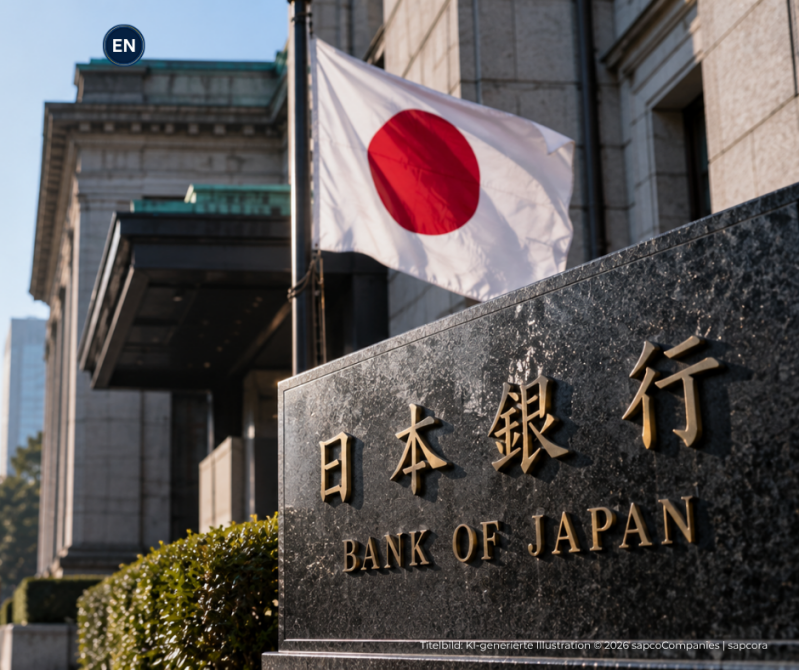
The Bank of Japan has raised its key interest rate from 1.00 percent to 1.25 percent, taking borrowing costs to their highest level since 1995. The decision marks another significant step away from the ultra-low interest rate policy that shaped Japan for decades and supplied global financial markets with an exceptional source of cheap capital.
Japan Moves Further Away From the Era of Ultra-Low Rates
TOKYO. The Bank of Japan raised its key interest rate by 25 basis points on Friday, September 18, bringing the rate to 1.25 percent and its highest level in 31 years. The decision was approved by a 7 to 2 vote at the conclusion of the central bank’s two-day monetary policy meeting. The increase had been widely expected by financial markets, but its significance extends beyond the immediate decision. Japan is continuing to dismantle a monetary policy framework that made the country one of the world’s most important sources of exceptionally cheap financing for much of the past three decades.
For years, the Bank of Japan stood apart from other major central banks. While the United States and Europe moved through repeated cycles of monetary tightening and easing, Japan maintained extremely low and at times negative interest rates in an effort to overcome persistent weak inflation and sluggish domestic demand. That environment has changed substantially. Inflation risks, higher energy costs and a weaker yen have given policymakers a different problem to manage, shifting the focus from generating price growth toward preventing inflation from becoming too persistent.
Inflation Has Changed the Bank of Japan’s Calculation
The latest increase reflects growing concern that inflationary pressure could remain stronger than the Bank of Japan considers consistent with long-term price stability. Japan spent years struggling to generate sustainable inflation around the central bank’s 2 percent target, but the policy challenge has changed as higher import costs and broader price pressures have altered the economic environment.
The balance remains difficult. Energy costs, government measures and currency movements can create significant short-term distortions in Japanese inflation, while domestic wage and price developments remain critical to determining whether higher inflation is becoming entrenched. The September decision therefore represents more than a technical adjustment in borrowing costs. It reflects a central bank increasingly prepared to use conventional monetary tightening after decades in which persistent deflation posed the greater threat.
The Pace of Normalization Is Accelerating
The decision follows the Bank of Japan’s previous increase from 0.75 percent to 1.00 percent in June. Two rate increases within three months underscore how significantly Japan’s monetary environment has shifted. For much of the country’s recent history, attempts to normalize monetary policy proceeded cautiously and were repeatedly interrupted by weak economic conditions. The current sequence shows that policymakers are prepared to move rates higher when they judge inflation risks to be increasing, while still emphasizing the need to assess economic conditions at each policy meeting.
At 1.25 percent, Japanese interest rates remain low compared with several other major economies. The direction of policy, however, is becoming increasingly important for international investors because the consequences extend far beyond Japanese households, businesses and government financing.
Ueda Leaves the Timing of Further Hikes Open
Bank of Japan Governor Kazuo Ueda said there is no predetermined schedule for additional rate increases. Future decisions will instead be made meeting by meeting, with the central bank assessing economic conditions and the outlook for inflation around its 2 percent target.
Ueda also indicated that the Bank of Japan’s challenge has changed. Where policy was once focused on lifting underlying inflation toward 2 percent, the central bank must now pay greater attention to the risk that inflation could move too far above that level and damage the economy. His comments offer no fixed timetable for the next move. They do, however, confirm that further tightening remains possible if economic and price developments continue to justify higher borrowing costs.
Why Higher Japanese Rates Matter Beyond Japan
Japan occupies an unusual position in the global financial system. Its exceptionally low borrowing costs helped make the yen a favored funding currency for so-called carry trades, in which investors borrow in a low-yielding currency and deploy that capital into assets offering higher returns elsewhere. That strategy can become less attractive as Japanese rates rise. If the gap between Japanese interest rates and those available in other major markets narrows, the economics of borrowing cheaply in yen can change, potentially affecting currency positions and international capital flows.
A single 25 basis point increase does not dismantle the global carry trade. What matters is the broader trajectory, because sustained increases in Japanese borrowing costs would gradually weaken one of the assumptions that has shaped global capital allocation for years. The yen is central to that calculation. The currency weakened following the latest rate decision as investors focused on the cautious tone surrounding the future pace of tightening, illustrating that higher rates alone do not automatically translate into a stronger currency.
Global Central Banks Confront Renewed Inflation Pressure
Japan’s decision comes during a period in which inflation risks have again become a central concern for monetary policymakers internationally. Elevated energy prices have complicated the outlook and increased the risk that higher production and transport costs feed through to businesses and consumers. The United States has also tightened monetary policy this week, reinforcing a broader shift among major central banks confronting renewed price pressures. For Japan, which relies heavily on imported energy, the combination of high commodity prices and currency weakness carries particular significance.
A weaker yen raises the local cost of imported goods and energy, creating an additional channel through which external price pressures can enter the Japanese economy. That makes the interaction between monetary policy, exchange rates and energy markets particularly important for the Bank of Japan.
The End of an Exceptional Monetary Era
Japan is not suddenly becoming a high interest rate economy. A policy rate of 1.25 percent remains modest by international standards, and the Bank of Japan continues to face structural economic constraints that argue against aggressive tightening. What is changing is more fundamental. The assumption that Japanese money will remain exceptionally cheap almost indefinitely is becoming increasingly difficult to sustain.
For decades, ultra-low Japanese rates were not simply a domestic policy choice. They became part of the architecture of global finance, influencing currencies, bond markets, investment strategies and international capital flows. The latest increase does not complete Japan’s monetary transition. It does, however, make clear that one of the longest periods of extraordinary monetary policy in the modern financial system is steadily moving toward its end.
Bank of Japan Raises Rates to 31-Year High. The Bank of Japan raises its key interest rate to 1.25 percent, the highest level in 31 years, as Japan moves further away from decades of ultra-low rates.