

Section: Technology & AI
Format: Analysis
Author: Sinisa Brkic (sb)
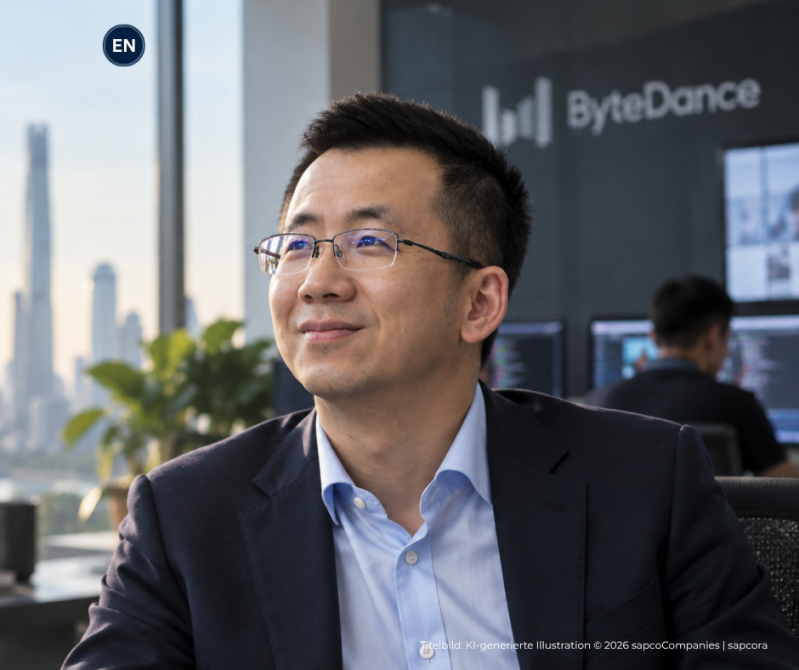
ByteDance founder Zhang Yiming has risen to the top of Asia’s wealth rankings with an estimated fortune of more than $105 billion. His ascent is more than another reshuffling among the world’s billionaires. It reflects a wider shift in how some of Asia’s largest fortunes are being created, as artificial intelligence and digital platforms challenge the traditional dominance of industry, energy, infrastructure and real estate.
A Fortune Above $105 Billion
Zhang Yiming, the 43 year old founder of ByteDance, has become Asia’s richest person with an estimated net worth exceeding $105 billion. His fortune has increased dramatically from the roughly $13 billion recorded when he first appeared on the Bloomberg Billionaires Index in 2019. The scale of that rise is striking, but the number requires context. ByteDance remains privately held, meaning Zhang’s wealth cannot be calculated from a continuously traded public share price. Much of the estimate reflects the value assigned to his ownership stake through private market transactions and valuations by major investors. That distinction matters because an estimated fortune is not the same as cash that could immediately be realized. Even so, the direction is unmistakable: investors are assigning increasingly high value to one of the world’s most powerful private technology companies.
TikTok Built the Platform, AI Is Expanding the Story
ByteDance became a global force through TikTok and its Chinese counterpart Douyin. Their recommendation systems changed the way hundreds of millions of people consume short form video and helped establish algorithmic personalization as one of the defining features of modern social media. But TikTok alone no longer explains ByteDance’s valuation. The company has expanded aggressively into artificial intelligence, developing products such as the Doubao AI assistant and the Seedance video generation model while increasing spending on chips, computing capacity and data center infrastructure. Doubao has emerged as one of China’s most prominent consumer AI products, while Seedance places ByteDance directly into the rapidly developing market for generative video. The company that built its global success on recommendation algorithms is now attempting to convert that technological base into a broader AI ecosystem. For ByteDance, that transition could determine the next phase of its growth. TikTok created global reach, but artificial intelligence is increasingly shaping how investors assess the company’s future value.
ByteDance Is Spending at AI Scale
The company’s ambitions are visible in the scale of its planned investment. ByteDance is expected to spend heavily on artificial intelligence infrastructure, with projected capital expenditure reaching as much as $70 billion in 2026. That places the company among a relatively small group of technology businesses capable of financing AI development at enormous scale. Competitive artificial intelligence increasingly depends not only on software expertise, but also on access to advanced chips, computing power, data centers and the financial capacity to sustain years of intensive investment. ByteDance has reinforced that position by securing a $29.6 billion loan from nearly 30 banks. The facility was expanded from an initial target of $20 billion after strong lender demand and is one of the largest corporate loans raised in Asia this year. The financing is particularly notable because it is unsecured. For a privately held company, access to capital on that scale signals considerable confidence among international lenders in ByteDance’s financial strength and long term prospects.
TikTok’s US Crisis Did Not Derail ByteDance
Zhang’s rise comes after years in which TikTok’s future in the United States appeared deeply uncertain. The platform became a central issue in Washington over data security, ownership and the role of Chinese technology companies in the American digital market. The dispute ultimately resulted in ByteDance giving up control of TikTok’s US operations after a prolonged political and legal battle. What once appeared capable of severely damaging the company, however, did not derail ByteDance’s broader expansion. That outcome is significant because the TikTok confrontation coincided with a period in which ByteDance was committing greater resources to artificial intelligence. Instead of retreating into its existing social media business, the company continued building capabilities in a sector that has become strategically important to both China and the United States. ByteDance therefore enters the next stage of its development as something larger than the company behind TikTok. Its future increasingly depends on whether it can establish itself among the companies shaping the global AI market.
Asia’s Wealth Map Is Changing
Zhang’s rise also carries a broader economic significance. Many of Asia’s largest private fortunes were historically created through property, manufacturing, telecommunications, energy, ports, retail and large industrial conglomerates. Those industries remain central to the region’s economy, but digital technology is changing the structure of extreme wealth. A founder whose primary asset is a privately held technology company can now accumulate a fortune comparable to or greater than those built around vast portfolios of physical infrastructure.
Artificial intelligence could accelerate that shift further. Digital businesses can expand across markets with a speed that is difficult to reproduce in traditional industries, while successful platforms can reach hundreds of millions of users without building comparable physical distribution networks in every country. The emerging model of Asian corporate power is increasingly based on algorithms, computing infrastructure, data and intellectual property. Zhang’s position at the top of the wealth rankings is one visible expression of that transition.
Private Valuations Carry Their Own Risks
There is, however, an important limitation to any billionaire ranking involving ByteDance. Private company valuations are less transparent than the market capitalization of publicly traded businesses and can change substantially depending on the price assigned to relatively limited transactions. Zhang’s estimated fortune rose by more than $12 billion during September as new valuations from large investment firms were incorporated into calculations of ByteDance’s worth. Such movements illustrate how rapidly private market estimates can alter the apparent wealth of a founder without an equivalent amount of cash changing hands. That does not make the valuation irrelevant. It does mean that the $105 billion figure should be understood as an estimate of the value of Zhang’s ownership interest rather than a measurement of liquid assets.
The distinction is especially important when comparing technology founders with billionaires whose wealth is tied to publicly traded companies. The headline number may be precise, but the underlying valuation remains dependent on assumptions about what a private company is worth.
The Bigger Story Is ByteDance
Billionaire rankings attract attention because they reduce complex shifts in corporate power to a single number. The more consequential story behind Zhang Yiming’s rise is the transformation of ByteDance itself. What began as a Chinese technology startup became the owner of one of the world’s most influential consumer platforms. It is now committing enormous financial resources to artificial intelligence, advanced computing and the infrastructure required to compete in a technology race dominated by some of the largest companies on the planet. Zhang may not remain Asia’s richest person indefinitely. Billionaire rankings move with markets, valuations and investor sentiment. But the forces behind his ascent are less temporary: the center of wealth creation is moving deeper into software, data, computing power and artificial intelligence. That shift matters far beyond one founder’s fortune. Zhang Yiming’s rise shows how rapidly a digital platform can become an industrial power in its own right, and how decisively AI is beginning to reshape the economic hierarchy of Asia.
Asia’s Richest Person: TikTok Founder Zhang Yiming Rises on ByteDance AI Growth. TikTok founder Zhang Yiming has become Asia’s richest person with a fortune exceeding $105 billion as ByteDance expands aggressively into artificial intelligence.
Kommentar hinzufügen
Kommentare