

Section: Geopolitics
Format: Special Report
Author: Sinisa Brkic (sb)
The Strait of Hormuz and Bab el-Mandeb are two of the world’s most critical maritime chokepoints, and both are now under mounting geopolitical pressure. One is central to global energy flows, the other to trade between Asia, Europe and the Mediterranean. If instability deepens around both routes at the same time, the consequences could reach far beyond the Middle East and into energy markets, shipping costs and global supply chains.
Two Straits at the Center of Global Commerce
The Strait of Hormuz is one of the most important energy corridors in the world. It provides maritime access from the Persian Gulf to the Gulf of Oman and the Indian Ocean, making it essential for major oil and gas exporters including Saudi Arabia, Iraq, Kuwait, Qatar and the United Arab Emirates. Bab el-Mandeb plays a different but equally strategic role. Located between Yemen and the Horn of Africa, it connects the Gulf of Aden with the Red Sea and ultimately the Suez Canal. For ships moving between Asia and Europe, the passage forms part of one of the shortest and most commercially important maritime routes in the world.
The strategic significance of both waterways lies not only in the volume of traffic they carry. Their geography makes alternatives difficult, expensive or limited in capacity. Any serious disruption can therefore force shipping companies, energy producers and governments to absorb higher costs almost immediately. Neither strait has to become completely impassable for the economic effects to spread. Military threats, attacks on commercial vessels, rising insurance premiums and doubts over safe navigation can influence shipping decisions long before a formal closure occurs.
Hormuz Becomes an Instrument of Pressure
Iran has placed the Strait of Hormuz at the center of its confrontation with the United States. Tehran said on October 4 that the waterway would not fully reopen until conditions contained in an interim agreement with Washington were met, linking access to one of the world’s most important energy corridors directly to political negotiations. The situation is more complicated than a simple blockade. Commercial energy traffic has continued through the strait under restricted and uncertain conditions, including recent Iraqi crude shipments, while Gulf producers remain under pressure to maintain exports despite the wider conflict. That distinction is important. Hormuz does not need to be completely closed to become an effective geopolitical instrument. Uncertainty over access alone can influence oil prices, tanker movements, insurance premiums and the willingness of commercial operators to enter the area. For markets, the relevant question is therefore not merely whether ships can still pass. It is whether companies can rely on the route remaining sufficiently safe, predictable and commercially viable over the coming weeks and months.
Energy Markets Are Already Pricing the Risk
The instability around Hormuz is occurring in an energy market already struggling with the consequences of regional conflict. OPEC+ decided on October 4 to leave its November production targets unchanged, but actual output among several Gulf producers remains constrained by the disruption surrounding Iran and the strait. Oil prices have consequently remained elevated. The pressure reflects not only reduced or uncertain supply, but also the additional risk attached to moving crude through a corridor that has become part of a wider military and diplomatic confrontation. The global energy system has alternatives, but none fully replaces Hormuz. Pipelines can redirect some exports and governments can release strategic reserves during emergencies, yet neither option can absorb indefinitely the volumes normally transported by sea. This is precisely why the strait carries such enormous strategic weight. Its importance derives from the combination of geography, energy concentration and the limited capacity of alternative routes.
Bab el-Mandeb Returns to the Military Front Line
Several hundred miles to the southwest, the crisis around Bab el-Mandeb has entered a more openly military phase. Yemen’s internationally recognized government launched a major operation on October 4 aimed at retaking territory held by the Iran aligned Huthi movement. The offensive follows significant Huthi advances along Yemen’s Red Sea coast and around strategically important areas overlooking Bab el-Mandeb. Those gains increased concern that the group could strengthen its ability to influence or threaten maritime traffic moving between the Gulf of Aden and the Red Sea. The conflict therefore extends far beyond control of territory inside Yemen. Positions near the coast can provide surveillance, launch areas and military leverage over one of the world’s most important shipping lanes. That gives events in Yemen a global economic dimension. A battlefield that appears geographically remote from major industrial centers can influence commercial decisions in Europe, Asia and North America within hours.
Shipping Has Already Learned the Cost of the Red Sea
The Huthis have previously demonstrated how quickly insecurity around the Red Sea can alter international trade. Attacks and threats against commercial vessels prompted major shipping companies to divert traffic around the Cape of Good Hope rather than continue through Bab el-Mandeb and the Suez Canal. The alternative route is viable, but expensive. Sailing around southern Africa adds substantial distance to voyages between Asia and Europe, consuming more fuel and keeping ships, crews and cargo at sea for longer periods. Those additional days reduce the efficiency of the global shipping fleet. A vessel that spends longer completing one journey is unavailable for its next assignment, tightening effective transport capacity even when the number of ships in service remains unchanged. The consequences therefore extend beyond individual freight contracts. Higher transport costs can filter into industrial production, inventories, retail prices and ultimately inflation.
Saudi Arabia Faces a Wider Strategic Challenge
For Saudi Arabia, the renewed war in Yemen is inseparable from the security of the Red Sea. Riyadh supports the internationally recognized Yemeni government and has a direct interest in preventing the Huthis from consolidating control near Bab el-Mandeb. The challenge is particularly sensitive because the kingdom faces pressure on two maritime fronts. Hormuz is critical to Gulf energy exports, while the Red Sea has become increasingly important to Saudi economic and security strategy. A stronger Huthi position near Bab el-Mandeb would therefore create risks that extend beyond Yemen itself. It could threaten regional shipping while simultaneously increasing pressure on Saudi Arabia at a moment when the wider Gulf security environment is already strained. Military escalation, however, carries its own dangers. A broader campaign could weaken Huthi positions, but it could also provoke further missile and drone attacks and deepen a conflict that has already inflicted severe humanitarian damage on Yemen.
Europe Cannot Treat the Red Sea as a Distant War
For Europe, the security of Bab el-Mandeb is a direct economic interest. The Red Sea and Suez route remains one of the principal maritime connections between European markets and manufacturing centers across Asia. European governments have deployed naval forces to protect commercial shipping, but concerns about the scale of those efforts are increasing. Italy said in early October that the European Union’s existing naval contribution in the Red Sea remained insufficient and called for stronger commitments from other member states. The problem is not simply the protection of individual vessels. Commercial shipping depends on confidence that an entire corridor can be used regularly without unacceptable military, financial or insurance risk. If that confidence deteriorates, companies will reroute even while naval escorts remain available. Commercial decisions are ultimately driven by predictable risk, not merely by the presence of warships.
The Greater Danger Is Simultaneous Pressure
The most important feature of the current situation is the possibility that pressure around Hormuz and Bab el-Mandeb could intensify at the same time. The two waterways serve different functions, but together they sit at the heart of energy flows and trade linking the Gulf, Asia, Europe and the Mediterranean. Hormuz is particularly important for oil and liquefied natural gas exports. Bab el-Mandeb is critical to commercial shipping moving through the Red Sea and the Suez Canal. A simultaneous deterioration would therefore expose several parts of the global trading system at once. Energy markets could face supply uncertainty while container shipping and bulk trade encounter longer routes, higher freight costs and reduced capacity. The world economy would continue to function, but it would do so less efficiently and at greater expense. Resilience should not be confused with immunity.
Alternatives Exist, but Every Detour Has a Price
The international trading system is capable of adaptation. Ships can avoid the Red Sea by sailing around Africa, some Gulf energy exports can be redirected through pipelines, and governments can use strategic petroleum reserves during periods of acute disruption. These options are valuable precisely because they prevent a single chokepoint from shutting down the global economy. They do not, however, eliminate the cost of disruption. Longer routes consume more fuel and increase voyage times. Pipelines have finite capacity, while strategic reserves are emergency instruments rather than permanent replacements for normal commercial supply. The resulting economic burden can appear in multiple places at once. Freight rates rise, insurance becomes more expensive, delivery schedules become less reliable and energy prices incorporate an additional geopolitical premium.
Geography Has Become Power Again
For decades, globalization encouraged companies and governments to treat the world’s major sea lanes almost like permanent infrastructure. Supply chains were optimized around predictable transit times, low transportation costs and uninterrupted access to strategic waterways. Recent conflicts have exposed the fragility of that assumption. A regional state or armed movement does not need to dominate global commerce to influence it. The ability to threaten a narrow maritime passage can create leverage far beyond the actor’s economic or military weight. Hormuz and Bab el-Mandeb illustrate that reality with unusual clarity. Their strategic importance cannot simply be engineered away because the geography itself cannot be replicated. The world can build pipelines, ports and storage facilities. It cannot relocate the Persian Gulf or move the entrance to the Red Sea.
Global Trade Is Entering a More Fragile Era
The immediate questions concern Iran’s negotiations over Hormuz and the outcome of the renewed military campaign in Yemen. Decisions made in Tehran, Washington, Riyadh and Sana’a will determine whether pressure on the two waterways intensifies or begins to ease. The deeper problem will remain even if the current confrontations subside. Global trade has been designed around efficiency and predictable access to a relatively small number of strategic corridors, leaving the system highly productive but vulnerable when several of those routes come under pressure simultaneously. Hormuz and Bab el-Mandeb expose that weakness with exceptional clarity. What begins as a regional confrontation can quickly move through energy markets, shipping networks and industrial supply chains until the economic consequences are felt thousands of miles from the battlefield.
The conflict may be centered in the Middle East. The risk belongs to the global economy.
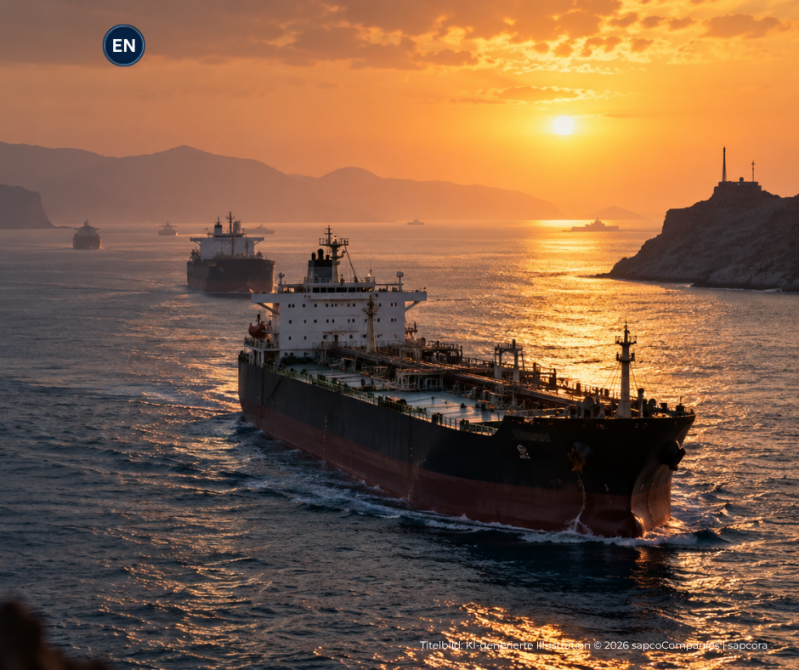
Hormuz and Bab el-Mandeb: Global Trade Under Threat. Rising tensions around Hormuz and Bab el-Mandeb expose a critical vulnerability in global trade, energy security and international shipping.
Kommentar hinzufügen
Kommentare