

Category: Finance
Format: News Article
Author: Sinisa Brkic (sb)
Date: October 15, 2026
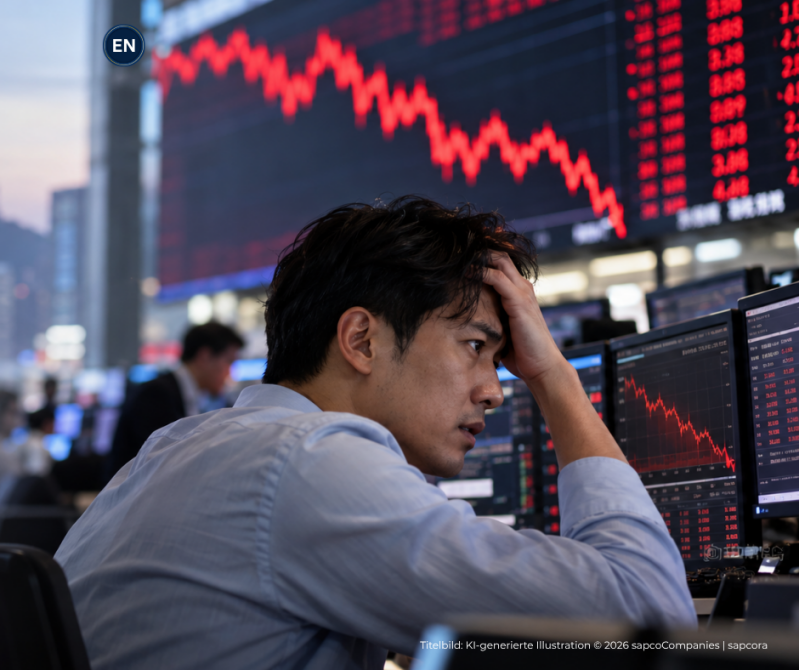
South Korea's stock market suffered a dramatic collapse Thursday, forcing authorities to temporarily suspend trading after the benchmark KOSPI index plunged more than 8%. Semiconductor giants Samsung Electronics and SK hynix led the selloff as mounting concerns over U.S. inflation and artificial intelligence investments sent shockwaves through Asian financial markets. The turmoil prompted an emergency response from South Korean financial authorities and exposed growing uncertainty surrounding the global technology sector.
Emergency Trading Halt After Historic Market Decline
South Korea's main stock exchange activated its circuit breaker mechanism on Thursday, October 15, after the KOSPI index dropped more than 8%, triggering an automatic 20-minute suspension of trading. At the height of the selloff, the benchmark had fallen as much as 9.29%, reflecting extraordinary pressure on one of Asia's most important financial markets. The disruption extended to the country's technology-heavy KOSDAQ market, where a decline exceeding 8% also triggered a temporary trading halt. Both exchanges resumed operations following the mandatory suspensions, which are designed to interrupt extreme market movements and prevent disorderly trading. By the end of the session, the KOSPI had recovered some of its intraday losses but still closed down 454.59 points, or 7.57%, at 5,554.22. The closing level was its lowest since April 7 and marked a seventh consecutive session of declines, the index's longest losing streak since September 2024. Thursday's emergency suspension was the first on the KOSPI since July 29 and the tenth circuit breaker activation of 2026. The repeated interventions illustrate the severity of volatility affecting a market that had previously attracted substantial investment through the expansion of artificial intelligence and semiconductor production.
Samsung and SK hynix Lead the Collapse
South Korea's semiconductor industry bore the brunt of the market downturn. Samsung Electronics ended the session down 9.5%, while SK hynix lost 11.1%, delivering another major setback to two companies central to the global technology supply chain. The losses carry particular significance because both manufacturers supply essential memory chips used in consumer electronics, cloud computing infrastructure and advanced artificial intelligence systems. Their importance to the KOSPI means sharp movements in their share prices can have an exceptionally large impact on the broader South Korean market. The selling pressure spread well beyond the semiconductor industry. Battery manufacturer LG Energy Solution declined 4.6%, while Hyundai Motor lost 5.7%, demonstrating that investors were reducing exposure across several major sectors of the economy. Foreign investors intensified the downturn by selling a net 3.6 trillion won, approximately $2.68 billion, in South Korean equities. The scale of these withdrawals highlighted the vulnerability of a market heavily exposed to changing international investment sentiment. Of the 917 stocks traded on the main exchange, 789 declined while only 113 advanced. The widespread losses confirmed that Thursday's disruption was not simply the result of weakness in a handful of technology companies.
Global Technology Selloff Spreads Across Asia
South Korea's market collapse followed another difficult session on Wall Street, where technology stocks came under pressure after stronger-than-expected U.S. inflation data renewed concerns about the future direction of interest rates. The Nasdaq Composite fell 1.9% on Wednesday, while the Philadelphia Semiconductor Index declined 4.3%. Major American technology companies suffered substantial losses, adding to concerns about the valuations of businesses closely associated with artificial intelligence development. The selling spread rapidly across Asia. Japan's Nikkei 225 fell approximately 5% during Thursday's trading, while Taiwan's Taiex declined around 3.4%. Equity markets in Hong Kong and mainland China also weakened, extending the downturn across several of the region's largest financial centers. The synchronized market reaction demonstrates how closely international technology investments have become connected. South Korean semiconductor manufacturers, American artificial intelligence developers and Taiwanese chip producers operate within overlapping supply chains, making them sensitive to changes in global investment expectations. South Korea was particularly exposed because of the substantial weight of Samsung Electronics and SK hynix in its benchmark index. Their steep losses amplified the broader market decline and placed Seoul at the center of the regional turmoil.
U.S. Inflation and AI Financing Concerns Shake Investor Confidence
The latest wave of selling followed the release of U.S. consumer price data showing that annual inflation accelerated to 3.7% in September, up from 3.4% in August. The increase exceeded economists' expectations and reinforced concerns that the Federal Reserve could be forced to maintain restrictive monetary conditions or raise interest rates further. For technology companies, the implications extend beyond the immediate cost of borrowing. Higher interest rates can reduce the valuations investors assign to future earnings, placing additional pressure on businesses whose share prices depend heavily on expectations of sustained growth. These concerns have become particularly important in the artificial intelligence industry. Companies are committing enormous financial resources to data centers, advanced semiconductors and computing infrastructure, while questions persist about how quickly those investments can produce sufficient profits. The latest market decline reflects growing investor scrutiny of that relationship. Strong demand for artificial intelligence technology does not automatically guarantee that every company involved in its development will generate returns sufficient to justify elevated valuations and extensive capital commitments. The distinction matters for South Korea's semiconductor sector. Although its manufacturers occupy strategically important positions in the global technology economy, their share prices remain vulnerable to changing expectations about future demand, investment spending and financing conditions.
Financial Authorities Respond to Growing Market Instability
The severity of Thursday's decline prompted South Korean financial authorities to convene an emergency meeting to assess market conditions. Officials pledged to respond proactively to instability and take measures aimed at protecting investors. The intervention came as market volatility climbed to its highest level since late August. Earlier regulatory efforts had sought to contain speculative activity, including risks associated with leveraged exchange traded funds tied to individual stocks. The latest disruption demonstrates the limits of such measures when international market conditions deteriorate sharply. Domestic safeguards can temporarily interrupt trading and reduce the risk of disorderly transactions, but they cannot eliminate the underlying pressures created by global capital movements, interest rate expectations and declining investor confidence. Nevertheless, the activation of a circuit breaker should not be confused with a financial system failure. The mechanism is a protective measure, and Thursday's trading resumed after the temporary suspensions. The more consequential question is whether the selloff represents a short-term adjustment in technology valuations or a deeper reassessment of the financial assumptions supporting the artificial intelligence investment boom.
A Critical Warning for Global Financial Markets
South Korea's collapse has brought renewed attention to the vulnerabilities of technology-driven equity markets. The country's semiconductor manufacturers remain essential to global computing infrastructure, yet their strategic importance has not shielded them from severe selling pressure. The next phase will depend heavily on developments in U.S. monetary policy, international investment flows and the financial performance of major technology companies. Investors will be watching whether corporate earnings and semiconductor demand can restore confidence after a prolonged period of market losses. Thursday's events do not establish that a wider financial crisis is inevitable. They do, however, reveal how quickly concerns about inflation, financing costs and artificial intelligence profitability can trigger extraordinary disruption across interconnected markets. South Korea's trading suspension has turned those concerns into a tangible market shock. What remains uncertain is whether the losses will stabilize or whether the reassessment of global technology investments has further to run. For financial markets already confronting persistent inflation and unusually high expectations for artificial intelligence, the events in Seoul represent a significant test of investor confidence.
South Korea Halts Trading After 8% Stock Market Crash. South Korea suspends stock trading after the KOSPI plunges over 8%. Samsung and SK hynix suffer heavy losses as the global tech selloff deepens.
Kommentar hinzufügen
Kommentare