

Category: Technology & AI
Format: Analysis
Author: Sinisa Brkic (sb)
What began in Shenzhen in 2016 as an ambitious robotics startup has developed into an internationally active technology company with a growing portfolio of intelligent machines. Pudu Robotics is advancing beyond conventional service robots into industrial automation, autonomous delivery, humanoid robotics, and emerging applications in security and infrastructure protection. As artificial intelligence increasingly enters the physical world, the company's development raises an important question for European businesses: where can robotics already deliver measurable value, and how will technology, economics, and regulation shape its future?
From an Ambitious Idea to an International Robotics Company
When Pudu Robotics was founded in Shenzhen, China, in January 2016, the commercial robotics industry was still searching for applications capable of moving intelligent machines beyond laboratories and highly structured manufacturing environments. Artificial intelligence, autonomous navigation, and advanced sensor technologies were progressing rapidly, but their integration into affordable and commercially useful robotic systems remained a substantial engineering challenge. The company emerged from the conviction that autonomous machines could perform repetitive physical tasks more efficiently while allowing people to concentrate on activities requiring judgment, communication, and individual attention. Its initial focus was deliberately practical: transporting food and other items through commercial environments where employees frequently spent considerable time moving between locations. Founder and CEO Felix Zhang brought a background in robotics research and technological entrepreneurship to the venture. Before establishing Pudu Robotics, he had been involved in other technology projects, including robotics development and the Chinese technology media sector, gaining experience at the intersection of engineering, product development, and commercial innovation.
The company's early strategy centered on developing autonomous robots that businesses could integrate into everyday operations without fundamentally redesigning their premises. This approach would become an important part of Pudu's subsequent international expansion. In March 2017, Pudu introduced its first delivery robot, PuduBot, marking the beginning of its commercial product development and international market activities. The system demonstrated how autonomous navigation, obstacle avoidance, and mobile transportation could be combined into a practical service solution. PuduBot also received the Red Dot: Best of the Best design distinction in 2017, an early recognition of the company's product development. More importantly, the platform helped establish the technological and operational foundations for subsequent generations of commercial robots. The following years brought additional products, international distribution partnerships, and growing demand from industries seeking to automate recurring transportation and service activities. What initially appeared to be a specialized market for restaurant robots gradually revealed opportunities across much broader sections of the economy.
A Decade of Expansion Across International Markets
Ten years after its foundation, Pudu Robotics has established a substantial international presence. According to the company's published figures, it has shipped more than 130,000 robotic units worldwide and operates across more than 85 countries and regions, with deployments extending to over 1,000 cities. Its commercial development has been accompanied by the expansion of research, manufacturing, and international business operations. Alongside its headquarters in Shenzhen, the company maintains research and development activities in Chengdu and Hong Kong and operates overseas subsidiaries serving markets including Europe, North America, and Asia. The company's history also reflects the increasing willingness of investors to support commercial robotics as an emerging industrial sector. Its financing history includes investments associated with major Chinese technology and investment organizations, providing capital for research, product development, manufacturing capacity, and international expansion. In March 2026, Pudu opened a new global headquarters in Shenzhen, incorporating an experience center designed to demonstrate commercial robotics technologies. The company also strengthened its presence in the United States with the establishment of its new American headquarters in Dallas. During 2026, Pudu announced nearly $150 million in additional financing, with the company reporting a valuation exceeding $1.5 billion. Although financing and valuation figures alone cannot establish commercial success, they illustrate the scale of investment being directed toward the next generation of intelligent robotic systems. Pudu's development reflects a broader transformation in the sector. Manufacturers increasingly recognize that long-term success depends not simply on producing sophisticated machines, but on delivering complete technological solutions supported by software, maintenance, customer service, and reliable integration into existing business operations. For European customers, these factors are particularly important. Robots introduced into security operations, industrial facilities, or logistics networks become part of essential workflows and must be supported throughout their operational life.
Four Business Areas, One Expanding Technological Ecosystem
Pudu Robotics now organizes its activities around four major product areas: service delivery, commercial cleaning, industrial delivery, and general embodied artificial intelligence. Service delivery remains an established part of the company's portfolio. Robots designed for restaurants, hotels, healthcare facilities, and office buildings transport goods across predefined routes while navigating around people and obstacles. Commercial cleaning represents another application with measurable operational potential. Autonomous cleaning robots can support the maintenance of shopping centers, transportation facilities, industrial premises, and other properties where large floor areas require recurring attention. Industrial delivery has become increasingly important as companies look to automate the transportation of components, materials, and finished products. Unlike conventional service robots carrying relatively small items, industrial platforms must accommodate heavier loads, more demanding operating conditions, and integration with manufacturing or warehouse management processes. The fourth business area, embodied artificial intelligence, represents a longer-term technological ambition. It concerns machines capable of combining physical movement, environmental perception, interaction, and increasingly flexible task execution. These areas share a technological foundation built around autonomous navigation, sensor processing, motion control, and software-based coordination. Pudu has developed proprietary capabilities across these disciplines, including navigation algorithms, multi-robot scheduling, motion controllers, and integrated robotic components. The strategic importance lies in their potential convergence. Improvements in perception, navigation, and machine intelligence may ultimately benefit multiple robotic platforms rather than remaining confined to individual products.
Artificial Intelligence Is Changing What Robots Can Become
For much of their commercial history, robots have performed highly specialized tasks within carefully defined operating conditions. Industrial machines assembled products, automated guided vehicles followed predetermined routes, and service robots transported objects between specified locations. The emergence of embodied artificial intelligence is changing the technological outlook. Unlike software systems operating exclusively in digital environments, embodied AI connects computational intelligence with physical machines. These systems must interpret information from the surrounding environment, plan appropriate actions, control mechanical movement, and respond to changing conditions. Pudu Robotics has adopted a development strategy described as "One Brain, Multiple Embodiments," reflecting its ambition to establish common intelligence capabilities across different robotic architectures. The concept recognizes that a delivery robot, a quadruped inspection platform, and a humanoid machine may require different mechanical designs while sharing elements of perception, reasoning, navigation, and interaction. During 2026, the company introduced PuduFM 1.0, an embodied intelligence foundation model, together with PuduAgent, a platform intended to support intelligent robotic applications. These developments indicate a shift toward software-defined robotics, where the intelligence governing a machine becomes increasingly important to its capabilities and future development. The practical challenge remains substantial. Physical environments are less predictable than digital systems, and reliable robotic operation requires precise coordination between software, sensors, motors, mechanical structures, and safety controls. Nevertheless, this direction represents one of the most consequential developments in contemporary automation. The next generation of robots may increasingly be evaluated according to the range of tasks they can perform rather than the single purpose for which they were originally designed.
Humanoid Robotics and the Next Stage of Development
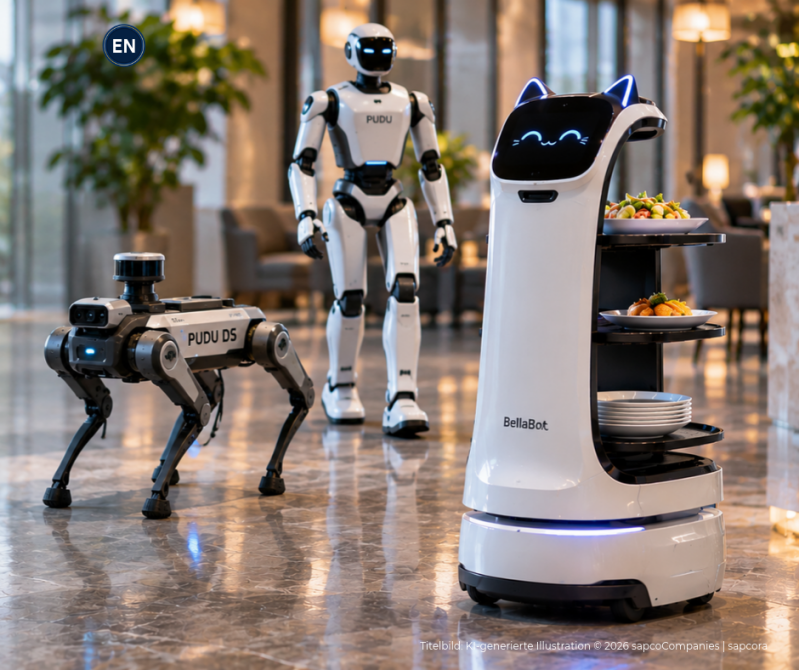
Pudu's expansion into humanoid and semi-humanoid robotics illustrates the company's long-term technological ambitions. The PUDU D9 is a full-size bipedal humanoid robot developed as part of the company's broader embodied AI program. Its development focuses on capabilities associated with human-like movement, environmental perception, physical interaction, and the coordination of increasingly complex tasks. The PUDU D7 follows a different technological approach. Designed as an industrial semi-humanoid platform, it combines a mobile base with manipulation capabilities intended for manufacturing and other operational environments. This distinction is important because humanoid robotics does not necessarily require every machine to reproduce the complete human form. In many industrial applications, a stable mobile platform equipped with robotic arms may offer greater practical value than a system designed primarily around bipedal walking. Pudu has also introduced FlashBot Arm, bringing manipulation capabilities into a service-oriented robotic architecture. Together, these systems demonstrate a strategy that extends beyond traditional transportation and cleaning applications. They represent an effort to develop robots capable of interacting more directly with objects and participating in workflows that currently require human physical intervention. Their commercial maturity varies, however, and advanced demonstrations should not be confused with unrestricted availability for every intended application. The transition from prototype capabilities to reliable large-scale deployment remains a significant challenge throughout the humanoid robotics industry. For Pudu, the significance of these projects extends beyond individual products. They position the company within a developing technological field that could eventually reshape manufacturing, logistics, facility management, and commercial services.
Security Robotics Could Become a Major Growth Market
Among the emerging applications of autonomous robotics, commercial security deserves particular attention. The protection of industrial premises, commercial properties, logistics centers, construction sites, and critical infrastructure facilities requires substantial human and technical resources. Conventional security operations depend on trained personnel, stationary cameras, access control systems, alarm equipment, and recurring inspection procedures. Mobile robots offer the possibility of extending these systems beyond fixed observation points. An autonomous inspection platform can move through designated areas, collect visual information, monitor environmental conditions through appropriate sensors, and transmit information to human operators. Depending on the equipment and software installed, it may also support alarm verification, remote inspection, and routine security patrols. The commercial appeal becomes particularly apparent on large properties where repeated inspections require extensive movement. A robot traveling predetermined routes across an industrial complex could support security personnel by providing regular observations and additional situational awareness. Such applications are not necessarily intended to replace human guards. Their value may lie in reducing repetitive work, increasing inspection frequency, and allowing personnel to concentrate on situations requiring professional judgment or direct intervention. The distinction between observation and protection remains essential. A robot capable of transmitting video cannot automatically prevent an intrusion, resolve a confrontation, or assume the responsibilities of a trained security professional.
PUDU D5: A New Platform for Inspection and Property Protection
The PUDU D5 Series is among the most interesting developments in the company's portfolio for security-related applications. Unlike conventional wheeled service robots, the D5 uses an industrial-grade quadruped architecture designed for mobility across more demanding environments. Its mechanical configuration allows it to negotiate obstacles, changes in elevation, and uneven terrain that may limit traditional indoor delivery systems. According to Pudu's technical documentation, the platform combines multiple cameras, dual LiDAR sensors, onboard computing, and autonomous navigation capabilities. The manufacturer also describes remote visual monitoring and control functions, making the platform relevant to industrial inspection and supervised mobile observation. The D5 Series offers IP67 ingress protection and a stated operating temperature range from minus 20 to 55 degrees Celsius. Its modular architecture supports optional equipment, including inspection accessories and delivery containers. These characteristics create opportunities for businesses responsible for extensive industrial and commercial premises. A suitably configured robot could conduct scheduled inspections of storage areas, loading facilities, outdoor installations, and restricted operational zones. Security personnel could also use remote visual access to examine a location following an alarm or investigate a potentially unusual situation without immediately dispatching an employee into the area. For industrial applications, the ability to transport inspection equipment or other suitable payloads adds another dimension. The same robotic platform could potentially support different operational tasks depending on its configuration and the systems integrated into it. However, it is important to distinguish the underlying hardware platform from a complete professional security solution. Automatic intrusion classification, integration with certified alarm systems, advanced incident analytics, and specialized surveillance capabilities cannot be assumed to be included in every D5 configuration. Pudu expressly notes that certain advertised features may not yet be available to customers and that accessories and delivered configurations must be confirmed individually. Battery endurance must also be considered. Published specifications indicate approximately two to three hours of operation under stated conditions, meaning continuous security coverage would require appropriate charging arrangements, operating schedules, or coordinated deployment of multiple systems. The D5 should therefore be assessed as a promising technological platform for inspection and security-related applications rather than as a universal replacement for existing protection systems.
Personal Protection: Supporting Human Security Professionals
The use of robots in personal protection presents a different operational challenge from routine property monitoring. Personal security involves the assessment of human behavior, rapid decision-making, communication, physical intervention, and responsibility for the safety of individuals. These functions cannot simply be transferred to a machine because it possesses autonomous movement or advanced sensors. Nevertheless, mobile robots may offer useful supporting capabilities. A robot accompanying security personnel through an industrial facility could transport equipment, provide additional visual information, and maintain a communications connection with a control center. In isolated or potentially hazardous areas, a mobile inspection platform could also examine a location before personnel enter. For organizations responsible for large private properties, these functions may improve operational coordination and reduce unnecessary exposure to certain environmental hazards. The most credible near-term model is human-supervised robotic assistance. Qualified security professionals would remain responsible for threat assessment, protective intervention, and emergency decisions, while robotic systems support observation, communication, inspection, and logistical tasks. This approach is particularly relevant to the European market, where commercial security services operate within established legal and professional frameworks. Robots can expand the tools available to security providers, but they do not independently acquire the legal authority or professional responsibilities associated with human security personnel.
Autonomous Delivery Offers a More Immediate Commercial Opportunity
While advanced security applications are still developing, autonomous delivery is already established across multiple commercial sectors. Pudu Robotics offers several systems designed for different transportation requirements, ranging from small deliveries inside buildings to industrial material handling. FlashBot Max is particularly relevant to hotels, hospitals, office properties, and other environments requiring transportation between designated locations or floors. Depending on the installation, it can work with compatible building infrastructure, including elevator integration, and offers compartment configurations intended for controlled delivery operations. For industrial facilities, the PUDU T300 provides a rated payload capacity of up to 300 kilograms. The T600 family extends this capacity to 600 kilograms, while the MP2000 is designed for automated pallet handling with a maximum rated load of 2,000 kilograms. These platforms address different operational requirements. Smaller systems are suited to distributing documents, packages, hospitality supplies, and other appropriate goods within buildings. Industrial transport robots can move materials between production areas, storage locations, and internal distribution points, reducing the need for employees to perform recurring transportation tasks. The potential value is particularly strong when routes are predictable and delivery frequency is high. A manufacturing operation moving components between departments throughout the day may benefit from automation more directly than a business with only occasional transportation requirements. Likewise, a large hotel or commercial complex may justify internal delivery robots where recurring services generate sufficient utilization. The economic case must ultimately be established through actual operating conditions, but the technological foundations are comparatively mature.
Where Investment in Robotics Makes Sense Today
The decision to invest in robotics should begin with an operational problem rather than the availability of an attractive new machine. Manufacturing and logistics facilities are among the strongest candidates because internal transportation is often repetitive, measurable, and organized around established processes. Autonomous robots can support material movement while allowing employees to devote more attention to production, quality control, maintenance, and other specialized activities. Healthcare facilities offer another relevant market. Internal deliveries involving medical supplies, documents, consumables, and suitable equipment can potentially be automated, subject to hygiene, safety, and operational requirements. Large commercial buildings, hotels, shopping centers, and corporate campuses may also benefit from autonomous delivery and facility services. These environments frequently contain recurring routes and established destinations that can be integrated into robotic workflows. For security applications, the strongest initial opportunities are likely to emerge at large industrial properties, warehouses, private logistics centers, and similar locations where routine inspection activities involve considerable distances. In such environments, robotic systems may improve inspection consistency and reduce the time personnel spend traveling between monitoring points. However, purchasing costs alone provide an incomplete picture of financial viability. Businesses must consider software, technical integration, maintenance, insurance, energy consumption, charging infrastructure, personnel training, and the availability of local service support. Operational interruptions, connectivity failures, and frequent manual interventions can substantially reduce anticipated savings. The decisive measurement is the value created over the machine's working life. For many businesses, a limited pilot deployment with clearly defined performance indicators will provide a more reliable basis for investment than theoretical calculations or product demonstrations.
Austria: Opportunities Within a Regulated Security Market
Austria offers a promising environment for robotics in manufacturing, logistics, commercial property management, and private security services. Its established industrial infrastructure and comparatively high labor costs create economic incentives to examine automation wherever repetitive processes can be performed safely and reliably. However, commercial security activities are subject to specific licensing requirements under Austrian law. Section 129 of the Austrian Trade Regulation Act distinguishes between activities assigned to professional detective services and those falling within the regulated guarding business. Professional personal protection falls within the activities of licensed professional detectives, while commercial guarding services cover defined forms of property and facility protection. This legal distinction is particularly important for companies planning to introduce robotics into commercial security operations. A business using a mobile inspection robot on its own premises is not automatically providing a regulated security service to third parties. By contrast, an operator commercially offering guarding or personal protection services must examine the applicable licensing requirements regardless of whether the activity is supported by human personnel, electronic systems, or autonomous robots. The introduction of robotic technology does not remove existing commercial obligations. A robot providing visual information to a security control center may support lawful guarding activities, but the responsibilities of the service provider remain subject to the relevant professional and regulatory requirements. Data protection presents a further consideration. Mobile robots equipped with cameras may process personal information whenever identifiable individuals enter their field of view. Such processing must comply with the General Data Protection Regulation and applicable Austrian data protection provisions. Organizations must establish a lawful basis for monitoring, ensure that surveillance is proportionate, restrict unnecessary collection, and implement appropriate retention and access controls. Workplace surveillance requires particular care. Under Section 96 of Austria's Labor Constitution Act, certain employee monitoring measures and technical systems that affect human dignity require works council approval, while other consent requirements may apply depending on the circumstances. These obligations make it essential to define the purpose and technical configuration of a security robot before implementation. Austria therefore offers opportunities for robotic inspection and facility protection, but successful deployment requires coordination between technology suppliers, operating businesses, and appropriately qualified legal and security professionals.
Germany: Industrial Scale Meets Established Security Regulation
Germany represents one of Europe's most significant potential markets for commercial robotics. Its manufacturing sector, extensive logistics infrastructure, and large commercial property market provide favorable conditions for autonomous transportation and mobile inspection systems. Industrial delivery robots are particularly relevant because many German businesses already operate complex production and warehouse processes supported by sophisticated automation technology. Security robotics must also be considered within Germany's regulatory framework. Section 34a of the German Trade Regulation Act requires businesses commercially guarding the lives or property of third parties to obtain the appropriate authorization. Additional requirements concerning reliability, professional qualifications, personnel, and insurance may apply. The use of autonomous machines does not independently remove these obligations. A security company incorporating robotic patrols into its services remains responsible for organizing its operations lawfully and ensuring that the deployed technology is appropriate for its intended use. Germany's data protection and employment law requirements also affect camera-equipped robotic systems. The GDPR applies wherever identifiable personal information is processed, while Section 87 of the Works Constitution Act establishes works council participation rights concerning technical systems intended to monitor employee behavior or performance. Businesses must therefore evaluate robotic deployments from both an operational and employment law perspective. For international manufacturers, Germany presents an attractive market precisely because of its demanding industrial requirements. Companies capable of demonstrating reliable performance, appropriate conformity documentation, cybersecurity, and strong local technical support may find substantial opportunities in the country's established automation sector.
European Regulation Will Help Define the Market
The European Union is establishing an increasingly comprehensive regulatory framework for intelligent machines. Commercial robots must satisfy the product legislation applicable to their design, intended use, and technical characteristics. Depending on the system, this can include machinery safety, electromagnetic compatibility, radio equipment requirements, and other relevant provisions. Regulation (EU) 2023/1230, the new Machinery Regulation, will apply generally from January 20, 2027. It will replace the previous machinery directive framework and establish updated requirements concerning machinery safety, conformity assessment, technical documentation, and related obligations. For robotics manufacturers and integrators, this reinforces the importance of appropriate risk assessment and documented safety measures. The EU Artificial Intelligence Act introduces a separate framework governing AI systems according to their intended uses and associated risks. Much of the legislation has applied since August 2, 2026, with selected provisions having entered into effect earlier. Following the 2026 legislative amendments, requirements for specified standalone high-risk AI systems are scheduled to apply from December 2, 2027, while the corresponding requirements for certain AI systems embedded in regulated products are scheduled for August 2, 2028. Not every robot using artificial intelligence is automatically classified as a high-risk AI system. A machine employing AI for navigation or obstacle avoidance must be distinguished from a system performing biometric identification or other functions that may significantly affect individual rights. This distinction is particularly relevant to security robotics. The installation of cameras, sensors, or AI-based analysis tools does not create unrestricted permission to identify, classify, or monitor individuals. Biometric applications and other sensitive processing functions require a separate legal assessment, with some practices subject to specific prohibitions or stringent conditions. For European businesses, the regulatory framework places considerable emphasis on the intended purpose of a robotic system rather than the general technological sophistication of the equipment.
Public-Space Delivery Remains a Regulatory Challenge
One of the most important practical distinctions in autonomous delivery concerns the operating environment. A robot moving goods through a privately controlled warehouse or commercial building faces different legal and operational conditions from a machine traveling independently along public sidewalks or roads. Internal transportation can often be managed through workplace safety procedures, appropriate product compliance, and clearly defined operating rules. Public-space delivery raises additional questions concerning traffic regulation, pedestrian safety, accessibility, liability, and vehicle classification. In Austria and Germany, commercial operators cannot assume that delivery robots are generally authorized to travel autonomously on public pedestrian infrastructure. The applicable legal requirements depend on the machine, its operating conditions, and the relevant national or local rules. Vienna's urban logistics policy, for example, expressly does not support unmanned delivery robots operating on sidewalks and bicycle paths. This position illustrates the broader difficulty facing autonomous last-mile delivery in European cities. Even when the underlying technology is sufficiently advanced, commercial operations must account for public safety, regulatory approval, and the interests of other road users. For companies seeking measurable returns today, private industrial sites, managed commercial properties, and controlled building environments are therefore more realistic starting points. The expansion of delivery robots into public spaces remains an important future opportunity, but technical capability alone will not determine its commercial viability.
Cybersecurity and Data Protection as Competitive Factors
Connected robots introduce a digital security dimension that businesses must treat with the same seriousness as physical safety. Autonomous systems may process video streams, navigation maps, operational records, access information, and instructions transmitted through remote management platforms. Integration with elevators, automated doors, building management systems, and security infrastructure can increase their practical usefulness while also expanding potential cybersecurity risks. For organizations operating sensitive properties, the handling of this information is a central purchasing consideration. Customers should establish where data are processed and stored, who can access the systems remotely, which network connections are required, and how security updates are managed throughout the product's operational life. These questions are particularly relevant when international manufacturers provide cloud services, remote technical support, or access to software infrastructure outside the European Economic Area. Any international transfer of personal data must comply with the GDPR and the safeguards applicable to the circumstances. The EU Cyber Resilience Act adds further obligations for manufacturers of covered products with digital elements. Since September 11, 2026, applicable reporting requirements have required manufacturers to notify certain actively exploited vulnerabilities and serious security incidents. The regulation's principal product cybersecurity requirements will apply from December 11, 2027. For the robotics industry, these developments make long-term software maintenance, transparent security procedures, and reliable technical support increasingly important. A robot that performs its physical tasks effectively but exposes an organization to unacceptable digital risks cannot be considered a complete commercial solution.
Why Security and Delivery Robotics May Eventually Converge
Security and delivery robotics are usually discussed as separate markets, but their underlying technologies have considerable similarities. Both require navigation, environmental perception, obstacle avoidance, communication, and the ability to perform tasks according to defined operational instructions. The differences lie primarily in their equipment, software, risk profiles, and operational responsibilities. A delivery robot must transport goods accurately, protect its cargo where necessary, and reach designated destinations. A security inspection robot must provide reliable situational information, support monitoring procedures, and operate within the legal boundaries of surveillance and protection. Over time, businesses may increasingly coordinate these different functions through integrated robotic management systems. A large industrial property could operate separate robots for transportation, cleaning, inspection, and security monitoring while managing their activities through connected software infrastructure. Such coordination would potentially improve equipment utilization, simplify operational planning, and provide management teams with a clearer picture of robotic activities across a facility. For manufacturers such as Pudu, the opportunity lies in building compatible technological foundations across different machine categories. The company's development of shared embodied intelligence technologies is relevant to this possibility, although the seamless integration of all robotic functions into a universal commercial platform remains a longer-term prospect rather than an established capability. The economic importance of this direction should not be underestimated. Robotics may gradually evolve from the purchase of individual machines toward the management of interconnected autonomous systems as a permanent component of business infrastructure.
Our Outlook: The Next Decade Will Be Defined by Practical Intelligence
The commercial robotics industry is entering a period in which technological progress must increasingly be measured against operational performance. Artificial intelligence will continue to expand the capabilities of autonomous machines, but the most commercially successful applications may not necessarily involve the most complex robots. Businesses are likely to prioritize systems that can perform useful work consistently, integrate with existing infrastructure, and demonstrate measurable financial benefits. Autonomous internal delivery already provides a relatively mature opportunity. Manufacturing facilities, warehouses, healthcare organizations, hotels, and commercial properties can introduce robotic transportation within defined operating environments while evaluating performance against established business processes. Security robotics presents a more demanding but potentially substantial market. Mobile inspection platforms may become a regular component of property protection and industrial monitoring, particularly where large facilities require frequent inspections. The strongest applications will combine autonomous movement and reliable information gathering with human supervision and clearly defined intervention procedures. Humanoid robotics offers a different timescale. Machines capable of manipulating objects and adapting to complex physical tasks may eventually expand automation into activities that conventional robots cannot perform economically. Their widespread adoption, however, will depend on further advances in reliability, safety, operating costs, and practical task execution. Pudu Robotics is pursuing development across all three areas. Its established delivery systems provide experience in commercially deployed autonomy, while industrial platforms such as the T300, T600, and MP2000 extend that experience into heavier transportation tasks. The D5 Series introduces additional possibilities for inspection and security-related applications, while humanoid and semi-humanoid projects such as D7 and D9 demonstrate the company's ambitions in embodied artificial intelligence. The introduction of PuduFM 1.0 and PuduAgent further indicates a long-term interest in developing the software capabilities required to connect different robotic architectures. These developments position Pudu within a broader transformation of the robotics industry. Yet technological ambition and market success are not interchangeable. The determining factors will remain practical reliability, customer support, operational economics, cybersecurity, and the ability to satisfy regulatory requirements across different markets.
The Real Opportunity Is to Make Robotics Part of Everyday Business
The development of Pudu Robotics over the past decade illustrates how quickly commercial robotics has moved beyond its original applications. A company that began by developing robots for food delivery now offers technologies addressing transportation, industrial automation, commercial cleaning, environmental inspection, and increasingly sophisticated forms of physical artificial intelligence. This expansion reflects a fundamental change in how intelligent machines are being considered by businesses. Robots are no longer relevant only to organizations seeking to automate individual repetitive tasks. They are becoming part of a wider discussion about operational resilience, workforce productivity, physical security, and the long-term organization of commercial infrastructure. For European businesses, the most sensible approach is neither unrestricted enthusiasm nor technological hesitation. It is a disciplined examination of where autonomous systems can already create value, supported by realistic performance expectations, appropriate regulatory compliance, and a clear understanding of human responsibility. In our assessment, autonomous delivery within controlled environments offers some of the strongest immediate opportunities. Mobile security and inspection systems represent a particularly interesting next stage, provided they are integrated with professional security operations rather than treated as independent substitutes for human protection. Pudu Robotics enters this period with a decade of product development, a substantial international presence, and an increasingly diverse technological portfolio. Its future will depend on how successfully the company converts its advances in robotics and artificial intelligence into dependable solutions that businesses can operate safely, economically, and with confidence. The companies that ultimately define the next era of automation will not simply be those that build the most sophisticated machines. They will be those that make intelligent robotics a reliable, secure, and economically valuable part of everyday life.
Pudu Robotics and the Future of Automation: AI, Security and Autonomous Delivery. Pudu Robotics, its history, future AI technologies, security robots, autonomous delivery systems and the legal framework for robotics in Europe.
Kommentar hinzufügen
Kommentare