

Section: International
Format: Special Report
Author: Sinisa Brkic (sb)
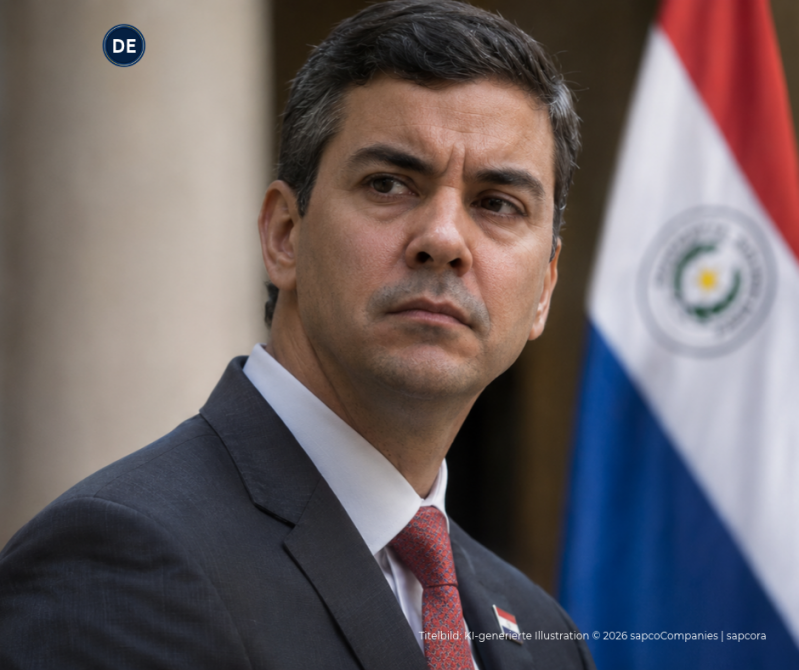
The collapse of one of Paraguay's largest digital banks has triggered a political crisis threatening the presidency of Santiago Peña. Nearly three million customers have been affected by restrictions on access to their accounts, while approximately $850 million in public funds has come under scrutiny. Peña has submitted his resignation, but Congress is pursuing impeachment proceedings as criminal investigations raise questions about financial oversight, political connections and the management of public money.
A Banking Failure Reaches the Presidency
Paraguay is facing a deepening political crisis after the collapse of Ueno Bank, a rapidly expanding digital lender whose failure has disrupted financial services for millions of customers and placed President Santiago Peña's political future in jeopardy. What began as a banking intervention has developed into a confrontation involving Congress, the presidency, financial regulators and criminal investigators. Peña submitted his resignation on November 5 amid mounting pressure from lawmakers and growing public anger. However, Congress did not formally accept his departure, leaving him in office while the Senate continued impeachment proceedings that could remove him through a separate constitutional process. On November 6, senators resumed proceedings and rejected the president's request for an additional 72 hours to prepare his defense. The confrontation has intensified divisions within Paraguay's governing Colorado Party and raised questions about the independence of institutions responsible for supervising the country's financial system.
Millions of Customers Lose Access to Their Money
Ueno Bank had become one of Paraguay's most recognizable financial institutions through aggressive expansion and the widespread adoption of its digital services. The lender reported approximately three million customers in a country with a population of roughly 6.5 million, giving its operations an unusually broad reach. That expansion came to an abrupt halt when Paraguay's central bank initiated a formal resolution process following the discovery of serious solvency deficiencies. The regulator determined that Ueno's solvency ratio had fallen below half the legally required minimum after adjustments were made to its financial statements. The intervention disrupted access to deposits, electronic payments, bank cards and other routine financial services. For households dependent on Ueno accounts for everyday transactions, the consequences extended far beyond uncertainty over the bank's future. The scale of the disruption also exposed the risks associated with the rapid growth of a financial institution serving a substantial proportion of the population. A failure involving millions of account holders can quickly become a matter of national economic stability, even when regulators maintain that the difficulties are confined to one bank.
Public Money at the Center of the Scandal
The crisis has become particularly sensitive because Ueno held approximately $850 million in public funds. These included deposits linked to government institutions and public-sector programs, with substantial amounts associated with Paraguay's pension and health system. The presence of public money has raised questions about how deposits were allocated, whether applicable safeguards were respected and whether political relationships influenced decisions involving the institution. Lawmakers have placed particular emphasis on the exposure of pension resources, arguing that public savings should have been subject to rigorous oversight. The precise financial losses have not yet been established, and the total amount deposited at Ueno must not be confused with money that has been permanently lost. The outcome will depend on the resolution process, the recovery of assets and the protection available through Paraguay's deposit guarantee arrangements. Nevertheless, the scale of public-sector exposure has changed the nature of the controversy. The collapse is no longer being examined solely as a failure of private banking management, but also as a test of the government's handling of public financial resources.
Peña's Former Business Ties Come Under Scrutiny
The political controversy centers partly on Peña's previous business relationship with the corporate group associated with Ueno. The president formerly held an ownership interest in Grupo Vázquez, which controlled the lender, but maintains that he sold his shares in March 2025. Peña has denied wrongdoing and rejected allegations that his former investment influenced government decisions concerning the bank. His previous ownership interest does not itself establish misconduct, although it has become an important element of the parliamentary accusations and ongoing investigations. Additional scrutiny has focused on Carlos Carvallo, whom Peña appointed to lead Paraguay's central bank. Carvallo had previously headed the financial company from which Ueno Bank developed, creating questions about potential conflicts involving the institution responsible for supervising the lender. Carvallo resigned as the banking crisis intensified, further weakening confidence in the government's handling of the situation. His departure has placed renewed attention on the independence of financial supervision and the safeguards intended to separate regulatory decisions from private commercial interests. Investigators must now establish whether these relationships affected official decisions or whether the supervisory failures resulted from other weaknesses in the regulatory process. Political connections may warrant examination, but criminal responsibility requires evidence that can withstand judicial scrutiny.
Criminal Investigations Widen
The banking collapse has prompted criminal proceedings involving senior Ueno executives and individuals associated with the institution. Arrest warrants were issued for eight executives, while investigators began examining suspected financial irregularities, including transactions involving businesses connected to the bank's controlling interests. Former Ueno chief executive Miguel Vázquez faces criminal accusations involving alleged breach of trust and attempted fraud. Judicial authorities have also ordered several former bank directors into pretrial detention as prosecutors investigate the institution's operations and the circumstances surrounding its failure. Separate investigations are examining the conduct of public officials and the management of government deposits at Ueno. Complaints involving Peña and other political figures form part of those inquiries, although the existence of an investigation does not establish that a criminal offense has occurred. The growing scope of the proceedings has intensified demands for a comprehensive examination of the bank's financial reporting, internal governance and regulatory supervision. Investigators face the task of distinguishing potential criminal conduct from management failures and deficiencies in the oversight system.
Congress Pursues Impeachment Despite Resignation
The political confrontation escalated dramatically on November 5 when Paraguay's Chamber of Deputies voted unanimously, by 78 votes to zero, to bring impeachment charges against Peña. The decision followed growing criticism of the government's response to Ueno's collapse and an erosion of support within the president's own political party. Peña subsequently submitted his resignation, saying he wanted to preserve the country's stability. But a joint congressional session failed to formally accept his departure after lawmakers withdrew and the chamber lost the quorum required to proceed. The distinction between resignation and impeachment carries substantial legal consequences. Under Paraguay's constitutional arrangements, a former president may be entitled to a lifetime Senate position, while removal through impeachment could affect eligibility for that status and its associated legal protections. The Senate continued proceedings on November 6 despite Peña's objections to the limited time available for preparing his defense. The president argued that he had received extensive documentation shortly before the hearing, while lawmakers pressing for impeachment maintained that the process should continue. Removing a president requires the support of 30 members of Paraguay's 45-seat Senate. At the latest verified reporting point on November 6, the proceedings had not produced a confirmed final removal from office. Vice President Pedro Alliana would be positioned to assume the presidency if Peña's departure becomes legally effective. The current presidential term is scheduled to end in August 2028, leaving any successor responsible for managing the consequences of the financial and political crisis.
Senior Resignations Weaken the Administration
The banking scandal has already led to the departure of several senior government officials. Interior Minister Enrique Riera resigned, followed by presidential chief of staff Javier Giménez and legal adviser Roberto Moreno as the impeachment proceedings gained momentum. Their departures reflect the political pressure surrounding the administration and the increasingly difficult position of the president. They also complicate the government's efforts to coordinate a response to a financial emergency affecting millions of customers. Public demonstrations have added to that pressure, particularly in Asunción, where protesters have demanded access to their savings and accountability for the collapse. The combination of financial hardship and allegations involving public officials has transformed frustration with a failed bank into a wider challenge to political authority. For affected households, the immediate concerns remain practical rather than constitutional. Access to wages, savings and ordinary payment services has become uncertain, while many customers face questions about how quickly their deposits can be recovered.
Deposit Protection Becomes an Urgent Priority
Paraguay's central bank has emphasized that its intervention is intended to protect depositors and preserve the stability of the wider banking system. The formal resolution process provides mechanisms for safeguarding assets, transferring eligible deposits and arranging compensation through the country's deposit guarantee framework. Under the applicable rules, deposits are protected up to 228.3 million Paraguayan guaraníes per depositor, equivalent to approximately $36,000. The guarantee applies within the legal framework governing the resolution process, while balances exceeding the protected amount remain dependent on further recovery measures. Authorities have also pursued emergency arrangements intended to accelerate access to funds for affected customers. The timing and extent of recovery remain important sources of uncertainty, particularly for depositors whose balances exceed statutory protection limits. The central bank has described Ueno's difficulties as an isolated case rather than evidence of systemic insolvency across Paraguay's banking sector. Maintaining that distinction will be essential to preventing the failure of one institution from undermining confidence in otherwise functioning banks.
Paraguay's Financial Reputation Faces a Test
The collapse has challenged the image of financial stability that Paraguay has worked to strengthen in recent years. The country had attracted international attention for its macroeconomic management, investment conditions and improvements in sovereign credit standing. The failure of a major digital lender holding substantial public deposits has introduced new concerns about governance and the effectiveness of banking supervision. International investors will be examining whether weaknesses in oversight allowed risks to accumulate and whether authorities can address them without disrupting the wider financial system. The political crisis adds further uncertainty. A government facing impeachment proceedings and the departure of senior officials must simultaneously manage depositor protection, regulatory intervention and the potential consequences for public finances. The economic implications will depend largely on the effectiveness of the resolution process and the credibility of the institutional response. A contained banking failure need not develop into a systemic crisis, but public confidence can deteriorate when financial distress becomes entangled with unresolved questions about political influence. For Paraguay, the challenge is therefore broader than restoring normal banking services. Authorities must demonstrate that financial institutions are subject to effective supervision regardless of their commercial relationships or political connections.
The Real Test Begins Beyond the Presidency
The immediate political question is whether Santiago Peña will leave office through resignation or impeachment. The longer-term consequences, however, will depend on whether Paraguay can establish how Ueno's financial position deteriorated and why the warning signs were not adequately addressed before intervention became necessary. Investigators will need to clarify the handling of public deposits, the role of financial regulators and the conduct of executives and officials involved in decisions concerning the bank. Those findings will be essential to determining responsibility and identifying reforms capable of preventing similar failures. The recovery of customer funds remains an equally important measure of institutional effectiveness. Millions of Paraguayans have experienced the consequences of a financial collapse whose causes are still being investigated, and restoring confidence will require more than political declarations. The crisis has already demonstrated how quickly weaknesses in financial governance can become a challenge to an entire administration. Whether Peña remains president or leaves office, Paraguay must confront the questions surrounding regulatory independence, public financial management and accountability. A change of president may resolve the immediate constitutional confrontation, but it cannot by itself repair the damage caused by the banking failure. The lasting measure of Paraguay's response will be whether depositors recover their money, investigators establish responsibility and financial oversight emerges with greater independence and credibility.
Paraguay Banking Crisis: Ueno Collapse Threatens Peña’s Presidency. Ueno Bank's collapse triggers a political crisis in Paraguay as President Santiago Peña faces impeachment and millions of customers struggle to access savings.
Kommentar hinzufügen
Kommentare