

Section: Security
Format: Special Report
Author: Sinisa Brkic (sb)
Publication Date: November 22, 2026
Mexican special forces have captured Fausto Isidro Meza Flores, known as “El Chapo Isidro,” one of the FBI’s Ten Most Wanted Fugitives. The operation, supported by American intelligence, left 11 people dead and triggered violent clashes across parts of Sinaloa. His arrest marks a major achievement in international law enforcement, but the confrontation also exposes the continuing influence of Mexico’s powerful criminal organizations.
A Major Arrest in Mexico’s Cartel Heartland
Mexican military special forces captured Fausto Isidro Meza Flores, one of the United States’ most wanted suspected drug traffickers, during an operation in Guasave, Sinaloa, on November 20, 2026. Known as “El Chapo Isidro,” Meza Flores had evaded authorities for more than a decade while allegedly directing a criminal organization responsible for transporting substantial quantities of illegal drugs into the United States. Mexican authorities confirmed the arrest on November 21, describing a coordinated operation involving elite Army units, the National Guard and intelligence cooperation with American agencies. Two alleged senior members of the organization were detained alongside Meza Flores, including a suspected deputy commander and a financial operator. In total, Mexican security forces arrested eight suspects during the operation. Three were transferred to Mexico City, while five others were placed in the custody of federal prosecutors in Culiacán, the capital of Sinaloa. The mission encountered heavy armed resistance as Mexican forces approached the location where the suspected cartel leader was hiding. Gunmen opened fire and used explosives, triggering a confrontation that required additional military support and ultimately resulted in significant casualties. The detention represents one of Mexico’s most prominent law enforcement achievements against internationally wanted drug trafficking suspects in recent years. Its importance extends beyond the capture of a single individual, reflecting the growing role of intelligence cooperation between Mexico and the United States in combating transnational organized crime.
Eleven Killed as Cartel Violence Erupts
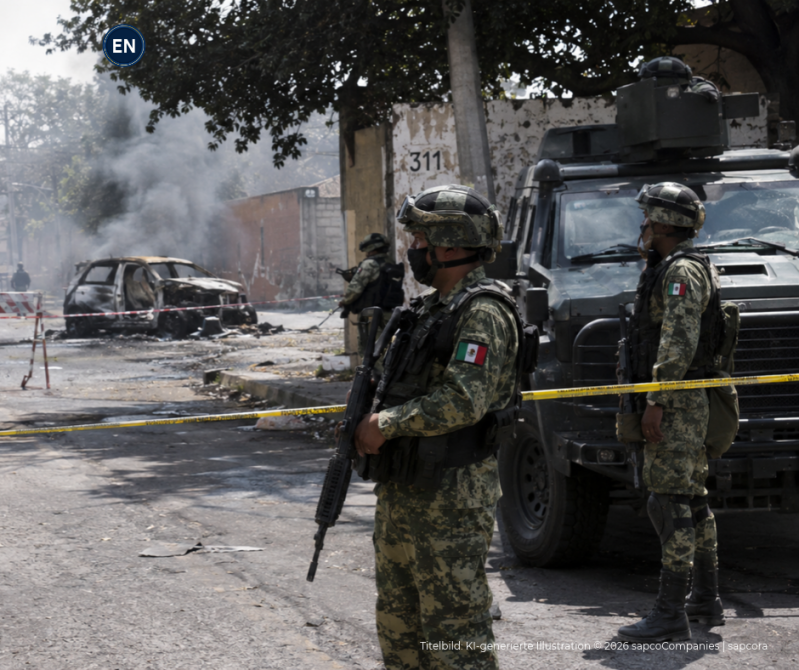
The military operation left 11 people dead, including four Mexican soldiers and seven suspected cartel gunmen. Mexican authorities confirmed the casualties as security forces worked to contain armed resistance and prevent further violence in the surrounding area. The confrontation caused considerable disruption in Guasave and nearby communities. Armed groups established roadblocks, set vehicles on fire and obstructed important transportation routes, while residents sought shelter as gunfire echoed through parts of the city. Videos circulating from the affected areas showed civilians fleeing a baseball game and taking cover as military helicopters operated overhead. Other footage documented burning vehicles, deserted streets and security personnel moving through areas affected by the fighting. The unrest extended beyond the immediate location of the arrest, with roadblocks and related disturbances reported in neighboring municipalities. Mexican authorities deployed additional personnel to secure highways, remove obstacles and restore normal traffic conditions. By Saturday, the immediate violence had substantially subsided, according to security officials. Authorities reported that the situation was under control, although residents remained cautious and businesses in some affected areas were still closed. The severity of the confrontation demonstrates the military capabilities retained by criminal organizations operating in Sinaloa. The ability to deploy armed personnel, obstruct highways and disrupt civilian life illustrates why the detention of a prominent cartel figure does not necessarily translate into an immediate reduction in criminal influence.
Who Is El Chapo Isidro?
Fausto Isidro Meza Flores emerged as a significant figure in Mexico’s criminal underworld through his association with the Beltrán Leyva organization, a powerful trafficking network that once competed with the Sinaloa Cartel. He subsequently established himself as the alleged leader of the Meza-Flores organization, also associated with the criminal group known as Los Mazatlecos. American investigators accuse his organization of trafficking large quantities of cocaine, methamphetamine, heroin, marijuana and fentanyl into the United States. Authorities have also linked the network to allegations involving kidnapping, extortion, torture, murder and attacks against law enforcement personnel. Meza Flores was originally indicted in the United States in May 2012, followed by additional federal charges in November 2019. Those proceedings focused on alleged international narcotics trafficking and firearms offenses connected to criminal activities spanning several years. In February 2025, the FBI added him to its Ten Most Wanted Fugitives list, identifying him as a priority target for American law enforcement. The United States offered a reward of up to $5 million for information leading to his arrest or conviction. The legal allegations against him have since expanded considerably. A federal indictment filed in September 2026 includes charges involving narcoterrorism, money laundering, firearms offenses, leadership of a continuing criminal enterprise and conspiracy to provide material support to a designated terrorist organization. American prosecutors allege that Meza Flores exercised control over heavily armed personnel and substantial territory in northern Sinaloa. According to the allegations, his organization used violence to protect trafficking operations, eliminate rivals and maintain control over strategically important areas. Despite the similarity in their nicknames, El Chapo Isidro is not Joaquín “El Chapo” Guzmán, the former leader of the Sinaloa Cartel who is serving a life sentence in the United States. The two men have distinct criminal histories and leadership roles. Meza Flores remains legally presumed innocent of the charges against him unless proven guilty in court. His detention is a major development in the criminal proceedings, but it does not constitute a conviction.
American Intelligence Behind the Operation
The involvement of American intelligence agencies gives the arrest considerable political and security significance. Mexican authorities confirmed that strategic intelligence sharing between the two countries contributed to identifying and locating the suspected cartel leader. The operation was conducted by Mexican military personnel, while American agencies supported the investigation and intelligence gathering. The United States Department of Justice subsequently acknowledged the contribution of several federal agencies, including the FBI and Homeland Security Investigations. American authorities described the arrest as the result of sustained cooperation between law enforcement institutions on both sides of the border. U.S. officials also expressed condolences to the families of the Mexican soldiers killed during the confrontation. The distinction between intelligence assistance and direct foreign military involvement is particularly important for Mexico. Its government has consistently emphasized national sovereignty and the responsibility of Mexican institutions for conducting security operations within the country. President Claudia Sheinbaum faces continued pressure from Washington to demonstrate stronger enforcement against criminal organizations involved in international drug trafficking. At the same time, her administration must manage domestic concerns about the possibility of direct American intervention in Mexican security affairs. The capture of Meza Flores illustrates how intelligence cooperation can produce significant operational results while leaving the execution of military operations under Mexican authority. It also provides both governments with a concrete achievement at a time when organized crime remains a central issue in their bilateral relationship.
Growing Pressure From Washington
The arrest comes amid sustained demands from President Donald Trump’s administration for more decisive action against Mexican drug trafficking organizations. Washington has increasingly linked cartel activity to broader concerns involving border security, fentanyl trafficking and threats to American national security. The Trump administration has also raised the possibility of unilateral military action against criminal organizations operating in Mexico. Such proposals have generated considerable political sensitivity because they would challenge Mexico’s longstanding position that foreign military operations on its territory require its consent. For Sheinbaum, the capture provides evidence that Mexican security forces can pursue major criminal figures through coordinated investigations and intelligence cooperation. It strengthens the argument that bilateral law enforcement efforts can produce meaningful results without transferring operational control to foreign forces. For Washington, the detention removes a significant target from the FBI’s international fugitive list and demonstrates the potential effectiveness of sustained investigations. However, the broader strategic value of the operation will depend on whether authorities can disrupt the financial and logistical structures supporting the organization. The arrest therefore carries importance beyond the immediate criminal case. It offers an opportunity for both governments to demonstrate that cooperation can deliver measurable security outcomes despite persistent political disagreements over sovereignty and enforcement methods.
The Criminal Power Struggle in Sinaloa
Sinaloa has long been one of Mexico’s most important centers of organized crime. Its established trafficking corridors, extensive criminal infrastructure and strategic geographic position have made the state a focal point for organizations supplying illegal drugs to American and international markets. The region has experienced prolonged instability as rival factions compete for territory, trafficking routes and influence. Leadership arrests, internal divisions and changing alliances have contributed to a criminal environment in which violence can escalate rapidly. Meza Flores developed his influence through the Beltrán Leyva criminal network, which historically maintained a rivalry with the Sinaloa Cartel. More recently, elements associated with his organization have reportedly maintained alliances with the Los Mayos faction, one of the groups involved in the struggle for control of the broader Sinaloa criminal landscape. These relationships illustrate the complex nature of Mexico’s trafficking organizations. Criminal networks frequently operate through regional commanders, financial intermediaries and armed groups whose interests may overlap without being controlled through a single centralized structure. The removal of a prominent leader can weaken established command relationships and create opportunities for law enforcement investigators. It can also encourage rival organizations or subordinate commanders to compete for territory and profitable criminal activities. Whether Meza Flores’s arrest will produce further fragmentation remains uncertain. The immediate violence demonstrates the capacity of armed groups to respond to security operations, but it does not establish how the organization’s leadership or alliances will evolve.
Why Arresting a Kingpin Does Not End a Cartel
Mexico has repeatedly demonstrated its ability to capture or eliminate powerful figures within major criminal organizations. The long-term consequences of these operations, however, have often been more complicated than the immediate law enforcement successes suggest. Large trafficking networks depend on financial systems, transportation infrastructure, weapons suppliers, regional commanders and established distribution channels. These structures can continue functioning even after influential leaders are removed, particularly when criminal activities are organized across several semi-independent groups. The detention of Meza Flores could allow investigators to identify additional suspects, trace financial transactions and uncover operational connections that were previously difficult to establish. Such opportunities are valuable, but their effectiveness depends on sustained investigations, prosecution and cooperation between national authorities. The possibility of intensified criminal competition also presents a serious challenge. Rival organizations may attempt to seize trafficking routes, while remaining commanders could compete for control over the activities previously attributed to the arrested leader. For communities in Sinaloa, these developments can have direct consequences. Competition among criminal factions may lead to renewed violence, intimidation and disruption of economic activity, particularly in areas where organized crime has maintained extensive local influence. The arrest therefore represents an important operational achievement rather than proof that the organization has been permanently dismantled. No verified evidence currently establishes that the detention has produced a sustained reduction in drug shipments or eliminated the network’s ability to conduct criminal operations.
Extradition and the Legal Consequences
The arrest raises significant legal questions concerning the possible extradition of Meza Flores to the United States. American authorities have pursued criminal proceedings against him for years, and the latest federal indictment includes charges carrying exceptionally severe potential penalties. According to the U.S. Department of Justice, the charges could result in life imprisonment or the death penalty if a conviction is secured under the applicable federal statutes. These potential penalties underline the seriousness of the allegations but do not predetermine the outcome of any judicial proceedings. Any transfer to American custody would require the relevant legal procedures and decisions by Mexican authorities. The existence of federal charges in the United States does not establish that extradition has already taken place or that a transfer is inevitable. Mexican investigators may also pursue additional proceedings connected to the organization’s alleged domestic activities. The detention of other suspected senior figures could provide opportunities to examine financial operations, command structures and connections with criminal networks operating beyond Sinaloa. The effectiveness of these investigations will be central to determining whether the arrest produces consequences beyond the removal of a prominent fugitive. Successful prosecution and the disruption of supporting criminal infrastructure would represent more substantial achievements than the detention alone.
A Major Victory With Uncertain Consequences
The capture of Fausto Isidro Meza Flores represents a significant achievement for Mexican security forces and American intelligence cooperation. It removes an internationally wanted suspect from circulation and demonstrates the ability of coordinated investigations to reach influential figures who have evaded authorities for years. Yet the deaths of four Mexican soldiers and seven suspected cartel gunmen illustrate the human cost of confronting heavily armed criminal organizations. The violence surrounding the operation also demonstrates that criminal networks can retain considerable operational capabilities even when their senior leadership is targeted. The broader consequences for public security and international drug trafficking remain uncertain. There is currently no verified evidence that the arrest has permanently dismantled the Meza-Flores organization, significantly reduced narcotics shipments into the United States or prevented further violence in Sinaloa. For Mexico, the central challenge is to translate this prominent arrest into lasting improvements in security and the rule of law. For Washington, the operation reinforces the value of intelligence cooperation while highlighting the need to target the financial and operational systems sustaining international trafficking networks. The true significance of the arrest will ultimately be measured by what follows. Capturing a powerful drug trafficking suspect demonstrates the reach of the state, but weakening the criminal structures that allowed him to operate for years will require a far more sustained effort.
FBI Most Wanted Drug Kingpin El Chapo Isidro Captured in Mexico. Mexico captures FBI fugitive El Chapo Isidro in a military operation supported by U.S. intelligence. Eleven people are killed in violent clashes in Sinaloa.
Kommentar hinzufügen
Kommentare