


Category: Business
Format: Article / Book Announcement
Author: Sinisa Brkic (sb)
Date: 25 November 2026
Carbon markets have become a significant part of the international economy, bringing together industrial corporations, financial institutions, technology companies and project developers. Yet how do these markets actually work, who makes money from them, and what opportunities exist for individuals and businesses seeking to enter this sector? A forthcoming international book by Austrian entrepreneur Sinisa Brkic examines the economic structures behind carbon trading and the practical possibilities for market participation.
The Market of the Future
What happens when a tonne of carbon dioxide acquires a financial value? Who determines its price, who generates revenue from it, and how has the regulation of greenhouse gas emissions evolved into a market involving some of the world's largest industrial and financial institutions? The figures illustrate its economic significance. In 2025, trading activity in European carbon markets reached a value of approximately €777 billion, while the auctioning of European emission allowances generated revenues of €43.2 billion. Globally, direct carbon pricing instruments generated more than US$107 billion in public revenue during the same year. This figure includes revenues from emissions trading systems and carbon taxes and should not be confused with trading volumes or private sector profits. Behind these figures lies a complex economic landscape in which regulatory obligations, financial markets, technological developments and commercial interests intersect. While public debate frequently concentrates on climate policy and emissions reduction targets, the economic mechanisms underpinning these markets remain less familiar to the wider public. Understanding those mechanisms is the starting point of an international publishing project currently being developed in Austria.
The Economics Behind Carbon Markets
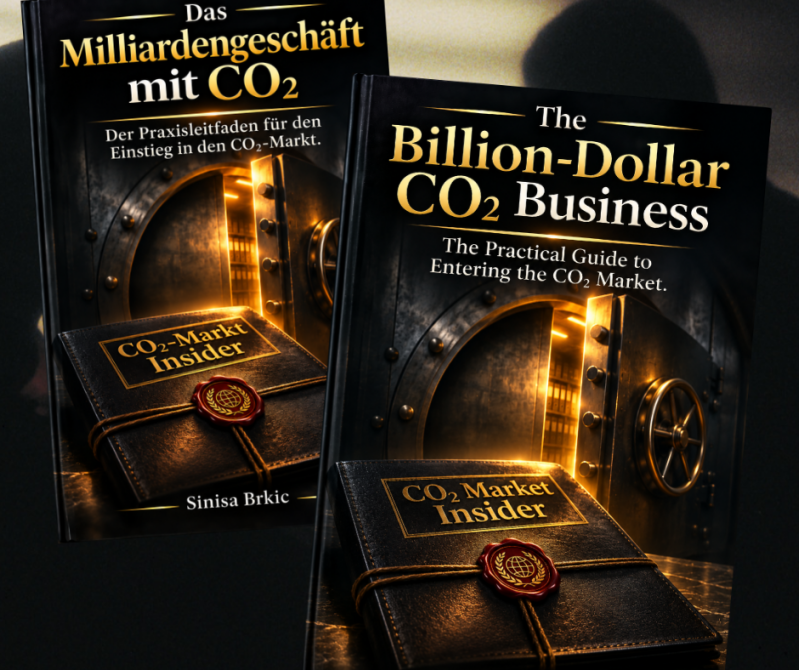
Austrian entrepreneur Sinisa Brkic is preparing an extensive international business and reference book entitled The Billion-Dollar CO₂ Business, with the subtitle The Practical Guide to Entering the CO₂ Market. The publication examines the historical, scientific, political and economic foundations of carbon markets while addressing a practical question: how can individuals and businesses establish a professional or commercial presence in this sector? Although terms such as carbon credits, emissions trading and carbon neutrality have become familiar, their economic and legal implications are often misunderstood. Under the European Union Emissions Trading System, an emission allowance represents the right to emit one tonne of carbon dioxide equivalent. Companies subject to the system must surrender sufficient allowances to account for their regulated emissions. A carbon credit, by contrast, generally represents a quantified emissions reduction or removal achieved under a specific crediting methodology. Its eligibility, recognition and commercial application depend on the rules and quality requirements of the relevant market or programme. Understanding these distinctions is essential for anyone considering professional or commercial involvement.
How Emissions Acquired an Economic Value
The origins of emissions trading extend considerably further back than contemporary climate policy. During the twentieth century, economists began examining how market mechanisms and financial incentives could be used to address environmental pollution. These ideas gradually developed into regulatory instruments designed to impose an economic cost on emissions and encourage their reduction through financial incentives. The adoption of the Kyoto Protocol in 1997, the introduction of the European Union Emissions Trading System in 2005 and the adoption of the Paris Agreement in 2015 represent significant milestones in the development of today's international carbon markets. Different jurisdictions have since established their own regulatory frameworks, while voluntary carbon markets and project-based mechanisms have developed alongside them. Their objectives, methodologies, legal requirements and commercial structures vary considerably. The book is intended to trace this development from its historical origins to the contemporary international market landscape, with a research and editorial cut-off date of 23 October 2026.
Who Makes Money in Carbon Markets?
The commercial activities surrounding carbon markets extend well beyond the purchase and sale of emission allowances or carbon credits. An extensive network of professional services has developed around the measurement, reduction, verification, documentation and commercialisation of greenhouse gas emissions. Consulting firms assist businesses with greenhouse gas inventories and emissions assessments. Project developers design activities intended to reduce emissions or remove greenhouse gases from the atmosphere, while technology companies provide solutions for data collection, calculation, monitoring and reporting. Financial institutions, intermediaries, verification bodies and registry operators perform further functions within the respective market structures. Depending on the business model, revenues may arise from consulting services, project development, transaction fees, software licensing, administrative services or trading activities. The financial scale of a market, however, does not automatically translate into profitable opportunities for every participant. Commercial success depends on demand, professional expertise, operational costs, regulatory compliance and the viability of the underlying business model. For certain activities, particularly those involving regulated financial instruments, specific authorisations may also be required.
Entering the Market Without Being a Major Corporation
One of the central themes of the forthcoming book is the examination of practical entry opportunities for individuals, independent professionals and businesses. Participation in the broader carbon economy is not necessarily restricted to industrial corporations, institutional investors or established commodity traders. Depending on the activity and applicable regulations, smaller businesses and entrepreneurs may also provide specialised services. Potential areas of involvement include greenhouse gas accounting, environmental consulting, project development, commercial intermediation, technical documentation, data management and digital services. Some of these activities require substantial capital, specialised qualifications or regulatory approval. Others depend primarily on professional knowledge, technical competence and the ability to establish commercially viable client relationships. The book explores these differences through an examination of professional requirements, potential revenue models, initial investment costs, operational responsibilities and financial risks. For prospective entrepreneurs, the relevant question is not simply whether a market exists, but whether they possess the capabilities, resources and legal prerequisites to establish a sustainable business within it.
An International Reference Work Across 90 Chapters
With a planned length of approximately 520 to 600 pages, The Billion-Dollar CO₂ Business is conceived as an extensive international reference work. Its current structure comprises 90 chapters organised into 15 main parts and five overarching thematic areas. These encompass the historical and scientific foundations, the development of international carbon markets, market instruments and methodologies, economic and political implications, and practical business opportunities. The publication is intended for readers with varying levels of experience, ranging from individuals without prior knowledge of carbon markets to students, entrepreneurs, investors, corporate executives and policymakers. Practical case studies will complement the historical and economic examination. Among the planned examples is the Carbon Protocol Council (CPC), a project founded and owned by the book's author, which addresses aspects of emissions measurement and documentation. The material is structured to introduce readers progressively to the subject, allowing them to establish a solid understanding of the market before examining its more specialised commercial and technical dimensions.
Commercial Opportunities and the Question of Credibility
Carbon markets are not without controversy. Questions concerning the environmental integrity of individual projects, the quality of carbon credits, double counting and misleading environmental claims have accompanied their development. One particularly important issue is additionality. Depending on the applicable crediting methodology, a project may need to demonstrate that its emissions reductions or removals would not have occurred without the incentive provided by the crediting mechanism. Such requirements have direct economic implications. The commercial value and eligibility of a carbon credit can depend on the methodology applied, the quality of the supporting evidence and the rules governing its intended use. Regulatory changes, price volatility, inconsistent quality standards and reputational risks present further challenges for market participants. The book's planned examination therefore includes critical perspectives on existing market structures. Understanding their limitations is as important as identifying their commercial possibilities, particularly for those considering professional involvement or financial commitments.
An International Publication in Two Languages
The publishing project has been conceived for an international readership from the outset. Alongside the English edition, a German version is being prepared under the title Das Milliardengeschäft mit CO₂, with the subtitle Der Praxisleitfaden für den Einstieg in den CO₂-Markt. The English edition is intended to reach readers across Europe, North America, Asia and the Middle East. The German edition will primarily address readers in Austria, Germany and Switzerland. Both editions will combine historical context, economic analysis, technical explanations and practical considerations, reflecting the international character of carbon markets and the differing regulatory environments in which they operate.
Publication Targeted for December 2026
The target date for publication is 7 December 2026, subject to manuscript completion, final editorial and technical review, and production readiness. The book is expected to be independently published, initially through small print runs. A retail price of €89.90 is currently planned for the premium German hardcover edition, subject to final production and distribution calculations.
Understanding the Market Before Entering It
The international carbon economy encompasses commercial activities ranging from industrial compliance and financial trading to environmental consulting, project development and digital technology. Its economic significance cannot be assessed solely through headline trading figures. For prospective market participants, the more relevant questions concern how value is created, which services are genuinely required, where barriers to entry exist and under what circumstances commercially sustainable businesses can be established. The Billion-Dollar CO₂ Business is being developed to examine these questions and provide readers with the knowledge necessary to make informed assessments of the market. The publication offers no guarantee of financial returns, commercial success or privileged market access. A market worth billions does not automatically create a profitable business opportunity. Understanding where its economic value originates, how it is distributed and what it takes to participate is the foundation on which informed commercial decisions must be built.
A forthcoming book by Sinisa Brkic explores global carbon markets, emissions trading, carbon credits, business models and practical market entry. This article announces the author's own forthcoming book, a publishing project connected to newsmedia.report. The author also founded and owns the Carbon Protocol Council, which is included among the book's planned case studies. This publication is not an independent book review.
Kommentar hinzufügen
Kommentare