

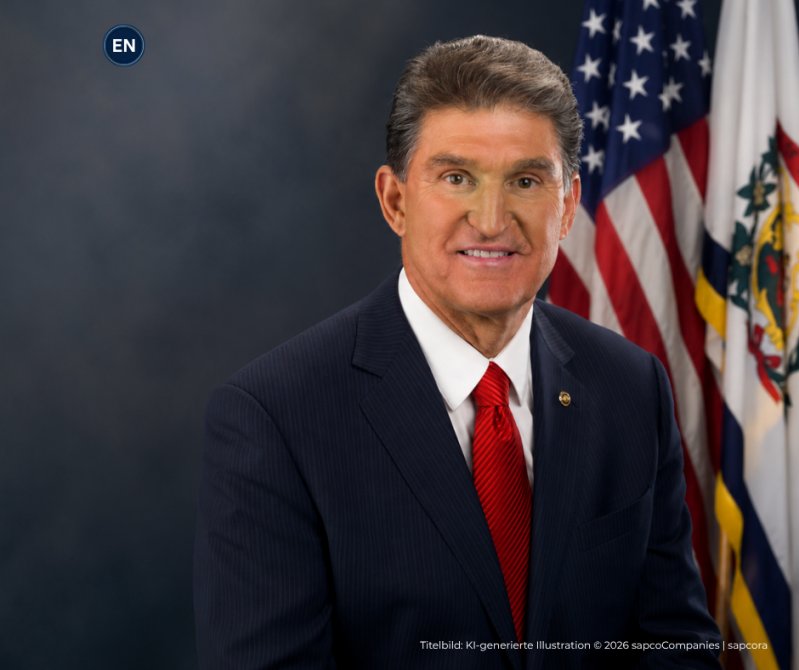
Photo: Rebecca Hammel / U.S. Senate, public domain
Rubric: Politics
Format: Special Report
Author: Sinisa Brkic (sb)
Joe Manchin Launches Independent Movement for the 2026 Elections. Joe Manchin’s Independent Leadership Council wants to elect independent candidates to Congress. Its success will depend on money, viable districts and a strategy that avoids the spoiler trap.
Former Senator Joe Manchin is returning to national politics with an organization designed to recruit and support independent candidates for Congress. The Independent Leadership Council insists that it is not creating a third party. Its larger ambition, however, is unmistakable: to weaken the political monopoly of Democrats and Republicans by establishing a new center of power inside Congress.
A political movement without a party
Joe Manchin is attempting something that American political history has repeatedly made look attractive and almost impossible.
The former West Virginia senator and his daughter, Heather Bresch, have launched the Independent Leadership Council to recruit, support and promote independent candidates in competitive congressional races. The organization presents itself not as a new political party, but as a coordinated network for candidates who reject formal allegiance to either Democrats or Republicans.
That distinction is more than a matter of branding.
A party requires national infrastructure, ballot access operations, policy platforms, state organizations and a long term voter coalition. A candidate support network can operate more selectively. It can enter only those races where local conditions appear favorable, direct money and professional assistance toward a limited number of candidates and avoid the burden of building a complete national political institution.
Manchin is therefore not trying to replace the two major parties across the country. He is trying to identify enough vulnerable points in the system to prove that independent candidates can win.
The objective is leverage, not numerical dominance
The Independent Leadership Council does not need dozens of victories to alter the balance of power in Washington.
A narrow House majority can be controlled by only a handful of votes. The Senate is even more sensitive to individual lawmakers who are willing to negotiate across party lines or withhold support from both sides. A small group of independents could become decisive in leadership elections, budget negotiations, committee organization and closely divided legislative battles.
This is the strategic logic behind Manchin’s initiative.
The council does not need to defeat the Democratic Party or the Republican Party. It needs to elect enough members to prevent either party from exercising power without negotiation.
That model reflects Manchin’s own political career. During his years in the Senate, he frequently occupied the decisive space between the Democratic leadership and Republican opposition. His influence came not from commanding a faction, but from being difficult to replace in an evenly divided chamber.
The new organization seeks to turn that individual position into a repeatable political structure.
The 2026 elections offer an opening
Public dissatisfaction with both major parties has created favorable language for an independent movement. Large numbers of Americans identify as independents, distrust national party institutions or believe that political polarization has made Congress less effective.
That frustration is real. Converting it into votes is considerably harder.
Many voters who describe themselves as independent still vote consistently for one major party. Their rejection of party labels does not necessarily mean that they are available to a centrist candidate. Some are ideological conservatives who dislike Republican leadership. Others are progressive voters frustrated with Democrats. Still others are politically disengaged rather than committed to a new center.
Manchin’s central challenge is therefore not discovering discontent. It is finding districts where dissatisfaction can be organized into a winning coalition.
The 2026 congressional elections may provide such opportunities because control of the House and Senate could depend on a small number of competitive races. In those contests, a locally credible independent candidate with sufficient financing and public recognition could become more than a protest option.
The political opening exists. The electoral path remains narrow.
Candidate quality will determine whether the project is serious
The first names publicly associated with the initiative suggest that the council is searching for candidates with existing political, professional or institutional credibility.
California Representative Kevin Kiley, Iowa House candidate Michael Bridgford and Montana Senate candidate Seth Bodnar have been identified among the figures connected to the initial effort. Their campaigns differ significantly, but together they reveal the kind of profile the council appears to be considering: candidates who can present themselves as more than symbolic alternatives.
That is essential.
Independent candidates rarely lose because voters have never heard criticism of the two party system. They lose because they lack money, campaign staff, voter data, ballot access expertise, media visibility and a realistic path to a plurality.
A credible independent campaign must perform nearly all the functions of a party operation without having a party behind it. It must build field organizations, qualify for the ballot, recruit donors, respond to attacks and persuade voters that supporting an independent will not merely help elect the candidate they dislike most.
The council’s value will be measured by whether it can provide that missing infrastructure.
The map matters more than the message
The initiative cannot succeed through a broad national appeal alone. It requires an exceptionally disciplined district strategy.
The most promising races are unlikely to be those where Democrats and Republicans possess deeply loyal voter bases. They are more likely to be districts with a history of ticket splitting, strong local identities, weak party nominees or unusually well known independent candidates.
Open seats may offer better opportunities than races against established incumbents. Districts shaped by redistricting, demographic change or internal party conflict may also create openings.
Another possibility involves informal cooperation with one of the major parties. An independent candidate becomes significantly more viable when Democrats or Republicans decide not to invest heavily in a competing nominee. That may occur when party officials conclude that an independent has a better chance of defeating the opposing side.
Such arrangements would create an immediate tension for Manchin’s project. A movement founded to escape party control could become dependent on strategic assistance from one of the parties it criticizes.
That contradiction will be difficult to avoid.
The spoiler problem cannot be dismissed
Every independent campaign faces the same accusation: it may not win, but it may determine who loses.
In a plurality election, an independent candidate does not need to attract equal numbers of Democratic and Republican voters. A relatively small imbalance can change the result. A centrist candidate who draws more heavily from moderate Republicans may help elect a Democrat. One who appeals primarily to disaffected Democrats may produce the opposite result.
There is no universal answer to which party Manchin’s candidates would hurt more.
The effect will depend on the political history of each district, the identity of the candidate and whether voters see that person as a former Democrat, a former Republican or a genuinely independent alternative.
This is why candidate selection cannot be separated from electoral analysis. A strong biography and a centrist platform are not enough. The council will need detailed evidence showing where each candidate’s support comes from and whether that coalition can reach first place.
Without that discipline, the movement could become known less for electing independents than for altering the outcome of races won by someone else.
Money will reveal the real structure
The most important unanswered questions concern financing.
The public launch has not yet provided a complete account of the council’s legal organization, available budget, major donors or the mechanisms through which candidates will receive support. It is also unclear how funding responsibilities will be divided among the Independent Leadership Council, Americans Together and the existing political organizations involved in the project.
Those details are not secondary.
Political influence depends on who controls the money, how it is raised and what conditions accompany it. Direct contributions to candidates are regulated differently from independent expenditures. A nonprofit organization, a political action committee and a candidate committee each operate under different disclosure and coordination rules.
The council may provide polling, consultants, advertising, donor access, campaign training or direct financial assistance through affiliated structures. Each model creates different legal obligations and different levels of public transparency.
Until official filings and financial reports clarify the architecture, claims about the scale of the operation should be treated cautiously.
The difference between a political movement and a durable electoral organization is often found in its bank accounts.
Heather Bresch may be the operational center
Joe Manchin provides the political profile, but Heather Bresch may prove equally important to the organization’s development.
Bresch brings experience from corporate leadership and centrist political organizing. Her involvement suggests that the council is intended to function as more than a vehicle for her father’s public appearances. Building a national candidate network requires donor relations, organizational management, recruitment systems and long term planning.
Her role will also influence how the initiative is perceived.
If Joe Manchin remains the dominant figure, the council may struggle to become larger than his political identity. If Bresch develops an independent organizational structure with credible staff, funding and candidate standards, the project could continue even without Manchin seeking office again.
The council has not yet fully defined the division of authority between them. That question will become increasingly important as candidates, donors and political professionals enter the operation.
A congressional bloc would need more than independence
Winning elections would be only the first stage.
Independent lawmakers would still need to decide how they organize once they reach Congress. Committee assignments, staff resources and procedural influence are largely controlled through party structures. In the Senate, independents have historically worked with one of the major party caucuses. In the House, a new group could attempt to negotiate collectively, but its members would need sufficient unity to make that leverage credible.
The council has not yet published a detailed set of political requirements for supported candidates.
That creates another fundamental question. What does membership in this movement actually mean?
A candidate may reject party labels while holding strongly conservative or progressive positions. Another may be centrist on economic policy but aligned with one party on abortion, immigration, climate policy or presidential authority. Independence is an institutional identity, not a complete governing program.
If elected members disagree on nearly every major issue, their value as a bloc will be limited. If the council imposes a rigid platform, it begins to resemble the party it says it is not creating.
The movement must find a degree of cohesion without reproducing the structure it seeks to escape.
No Manchin candidacy has been announced
The launch inevitably renews speculation about Joe Manchin’s own political future.
There is currently no confirmed announcement that he intends to run for Congress, seek the presidency in 2028 or become a candidate for another office. The new organization gives him a national platform, access to donors and a role in candidate recruitment, but those facts do not amount to a campaign declaration.
Manchin has spent years criticizing partisan polarization and presenting himself as a representative of the political center. The council is consistent with that record. It may also keep him relevant in national politics without requiring him to become a candidate.
Any claim that the organization is a vehicle for a personal campaign would therefore go beyond the available evidence.
For now, Manchin is positioning himself as a builder, recruiter and political broker.
The first disclosures will be decisive
The Independent Leadership Council has successfully created attention. Its next steps will determine whether that attention develops into political power.
A complete candidate list would reveal the scale of its ambition. Financial filings would show whether the organization has the resources to compete. Donor disclosures would clarify who is investing in the project. District level polling would indicate whether its candidates can win or merely influence close contests.
The council will also need to explain how it evaluates candidates, what political commitments it expects and how elected independents would work together in Congress.
Until those answers emerge, the initiative remains a significant experiment rather than a proven national force.
Manchin has correctly identified a deep weakness in American politics. Millions of voters are dissatisfied with the two major parties, yet the electoral system gives those parties enormous structural protection. The Independent Leadership Council is attempting to turn that dissatisfaction into organization, money and congressional seats. That is the point at which most independent movements fail. If Manchin can overcome it, he will not need to break the two party system. A few well placed victories could be enough to force it to negotiate.
Kommentar hinzufügen
Kommentare