

Section: International
Format: Special Report
Author: Sinisa Brkic (sb)
Japan Earthquake: Death Toll, Heat Crisis and Supply Chain Risks in Kumamoto. Japan’s earthquake crisis deepens as deaths rise, water shortages persist and semiconductor and automotive plants assess damage across Kyushu.
Four days after a powerful earthquake struck southern Japan, the emergency has moved far beyond collapsed buildings. Officials now report 36 deaths, while 72,000 households remain without running water and thousands of residents face extreme heat in shelters, vehicles and damaged homes. At the same time, disruptions across Kyushu’s semiconductor and automotive corridor are raising questions about consequences that could extend well beyond Japan.
The Disaster Is Entering a More Dangerous Phase
The earthquake struck the Kumamoto region of Kyushu at 4:27 p.m. local time on July 28. The Japan Meteorological Agency measured the event at magnitude 7.1 and recorded the highest level on the country’s seismic intensity scale. The United States Geological Survey calculated a magnitude of 6.8, a difference attributable to separate measurement systems rather than disagreement over the event itself.
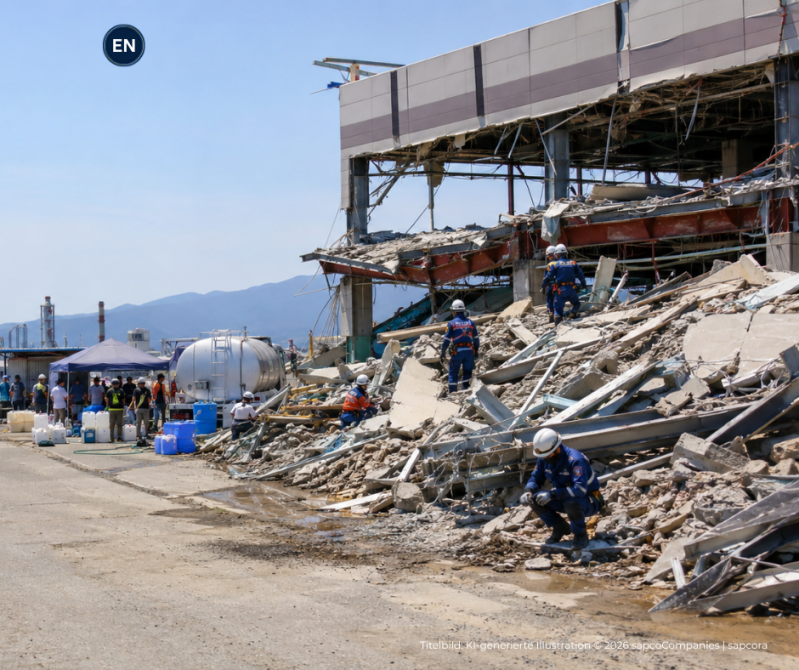
The initial shock caused extensive destruction across parts of Kumamoto Prefecture. Buildings collapsed or burned, roads and rail infrastructure were damaged, and rescue teams were sent into unstable structures, including a severely damaged shopping center and an industrial site where a large chimney had fallen.
The official prefectural tally on the morning of August 1 listed 138 casualties. That figure included 36 deaths and 102 injured people, nine of them seriously. Authorities had formally classified 34 deaths as disaster related, while the circumstances of two additional deaths remained under review.
At the Nippon Paper facility in Yatsushiro, all 11 people who had been trapped were eventually reached, but nine died. At Aeon Mall Kumamoto, officials reported seven deaths and five minor injuries among 12 people rescued from the site. Search and recovery operations continued in designated areas of the damaged complex.
Water Has Become the Central Humanitarian Problem
The scale of the water disruption now exceeds the remaining electricity outage. Approximately 72,000 households were without running water at the latest official count, although that number had fallen by about 7,100 from the previous update. Sixteen municipalities were operating emergency water distribution points.
Yatsushiro remained among the worst affected areas, with about 25,300 households without water. Uki reported roughly 17,800, Uto about 12,200, Kami-Amakusa about 7,300 and Kumamoto City about 3,200. Further outages affected Hikawa, Ashikita, Amakusa, Mifune and Kosa.
The figures reveal why the next stage of the disaster may prove as dangerous as the earthquake itself. Drinking water is only one part of the emergency. Hospitals, nursing facilities, shelters, sanitation systems and cooling equipment all depend on reliable water and power supplies.
Around 6,000 households were still without electricity on the morning of August 1. That represents significant progress from the first hours after the quake, but the remaining outages are concentrated in communities already struggling with damaged roads, disrupted water networks and limited access to essential services.
Extreme Heat Turns Disruption Into a Medical Threat
Temperatures in and around Kumamoto were expected to approach 39 to 40 degrees Celsius, or roughly 102 to 104 degrees Fahrenheit, during the first weekend of August. Forecasts indicated that dangerous heat could continue for several days.
The combination of heat, dehydration and interrupted electricity sharply increases the risk for older adults, young children and people with chronic illnesses. Residents sleeping in cars or remaining inside damaged homes may be particularly difficult for emergency services to monitor.
Kumamoto Prefecture intensified the distribution of drinking water, portable toilets and spot cooling equipment from August 1. The measures were intended not only for registered shelters, but also for people sleeping in vehicles or staying outside the formal evacuation system.
The pressure on health and care infrastructure is extensive. Authorities had received damage reports involving 191 medical facilities, 104 pharmacies, 785 elder care facilities, 337 child welfare facilities and 314 disability support facilities. The reports do not indicate that every facility suffered severe structural damage, but they demonstrate how widely the disaster has affected the regional care network.
A mobile pharmacy began operating in Uki on August 1. Such services may become increasingly important if transport problems, heat and shortages prevent patients from reaching functioning pharmacies or replacing essential medication.
Thousands Remain Displaced
Officials reported 9,228 people in 229 evacuation shelters. Conditions vary substantially, with some facilities operating normally and others confronting crowding, limited sanitation and inadequate cooling.
The official damage assessment had reached 1,543 homes and buildings. It included 182 structures classified as destroyed, 20 with major partial destruction, 225 half destroyed and more than 1,000 with lesser but documented damage. The number is likely to change as inspections reach communities that were initially difficult to access.
Structural assessments are now essential because apparently standing buildings may have lost load bearing capacity. Repeated shaking can dislodge walls, roofs, stairways and exterior materials that survived the main event but were left critically weakened.
Aftershocks Keep Buildings and Slopes Unstable
More than 100 aftershocks were recorded during the first days of the emergency. The Japan Meteorological Agency’s records included a magnitude 6.1 event shortly after the main earthquake and another significant tremor measured at magnitude 5.8 on July 29.
Further aftershocks are normal following a powerful earthquake, but their timing and strength cannot be predicted precisely. Authorities continue to warn residents about unstable buildings, falling debris and landslides, particularly in areas where slopes have been weakened.
There is no scientific basis for claiming that Japan is immediately facing a so-called megathrust earthquake because of the Kumamoto event. Aftershock activity warrants caution, but it does not provide a reliable forecast of a much larger disaster.
No tsunami warning or advisory was in effect at the latest official checkpoint. That position could change if a separate offshore earthquake occurred, but the current emergency is dominated by structural damage, disrupted utilities, heat exposure and transport failures.
Transport Damage Is Slowing the Recovery
The earthquake caused serious damage to parts of Kyushu’s rail network. Inspectors found more than 200 damaged locations on the Kyushu Shinkansen between Kumamoto and Kagoshima-Chuo, including two broken rails and displacement affecting a bridge pier.
The Kagoshima Main Line between Kumamoto and Yatsushiro also sustained damage. Authorities reported a broken overhead power line, distorted rails, damaged platforms, numerous affected utility poles and damage to two train sets.
Kumamoto Airport continued operating despite problems in parts of the facility and turbid water inside the terminal. Two stores remained closed. The broader picture is therefore one of severe regional disruption rather than the shutdown of transportation across Japan as a whole.
Travel into the most heavily affected parts of Kumamoto and Yatsushiro remains subject to sudden route changes, delays and restrictions. Travelers should not interpret the continued operation of airports or some rail services as evidence that access to individual communities has returned to normal.
Kyushu’s Industrial Corridor Comes Under Pressure
Kyushu is central to Japan’s automobile, electronics and semiconductor industries. The region hosts manufacturing sites operated by Sony, Toyota, Honda, Taiwan Semiconductor Manufacturing Company and major equipment suppliers.
Sony said its Kumamoto Technology Center had suspended operations following the earthquake. Safety inspections were completed, and the company planned a phased restart beginning August 4, with production expected to return to pre-earthquake levels by the middle of the month, provided the recovery proceeds as planned.
TSMC’s Japanese subsidiary evacuated facilities and began a gradual restart after confirming that its buildings remained structurally safe. Detailed assessments of production equipment continued, making it too early to determine the full effect on output. Construction at the company’s expansion site was not reported to have sustained significant damage.
Toyota suspended operations at several plants in the region, including facilities producing Lexus vehicles, hybrid components and engines. Honda extended the shutdown of its Kumamoto motorcycle plant, while other manufacturers and suppliers reduced or paused production because of safety inspections and logistics problems.
The evidence does not support claims that Japan’s semiconductor industry has broadly collapsed. What has been confirmed is a series of temporary production interruptions, evacuations, safety checks and controlled restarts at individual facilities.
The Supply Chain Risk Lies Beneath the Factory Roof
The decisive economic question is not how many factories stopped during the first hours after the earthquake. It is whether sensitive production equipment, cleanroom systems, water supplies and electrical infrastructure can operate reliably after restarting.
Semiconductor manufacturing depends on highly calibrated machinery and stable utility systems. A facility may appear structurally intact while still requiring extensive inspection and recalibration before production can safely return to normal.
The same applies to automotive manufacturing. Even when an assembly plant avoids major damage, production can be interrupted by unavailable components, damaged roads, absent employees or shutdowns at smaller suppliers elsewhere in the region.
At present, there is no confirmed global shortage directly attributable to the earthquake. The international risk will become clearer only after manufacturers disclose production losses, inventory levels and realistic restart schedules.
A Disaster With Two Timelines
The humanitarian and industrial emergencies will not develop at the same speed. Rescue operations, medical care and water distribution require immediate decisions, while the consequences for chip production, vehicle manufacturing, insurance and reconstruction may unfold over weeks or months.
For residents, the most urgent measures are restoring water, cooling shelters, reaching isolated households and determining which buildings remain safe. For international companies, the focus is shifting toward supply continuity, replacement capacity and the condition of highly specialized production equipment.
Those priorities are connected. Industrial facilities cannot operate normally while workers lack housing, transport, water or medical support. A production restart on paper may therefore say little about the real resilience of the regional economy.
What Remains Unconfirmed
Reports circulated on August 1 about a separate magnitude 5.7 earthquake near Hokkaido. At the reporting cutoff, the event had not been confirmed through sufficiently authoritative information from the Japan Meteorological Agency, the USGS or a major international news agency.
It is therefore not included as a confirmed trigger for the latest surge in public concern. It should also not be presented as evidence that the Kyushu earthquake is spreading northward or that the two events are connected.
The precise cause of the explosion reported at the damaged shopping center also remained under investigation. Any claim involving gas, electrical equipment or structural failure would be premature until authorities release a formal finding.
The Next Phase Will Define the True Scale of the Crisis
The earthquake’s final toll will not be determined by the initial shaking alone. It will depend on whether authorities can restore water, electricity, sanitation, cooling and transport before extreme heat and unstable infrastructure produce a second wave of casualties.
Japan has extensive experience managing seismic disasters, but experience cannot eliminate the vulnerabilities exposed when a major earthquake strikes an industrial region during intense summer heat. Kyushu is now confronting three emergencies at once: a rescue operation, a public health crisis and a test of one of Asia’s most important manufacturing centers.
The outcome will be measured not only in buildings rebuilt and factories restarted. It will also be measured by whether displaced residents can survive the days after the earthquake without becoming victims of conditions that should have been preventable.
Kommentar hinzufügen
Kommentare