

Rubric: Politics
Format: Special Report
Author: Sinisa Brkic (sb)
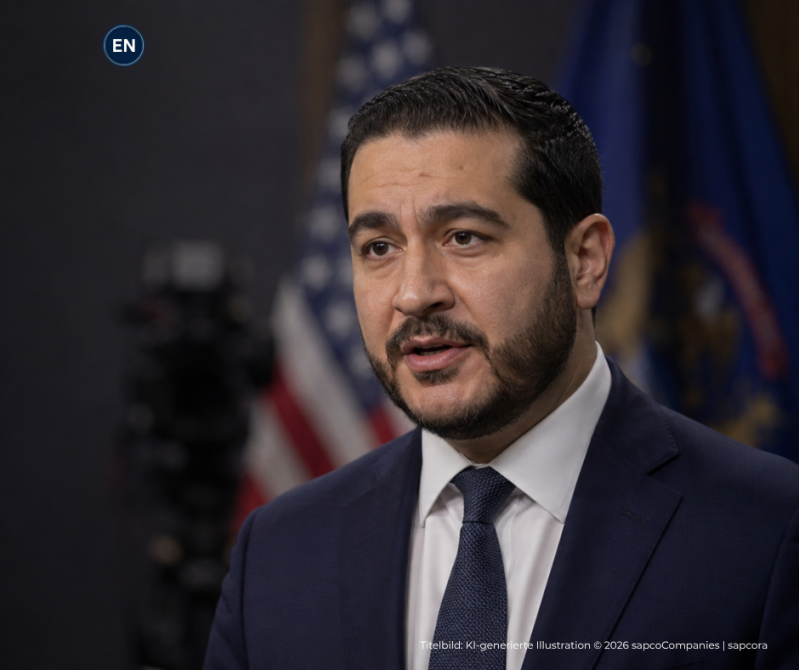
Abdul El Sayed has won Michigan’s Democratic Senate primary by less than one percentage point, defeating Representative Haley Stevens and a formidable alliance of party leaders and outside spending groups. His victory marks a serious breakthrough for the progressive wing of the Democratic Party, but it does not yet prove that the same coalition can win a statewide general election. The decisive test now comes against Republican Mike Rogers in a race that could help determine control of the United States Senate.
A narrow result with consequences far beyond Michigan
The margin was extraordinarily small. When the Associated Press declared El Sayed the winner, he led Stevens by 14,893 votes, just under one percentage point, with more than 1.5 million ballots counted. The final state certification was still pending at the time of publication, but the political outcome was no longer in serious doubt. El Sayed had secured the Democratic nomination for the open Senate seat being vacated by Gary Peters.
The scale of participation was itself notable. The contest surpassed turnout in previous Michigan Senate and gubernatorial primaries and approached levels normally associated with far more prominent statewide elections. That turnout strengthens El Sayed’s argument that his campaign mobilized voters who were dissatisfied with the party’s existing leadership. It does not, however, reveal whether those voters will appear in comparable numbers on November 3.
The establishment had the endorsements
Stevens entered the primary with the support of some of the most influential figures in Michigan and national Democratic politics. Governor Gretchen Whitmer, outgoing Senator Gary Peters and Senate Democratic leader Chuck Schumer all backed her candidacy.
Their case rested on experience and electability. Stevens had won competitive congressional races and presented herself as a candidate capable of holding suburban voters while maintaining support among organized labor and traditional Democratic constituencies.
El Sayed offered the opposite argument. He claimed that caution, institutional approval and carefully managed centrism had become political liabilities rather than guarantees of electoral success.
The result does not show that Stevens lacked a constituency. Nearly half of Democratic primary voters supported her, which makes any description of El Sayed’s victory as an overwhelming ideological mandate difficult to sustain.
What the result does show is that endorsements from the party hierarchy no longer settled the question. Democratic voters were willing to reject the candidate presented to them as the safer choice.
El Sayed built a campaign around power
El Sayed is a physician and former public health official who has never held elected office. He first attracted statewide attention during an unsuccessful campaign for governor in 2018, when he lost the Democratic primary to Whitmer by more than 20 percentage points.
His return to electoral politics was based on a sharper and more disciplined message. Medicare for All, higher taxes on concentrated wealth, campaign finance reform and an end to unconditional United States military assistance for Israel became the central pillars of his candidacy.
These positions were not presented as separate policy proposals. El Sayed framed them as parts of a single argument about political power, economic insecurity and the influence of wealthy interests over public policy.
His campaign also invested heavily in personal contact. El Sayed said he visited 110 cities and participated in more than 500 events, while his organization reported a volunteer network of approximately 12,000 people.
Those figures originated with the campaign and should be understood as such. The election result nevertheless indicates that the organization created something more substantial than online enthusiasm or national progressive attention.
The outsider was not financially powerless
El Sayed’s victory has frequently been presented as a triumph of a poorly financed insurgent against an overwhelmingly wealthy establishment. That description captures the imbalance in outside spending, but it does not fully describe the candidates’ own fundraising.
Federal Election Commission records show that El Sayed’s authorized campaign had reported approximately $14.5 million in receipts through July 15. Stevens’s Senate campaign had reported approximately $11.9 million during the same filing period.
El Sayed therefore raised more money through his own campaign than Stevens did through hers. He was an outsider in relation to the party establishment, but not a candidate without substantial financial resources.
The decisive imbalance existed outside the campaigns. Independent groups supporting Stevens or opposing El Sayed spent more than $60 million, creating a volume of advertising and political intervention far beyond the candidates’ direct budgets.
That distinction matters because the campaign finance system separates candidate committees from independent political organizations. The money spent by those groups was not transferred directly to Stevens and was not under the legal control of her campaign.
AIPAC’s intervention reached unprecedented dimensions
AIPAC and affiliated organizations accounted for more than $30 million of the outside spending behind Stevens. The intervention was the largest reported investment by the pro Israel network in a single race at that stage of the election cycle.
The spending largely took the form of independent advertising supporting Stevens or attacking El Sayed. There is no evidence that AIPAC made illegal payments to Stevens or that her campaign directly controlled the spending.
The political significance lies elsewhere. A legally independent organization invested an extraordinary sum in an effort to shape the outcome of a Democratic primary in one state.
The intervention reflected AIPAC’s determination to block candidates who oppose current levels of American military support for Israel. El Sayed had made ending unconditional military aid a central element of his campaign and had sharply criticized Israel’s conduct in Gaza and the West Bank.
AIPAC’s strategy was therefore understandable within its stated political objectives. The result, however, shows that the scale of the intervention did not produce the desired outcome.
The spending became an argument against itself
El Sayed turned the money deployed against him into evidence for his own campaign. Every additional advertisement allowed him to argue that concentrated financial power was attempting to override the preferences of Democratic voters.
He did not need to prove that Stevens was personally controlled by AIPAC. He needed only to convince enough voters that the volume of outside spending represented a political system they no longer trusted.
That distinction was central to the campaign’s effectiveness. The attack focused less on Stevens’s personal motives and more on the machinery surrounding her candidacy.
The result raises an uncomfortable question for outside spending groups. At what point does an attempt to define a candidate instead reinforce the candidate’s argument that wealthy institutions exercise excessive influence?
Michigan does not provide a definitive national answer. It does show that financial dominance can become politically counterproductive when voters interpret it as an attempt to predetermine their choice.
Gaza mattered, but the election was not only about Gaza
The war in Gaza, military assistance to Israel and the role of pro Israel organizations shaped the race. They influenced endorsements, advertising, donor activity and the national attention directed toward the primary.
Reducing El Sayed’s victory to foreign policy alone would nevertheless be misleading. His campaign connected the issue to healthcare costs, economic inequality, corporate power and distrust of Washington.
This broader structure was politically important. El Sayed did not ask voters to choose between domestic policy and foreign policy. He presented both as examples of a government whose priorities had become detached from the material concerns of ordinary citizens.
Stevens represented a more conventional Democratic position. She emphasized governing experience, support for Israel, industrial policy and the need to assemble a coalition broad enough to defeat Republicans. The closeness of the result shows that both arguments retained considerable support. El Sayed won the nomination, but the party’s internal dispute over Israel, economic policy and electoral strategy remains unresolved.
Michigan’s communities cannot be treated as a single bloc
Michigan is home to one of the largest Arab American populations in the United States. Opposition to Israel’s military campaign in Gaza has been especially intense in parts of the state, making the issue more electorally significant than it might be elsewhere.
That reality does not justify treating Arab American or Muslim voters as a uniform political bloc. These communities differ by religion, national origin, class, generation, geography and political outlook.
The statewide result alone cannot prove which demographic group determined the outcome. Detailed precinct data and turnout analysis will be required before strong conclusions can be drawn.
Reuters reported that Stevens performed more strongly in counties with significant working class and Black populations, while El Sayed did better among white voters with college degrees. Those patterns complicate the assumption that his victory can be explained primarily by Muslim or Arab American support.
El Sayed now faces the task of expanding his coalition. His outreach to Black and Jewish voters after the primary reflects an understanding that the general election requires a broader political base than the one that secured the nomination.
Why Zohran Mamdani appears in the trend cluster
The surge in online interest has also been associated with Zohran Mamdani, whose name appeared prominently in search clusters connected to El Sayed’s victory. Mamdani was not a candidate in Michigan and had no role in the Senate primary.
His name appears because search platforms group politically related queries. Users interested in younger progressive candidates, economic populism, criticism of Democratic institutions and opposition to Israeli government policy were searching for both figures.
The resulting description of a “Mamdani wave” is a political interpretation rather than an established movement. Similarities in rhetoric and voter frustration do not automatically create a national organization or a transferable electoral model.
El Sayed and Mamdani operate in different political environments and seek different offices. Their coalitions, institutional powers and general election challenges cannot be treated as interchangeable.
The comparison is still revealing. It shows that voters and political observers are searching for a larger pattern behind a series of progressive victories against establishment backed candidates.
A progressive breakthrough, not yet a realignment
El Sayed’s victory provides progressives with something they have long sought. It demonstrates that an openly left leaning candidate can win a statewide Democratic primary in one of the country’s most competitive states.
That is more significant than winning a deeply Democratic congressional district or municipal contest. Michigan is a battleground that Donald Trump carried in 2016 and again in 2024.
The result therefore extends the progressive argument into more difficult electoral territory. It suggests that economic populism, criticism of large donors and opposition to established foreign policy positions can mobilize a substantial statewide electorate.
It does not yet prove that such a coalition can defeat a Republican in a general election. Primary voters are more ideologically engaged, and the November electorate will include independents, moderate Democrats and Republicans who did not participate in the nomination contest.
The general election will determine whether El Sayed has discovered a broader political formula or merely won the argument inside his own party. Until that question is answered, claims of a national progressive realignment remain premature.
Party unity now has a credibility test
Democratic leaders moved quickly after the result. Schumer said the party would unite behind El Sayed, Peters endorsed him, and Stevens pledged to help Democrats retain the seat.
Those statements are necessary but insufficient. The same officials had spent months arguing, directly or indirectly, that Stevens was the stronger general election candidate.
They must now persuade voters that their support for El Sayed is genuine rather than procedural. A divided national party cannot afford to treat Michigan as an ideological experiment while relying on the seat for its Senate strategy.
El Sayed faces an equally difficult adjustment. He won by attacking the party establishment, but he cannot win in November by treating Stevens’s voters, donors and allies as permanent adversaries.
Nearly half of the primary electorate voted against him. His first strategic task is therefore not to celebrate the defeat of the establishment, but to absorb enough of its coalition without surrendering the identity that made his campaign successful.
Republicans have already chosen their attack
Mike Rogers and Republican campaign organizations immediately described El Sayed as too radical for Michigan. Their intention is to define him through his most progressive positions before he can introduce himself to a broader electorate.
The Republican argument will focus on Medicare for All, taxation, immigration, policing and Israel. It will also connect El Sayed to the national progressive left and portray his nomination as evidence that the Democratic Party has moved outside Michigan’s political mainstream.
Rogers enters the race with statewide campaign experience. He narrowly lost Michigan’s 2024 Senate election to Democrat Elissa Slotkin while Trump carried the state.
Republican organizations have already reserved approximately $45 million in Michigan advertising. AIPAC has also indicated that its opposition to El Sayed will continue in the general election.
El Sayed will therefore face a larger and more coordinated campaign than the one he overcame in the primary. The opposition will no longer be divided among Democrats debating the future of their party.
Michigan is close to indispensable for Democrats
Republicans currently control 53 Senate seats. Democrats and the two independents who caucus with them hold 47.
For Democrats, Michigan is a defensive necessity rather than an optional opportunity. The party must protect the open seat while also attempting to win several Republican held contests elsewhere.
Losing Michigan would make an already difficult route to a majority substantially narrower. It could also strengthen Republican control over legislation, federal appointments and judicial confirmations during the final two years of Trump’s current term.
The race therefore carries consequences far beyond El Sayed’s political career. His campaign has become a test of whether Democrats can defend a crucial battleground while changing the ideological composition of their own ticket.
That tension will define the next three months. The party needs El Sayed to preserve the energy that defeated Stevens while convincing skeptical voters that his program can function as a statewide governing agenda.
The first Muslim senator remains a possibility, not a result
El Sayed would become the first Muslim elected to the United States Senate if he defeats Rogers. The historical significance would be considerable in a country where Muslim Americans remain severely underrepresented in national office.
That possibility must not be confused with the current result. El Sayed has won a party nomination, not a Senate seat.
His religion will inevitably become part of the campaign, both as a source of symbolic importance and as a potential target for political attacks. Responsible coverage must distinguish legitimate scrutiny of his policies from insinuations based on faith, ancestry or identity.
The same standard applies to criticism of his position on Israel. Opposition to military assistance or to Israeli government policy is not in itself evidence of hostility toward Jewish people, just as allegations of antisemitism cannot be dismissed without examining the statements or conduct involved.
The general election will test whether Michigan’s political debate can maintain those distinctions. The early tone of the race suggests that the pressure to abandon them will be considerable.
The machine lost, but the larger verdict is still open
El Sayed achieved what powerful political institutions spent heavily to prevent. He defeated a sitting member of Congress, overcame the preferences of senior Democratic leaders and survived one of the most expensive primary interventions in recent American politics.
His victory exposes the limits of endorsements, advertising and inherited assumptions about electability. It also demonstrates that resistance to large donor influence has become an electoral force rather than merely a rhetorical position.
The result is not proof that money no longer matters. El Sayed raised substantial funds himself, benefited from supportive outside spending and now faces another wave of national investment against him.
Nor does the result prove that the Democratic Party has completed a progressive transformation. Stevens nearly won, and the voters who supported her remain essential to any Democratic victory in November. Michigan has delivered a warning, not a final judgment. The party establishment can no longer assume that money and institutional authority will settle its internal arguments, while the progressive left can no longer avoid proving that its victories can survive beyond the primary electorate. November will decide which lesson carries greater weight. Until then, Abdul El Sayed’s victory stands as a genuine political breakthrough whose national meaning remains unresolved.
Abdul El Sayed Wins Michigan Senate Primary Despite Massive Outside Spending. Abdul El Sayed defeated Haley Stevens in Michigan despite more than $60 million in outside spending. His victory challenges the Democratic establishment and places AIPAC’s political influence under renewed scrutiny.
Kommentar hinzufügen
Kommentare