

Rubric: Politics
Format: Special Report
Author: Sinisa Brkic (sb)
The bulk carrier EMIL, commercially managed by a Hamburg shipping company, was struck during a Russian attack near Odesa and temporarily left without propulsion. The incident does not amount to a military attack on Germany, but it exposes a widening threat to merchant shipping, Ukrainian exports, and the fragile security architecture of the Black Sea.
A German Shipping Connection, but Not a German-Flagged Vessel
A Russian drone attack has damaged the bulk carrier EMIL off the Ukrainian port city of Odesa, bringing the expanding maritime dimension of the war directly into the orbit of a German shipping company. The vessel is commercially linked to Hamburg-based Johann M. K. Blumenthal, but that connection requires careful description.
The EMIL should not simply be presented as a German ship. Public vessel databases identify a foreign registered owner and list companies associated with the Blumenthal group in commercial, technical, or safety management roles. Available databases also differ on the vessel’s current flag, with some listing Liberia and others the Cayman Islands. Until an authoritative registry entry for the date of the attack is established, the legally safer description is a foreign-flagged bulk carrier under German commercial management.
That distinction is more than a technicality. A ship’s flag determines its nationality under maritime law, while ownership, commercial management, technical supervision, and operational control may be divided among several companies in different jurisdictions. The German connection is commercially significant, but it does not transform the strike into a direct military attack on the Federal Republic of Germany.
Multiple Strikes, Fire and an Evacuated Crew
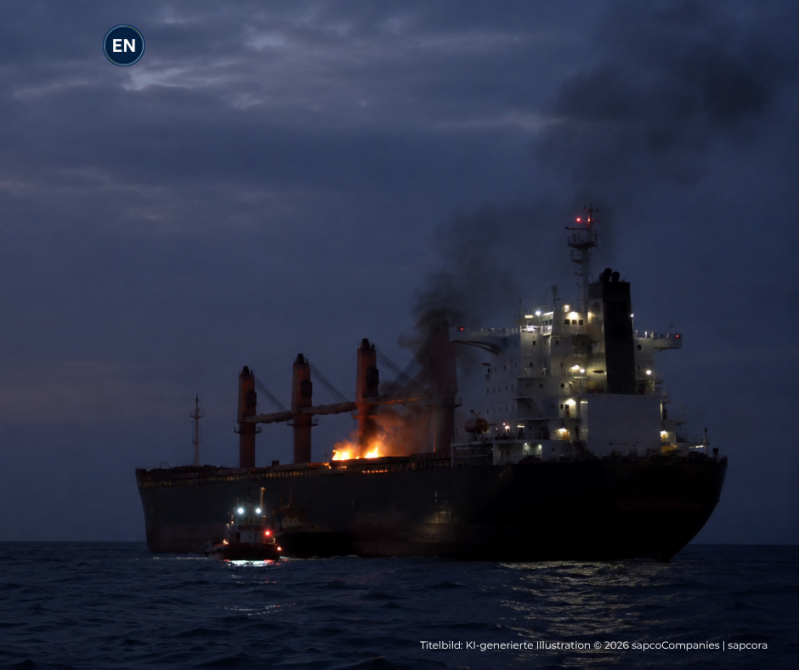
The vessel was reportedly hit on August 5 during attacks on shipping near Odesa. Fire broke out on board, technical systems were damaged, and the ship was at least temporarily unable to maneuver. The eleven crew members were evacuated, with no confirmed reports of injuries at the time of publication.
Several important details remain unresolved. The number of direct hits, the type of drone used, the vessel’s exact coordinates, the full extent of the damage, and its current operational condition have not yet been independently established. There is also no verified indication that the ship was selected because of its relationship with a German company.
Russia’s Defense Ministry said its forces had attacked three cargo vessels near Odesa and alleged that they were carrying military supplies for Ukraine. It did not publish independently verifiable evidence supporting that claim, and Reuters reported that it could not confirm the asserted nature of the cargo.
The distinction between a confirmed strike and an unverified justification is central. The damage to merchant vessels is documented through current reporting, while the claim that they were transporting weapons remains an allegation by a party to the conflict.
The Cargo Question Determines the Legal Assessment
Whether the EMIL was carrying civilian goods, military equipment, or dual-use cargo is not yet publicly established. That missing fact is decisive for any serious legal assessment of the attack.
Merchant ships do not automatically lose civilian protection merely because they enter a war zone or call at a Ukrainian port. Their status can change, however, if they make an effective contribution to military action and if their destruction offers a definite military advantage under the circumstances. Establishing those conditions requires more than a general accusation that a vessel was supporting Ukraine.
Even where a ship constitutes a lawful military objective, the attacking party remains bound by the principles of distinction, proportionality, and precautions in attack. Questions concerning the crew, surrounding civilian traffic, the vessel’s cargo, and the foreseeable environmental consequences remain relevant.
There is therefore no sound basis at this stage for describing the incident categorically as a war crime. There is equally no basis for accepting Russia’s account of a military cargo as fact. The legally responsible position is that the vessel’s use and cargo remain unverified and that any final judgment depends on evidence not yet available publicly.
The Black Sea Is Becoming a Direct Combat Zone for Commerce
The strike on the EMIL is not an isolated maritime incident. Russia and Ukraine have increasingly targeted ports, logistics sites, tankers, cargo vessels, and infrastructure linked to military and economic supply chains around the Black Sea.
On August 4, Turkey called on both countries to protect freedom of navigation after drones struck Turkish-controlled commercial vessels near the Russian port of Novorossiysk. Three crew members aboard the cargo ship Nadezhda were seriously injured, and all 22 people on board were evacuated. The origin of that attack had not been conclusively established when Turkish authorities issued their warning.
The incidents near Odesa and Novorossiysk show that the risk is no longer concentrated around one coastline or one belligerent’s ports. Commercial shipping can now be exposed while approaching Ukrainian terminals, leaving Russian harbors, or operating in waters where military and civilian logistics overlap.
This erosion of maritime predictability is strategically significant. The Black Sea is not merely a regional theater of war. It is a commercial corridor connecting agricultural producers, energy markets, industrial supply chains, and ports serving Europe, the Caucasus, the Middle East, and parts of Africa.
Shipping Companies Face a New Cost Calculation
For shipowners and charterers, the immediate question is not only whether a voyage remains physically possible. It is whether the commercial risk can still be priced, insured, and operationally controlled.
Repeated attacks can increase war-risk premiums, tighten underwriting conditions, and raise the cost of hiring vessels and crews for voyages to Ukrainian ports. Insurers may demand higher deductibles, impose narrower geographical limits, or withdraw coverage for particular routes with little notice.
Crews may also become harder to recruit for Black Sea operations. Seafarers are being asked to enter waters affected by drones, missiles, mines, electronic interference, damaged navigation systems, and uncertain rescue capacity. A voyage that remains profitable on paper can quickly become untenable if a ship cannot obtain insurance, trained personnel, port access, or emergency assistance.
The damage to one bulk carrier is therefore only the visible part of the economic risk. The wider consequence may be a gradual reduction in the number of operators willing to serve Ukrainian ports, accompanied by higher freight rates and increasingly fragile sailing schedules.
Ukrainian Exports Depend on Maritime Access
Ukraine’s Black Sea ports remain essential to the country’s export economy. Grain, oilseeds, metals, and other bulk commodities cannot be shifted entirely to road, rail, or Danube routes without major delays and additional cost.
Every successful attack on a merchant vessel reinforces the perception that voyages to Odesa and neighboring ports carry exceptional danger. Even when port infrastructure remains operational, uncertainty can reduce capacity by discouraging ships from entering the region.
The consequences extend beyond Ukraine. Countries in North Africa and the Middle East depend heavily on imported grain, and sudden disruptions can affect prices, public finances, and food security. The relationship is not automatic, since global prices also depend on harvests, inventories, currency movements, and alternative suppliers. Persistent interference with Ukrainian exports nevertheless adds pressure to an already politically sensitive market.
The threat to shipping therefore creates leverage far beyond the immediate battlefield. It places pressure on Ukraine’s revenue, raises the cost of international trade, and exports part of the war’s economic burden to states that are not parties to the conflict.
Germany’s Role Is Commercial Before It Is Political
The involvement of a Hamburg shipping group gives the incident immediate political relevance in Germany, but the likely first response will be consular, commercial, and diplomatic rather than military.
German authorities may seek information from the company, the flag state, Ukrainian officials, and maritime security partners. They may also assess whether German citizens, German-controlled assets, or insured commercial interests were affected. None of that should be confused with the collective defense questions that would arise from an attack on German territory or a German state vessel.
A stronger political reaction could follow if evidence showed that the vessel was deliberately selected because of its German management, that German nationals were harmed, or that Russia was systematically targeting ships connected to European companies. No such conclusion is currently supported by publicly verified evidence.
The German dimension matters because shipping companies operate through transnational corporate structures that blur conventional ideas of nationality. A vessel can be registered in one jurisdiction, owned through a company in another, managed from Hamburg or Singapore, insured in London, financed elsewhere, and crewed by several nationalities. Modern maritime commerce is international by design, which also means that an attack on one ship can create political consequences across several states.
Ankara’s Warning Carries Particular Weight
Turkey occupies a uniquely important position in the Black Sea. It controls access through the Bosporus and the Dardanelles under the Montreux Convention, maintains relations with both Moscow and Kyiv, and has repeatedly attempted to protect shipping and food-export arrangements from the wider conflict.
Its appeal for safer navigation reflects more than concern for Turkish companies. Ankara has a direct interest in preventing the Black Sea from becoming an unrestricted zone of maritime retaliation. A continuing series of attacks on commercial vessels would increase pressure on Turkey to intensify diplomatic engagement, maritime monitoring, and coordination with coastal states.
Turkey’s room for maneuver remains limited. It cannot guarantee the safety of ships operating near active combat zones, and any expanded security mechanism would require at least partial cooperation from Russia and Ukraine. Its warning nevertheless signals that the cumulative risk to trade has reached a level that regional governments can no longer treat as incidental.
What Must Still Be Established
A definitive account of the EMIL incident depends on several facts that remain unavailable. Investigators must establish the vessel’s precise position, heading, cargo status, port instructions, flag registration, and technical condition at the moment of impact.
They must also determine whether the drones were directed specifically at the ship, whether the vessel was struck during a broader attack on port infrastructure, and whether other ships were hit in the same operation. Satellite imagery, automatic identification system data, bridge records, damage patterns, crew testimony, and port documentation will be crucial.
The commercial structure surrounding the vessel also requires exact clarification. Public databases indicate separate registered ownership, commercial management, and safety-management entities, but such records can change and do not always reflect the full beneficial ownership structure. Any report claiming that the ship “belongs to Germany” or was operating under a German flag risks collapsing legally distinct categories into a politically charged shorthand.
A Maritime Threshold Is Being Tested
The strike on the EMIL does not establish that Russia has attacked Germany. It does establish that a vessel connected to a German shipping company has been drawn into an intensifying campaign against maritime logistics around Ukraine.
That distinction should prevent exaggeration, but it should not obscure the wider danger. Merchant ships are becoming increasingly exposed to military operations on both sides of the Black Sea, while the boundary between commercial transport and wartime logistics is being contested through force, accusation, and incomplete evidence.
The consequences will be measured not only in damaged steel and disrupted voyages. They will appear in insurance contracts, freight rates, crew decisions, diplomatic protests, export volumes, and food prices. The attack on the EMIL is therefore more than an incident involving one ship. It is another warning that the Black Sea’s commercial order is being steadily absorbed into the war.
Russian Drone Strike Hits German-Managed Cargo Ship near Odesa. A Russian drone strike damaged the German-managed bulk carrier EMIL near Odesa. The incident raises new concerns over civilian shipping, insurance costs, Ukrainian exports, and maritime security in the Black Sea.
Kommentar hinzufügen
Kommentare