

Section: Economy
Format: Special Report
Author: Sinisa Brkic (sb)
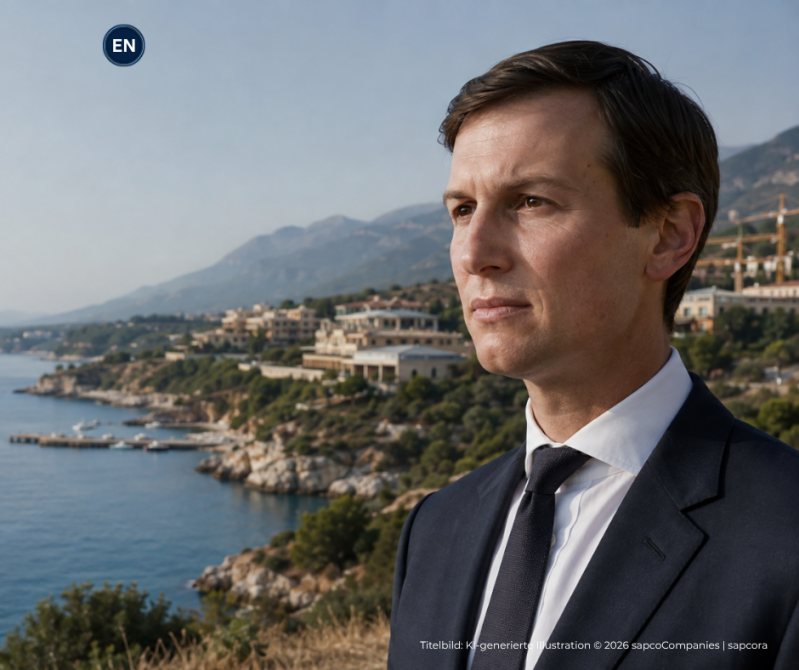
Jared Kushner’s investment push in Albania has grown into something far larger than a luxury resort story. At stake are billions of euros in planned development, valuable coastal land, Albania’s ambition to move decisively into high-end tourism, and the terms on which a relatively small European economy opens strategic assets to international capital. What began as an investment proposition has become a test of whether large-scale tourism development can generate durable economic value without weakening property rights, environmental safeguards and public confidence
Albania is trying to move up the tourism value chain
Albania’s tourism economy has expanded rapidly in recent years, making the country increasingly visible to European travelers and international investors. Tourism, construction and private consumption have become important drivers of economic growth, while the country continues to attract development capital along a coastline that remains considerably less built up than many competing Mediterranean destinations. The International Monetary Fund has described Albania’s recent growth as strongly influenced by tourism, with economic expansion expected to remain solid in 2026.
For the government of Prime Minister Edi Rama, the next step is not simply attracting more visitors. The strategic objective is to attract wealthier visitors, internationally recognized hotel operators, luxury residential development, marinas and investors capable of shifting Albania toward the premium end of the Mediterranean tourism market. Kushner’s plans fit almost perfectly into that ambition.
The economic argument is straightforward. High-end tourism can generate substantially more revenue per visitor than mass tourism, while luxury resorts can support restaurants, marine services, construction, transportation, real estate and specialized employment. It can also raise the international profile of an entire destination, particularly when major global hospitality brands become involved.
The harder question is how much of that value ultimately remains in Albania.
Sazan is the formal centerpiece
The clearest part of the Kushner-linked investment structure concerns Sazan Island, located off the coast near Vlorë. In December 2024, Albania’s Strategic Investment Committee granted special strategic investor status to Atlantic Incubation Partners LLC for a proposed tourism project on the island. The official decision places the expected investment at €1.4 billion and projects approximately 1,000 jobs during the development and operational phases.
The planned development covers a construction footprint of approximately 45 hectares on an island with a total area of about 562 hectares. According to the government decision, the concept includes elite accommodation, high-standard residences, restaurants, recreational facilities and improvements to the existing marina. Development is intended to proceed in three phases.
This composition matters economically. The project is not based solely on hotel rooms and tourism revenue. Luxury residences and marina infrastructure create additional sources of value, particularly through property sales, long-term asset appreciation and premium waterfront access.
That makes Sazan as much a real estate investment as a tourism investment.
The Albanian state is not merely issuing permits
The Sazan structure also goes beyond a conventional private development in which an investor acquires land, secures permits and builds at its own expense. Albania’s strategic investment decision foresees state participation through a joint legal entity involving the Albanian Investment Corporation, the Albanian Seaports Development Company and Atlantic Incubation Partners.
State-owned property may be made available for the project subject to additional legal procedures and government decisions. The strategic investor framework also provides expedited administrative procedures and assistance with permits, licenses and authorizations. The final terms of the state’s participation, responsibilities and support measures require further agreements and legal steps.
Economically, this distinction is crucial. When public property, regulatory facilitation and state participation form part of a private investment structure, the relevant question is no longer only whether the investor is committing sufficient capital. The state must also determine whether the economic return to Albania adequately reflects the value of the assets, access and institutional support being contributed.
A €1.4 billion headline investment can therefore be impressive without answering the central public finance question: what exactly does Albania receive in exchange for what it provides?
Infrastructure costs reveal a more complicated equation
Sazan’s existing infrastructure is limited, a consequence of its former military role and decades of restricted civilian development. Albania’s own strategic investment decision acknowledges that the island lacks drinking water infrastructure and wastewater treatment capacity. It also identifies requirements involving electricity connections, waste management, maritime infrastructure and the handling of former military installations.
The official framework states that alternative water solutions are to be financed by the investor and that private resorts near bathing waters must construct individual wastewater treatment systems. Electricity connection costs are also expected to be borne by the party seeking access to the existing grid. These provisions reduce one potential area of direct public expenditure, although the broader division of infrastructure costs and public responsibilities depends on the final project structure.
For Albania, the economic opportunity is significant precisely because Sazan begins from such a low development base. New infrastructure could unlock an asset that previously generated relatively little commercial activity. Yet this also means the project’s profitability depends heavily on transforming publicly controlled territory into a highly valuable tourism and real estate destination.
That transformation itself has economic value. How that value is divided between investor and state is one of the most important questions surrounding the project.
Zvërnec dramatically increases the scale
The broader controversy concerns development around Zvërnec and the Vjosa-Narta coastal area opposite Sazan. Public descriptions have varied as plans have evolved, but Prime Minister Rama has referred to a wider investment of approximately €4 billion, while Reuters reported in June 2026 that the broader resort development was expected to cost around €5 billion. These figures should not be confused with the formal €1.4 billion investment attached specifically to the official Sazan strategic investor decision.
The distinction is important because public discussion has frequently merged Sazan and the mainland coastal development into a single project. In economic terms, however, they involve different land structures, regulatory questions and levels of disclosed information.
The mainland concept includes hotels, residential property, villas and other tourism infrastructure. If development on this scale proceeds, the combined effect could reshape the tourism economy around Vlorë and the wider southwestern coast, creating a new concentration of luxury accommodation and real estate investment.
Such a concentration can attract additional capital. It can also accelerate land prices far beyond what local wages and traditional economic activity can support.
The immediate winners are easier to identify than the long-term beneficiaries
Large resort developments generate an initial economic wave that is relatively easy to measure. Construction companies receive contracts, landowners can realize substantial gains, professional services earn fees, infrastructure spending increases and employment expands. Once resorts begin operating, hotels, restaurants, transport providers, yacht services and tourism suppliers gain new customers.
The deeper effects depend on ownership and procurement. If hotels import much of their equipment, employ large numbers of seasonal foreign workers, purchase services through international groups and transfer profits abroad, the domestic multiplier becomes smaller. If Albanian companies enter the supply chain, workers gain skills, local agriculture and food producers win contracts, and profits are reinvested domestically, the multiplier becomes considerably stronger.
The official Sazan decision projects 1,000 jobs, but employment numbers alone reveal little about the quality of the economic outcome. Wage levels, permanent versus seasonal work, local recruitment, management positions and opportunities for Albanian suppliers will matter more over time than the headline number itself.
That is why the economic case for the project cannot ultimately be judged by investment volume alone.
Luxury real estate changes the incentive structure
Luxury resorts increasingly operate through a mixed model combining hospitality with branded or premium residential property. From an investor’s perspective, residential sales can generate capital returns much earlier than a hotel relying primarily on operating income.
The Sazan proposal explicitly includes high-standard residential units alongside tourism accommodation and marina infrastructure. This means that part of the commercial logic rests on converting a previously inaccessible location into scarce, premium real estate.
Scarcity is precisely what makes such projects attractive. An island, a marina, controlled development density and proximity to untouched coastline create characteristics that cannot easily be replicated elsewhere.
For Albania, this creates both opportunity and risk. Rising land values can increase wealth, investment and tax revenues, but rapid appreciation can also transfer economic advantage toward those who control land before development begins. That makes transparent ownership records and legally secure property transfers fundamental to the project’s economic legitimacy.
The Zvërnec land dispute is now a financial risk
That issue has become particularly serious around Zvërnec. Residents have claimed that land intended for the resort was sold despite competing ownership claims, producing court disputes over property that had previously been confiscated during Albania’s communist era. Reuters reported that several villagers presented deeds and tax records supporting their claims.
The controversy escalated in July 2026 when Albanian prosecutors alleged that businessman Artur Shehu had used forged property documents in connection with coastal assets later sold to Albania Land Development. Prosecutors froze proceeds from the transaction. Shehu denies the allegations, and authorities have not accused Kushner, Sazan Real Estate Development, Albania Land Development or other project investors of wrongdoing or of knowing about the alleged irregularities when the land was acquired.
For investors, unresolved title risk is not a secondary legal inconvenience. It can affect financing, valuations, construction schedules, insurance and eventual sales. For Albania, it creates an equally serious problem because a tourism strategy based on attracting institutional foreign capital requires confidence that property ownership is both legally secure and politically defensible. A spectacular resort can market a country. A disputed title can market something else entirely.
Environmental protection has become an economic issue
The controversy surrounding the Vjosa-Narta area is often described principally as an environmental dispute, but its economic implications are substantial. The coastal wetlands and surrounding habitats form part of the natural capital on which Albania’s tourism appeal increasingly depends.
Environmental groups argue that large-scale development could damage sensitive habitats used by flamingos, sea turtles and other wildlife. Thousands of protesters have demonstrated against the plans, while the European Commission has urged Albania to ensure that its environmental legislation is aligned with EU standards. Prime Minister Rama has continued to defend the development while saying environmental requirements will be respected.
This matters because Albania is seeking European Union membership. Environmental compliance therefore has a value extending well beyond a single lagoon or development permit. If a multibillion-euro private project creates friction with EU accession requirements, the economic calculation changes immediately. The potential benefits of hotels, villas and investment must then be weighed against regulatory credibility, accession priorities and the long-term reputation of Albania as an investment jurisdiction.
The government sees a flagship project
Rama’s political and economic logic is not difficult to understand. Albania has a limited window in which to establish itself as a serious Mediterranean tourism market before coastal development becomes saturated. A globally recognizable investor, luxury hospitality operators and billions in private capital can accelerate that transformation dramatically.
The government argues that Albania should not reject exceptional investment simply because development on this scale is unfamiliar. Rama has repeatedly indicated that he intends the project to proceed and has presented it as part of a wider modernization strategy.
There is a credible economic case behind that position. Premium resorts can alter international perceptions faster than years of conventional tourism promotion, particularly in a destination still establishing its global identity. But flagship projects also create flagship risks.
Kushner’s interest is not difficult to understand either
For Kushner and his investment partners, Albania offers characteristics increasingly difficult to find elsewhere in the Mediterranean: undeveloped coastline, relatively low entry costs compared with established luxury markets, political support for major tourism investment and substantial potential for land appreciation.
The business opportunity is therefore broader than operating luxury hotels. It involves creating an entirely new high-value destination and capturing part of the increase in property value produced by that transformation.
Kushner’s investment ecosystem has significant access to international capital. Affinity Partners reported billions of dollars under management after receiving substantial commitments from Middle Eastern investors, although the precise financing structure of the Albanian developments has not been fully disclosed publicly. The existence of Gulf capital in Affinity should therefore not automatically be treated as proof that particular sovereign funds are financing the Albanian resorts.
What is clear is that Albania offers a type of opportunity attractive to large private investors: a market where relatively early positioning can produce substantial gains if the country successfully develops into a premium tourism destination.
Albania’s real test is value capture
The central economic question is therefore not whether Albania needs foreign investment. It does, and successful foreign investment has an important role in accelerating development, expanding infrastructure and integrating the country more deeply into international markets.
The relevant question is whether Albania has structured this investment so that public value grows alongside private value.
That requires more than jobs and construction spending. It requires transparent state participation, defensible land ownership, competitive procurement, meaningful opportunities for domestic businesses, enforceable environmental standards, clear infrastructure obligations and a tax structure capable of capturing part of the wealth created by increasingly valuable coastal assets.
Without those safeguards, Albania risks becoming a location where international capital benefits from scarcity while the state absorbs the political, institutional and environmental costs. With them, the same project could become an unusually powerful catalyst for a higher-value tourism economy.
Billions do not settle the argument
The size of the proposed investment gives the Kushner-linked developments extraordinary economic weight. The official Sazan project alone is valued at €1.4 billion, while public estimates for the broader coastal ambition run into several billion euros. In a country of Albania’s size, those numbers guarantee attention. But investment volume is an input, not a verdict.
The ultimate measure of success will be whether Albania converts private capital into lasting national value while retaining confidence in its property system, environmental governance and public institutions. If it does, Sazan and Zvërnec could mark the moment Albania entered a different class of Mediterranean tourism. If it does not, the resorts may still become extraordinarily valuable. The more uncomfortable question would then be: valuable for whom?
Jared Kushner’s Albania Investment: Billions, Tourism and Economic Interests. Jared Kushner’s Albania projects promise billions in investment and a new luxury tourism market. A special report examines the economic interests, potential gains, public exposure and growing risks behind Sazan and Zvërnec.
Kommentar hinzufügen
Kommentare