

Section: Geopolitics
Format: Special Report
Author: Sinisa Brkic (sb)
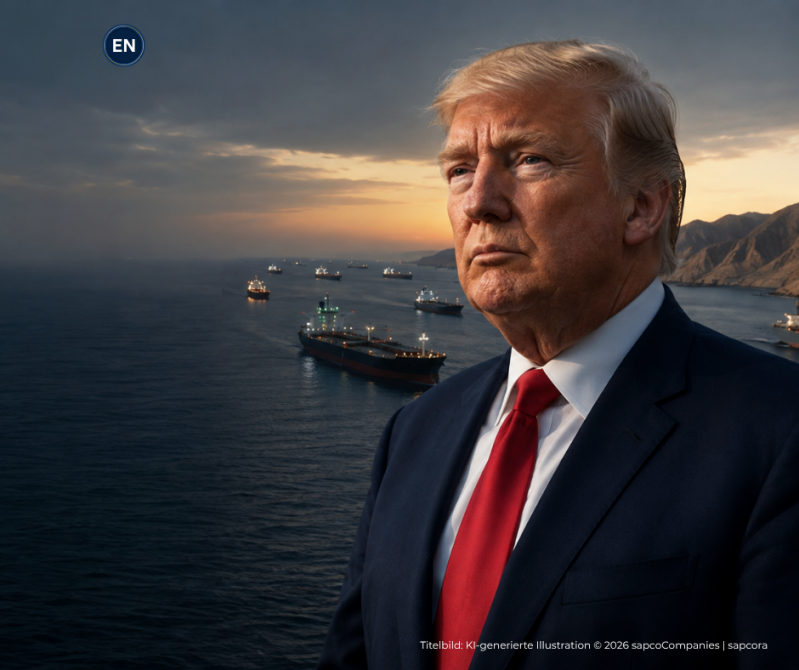
Donald Trump is signaling a more restrained approach toward Iran just as Tehran and Oman move closer to an agreement over shipping through the Strait of Hormuz. But the shift in tone should not be mistaken for peace. The waterway remains severely disrupted, Washington and Tehran are still divided over the terms of any durable settlement, and Hormuz has become the place where military pressure, diplomacy and the global energy economy now converge.
Trump is changing the tone, not ending the confrontation
Donald Trump has noticeably softened the public language surrounding the confrontation with Iran. Rather than emphasizing another immediate large scale military escalation, the US president is now placing greater emphasis on the economic pressure being applied to Tehran.
That is a meaningful shift, but not a strategic retreat. Washington still holds substantial military leverage, sanctions remain a central instrument of US policy, and the wider confrontation between the two countries has not been resolved. The current approach suggests that Trump is prepared to give economic pressure and indirect diplomacy more room before deciding whether another major military operation is necessary.
For investors, governments and consumers, that distinction matters. A quieter White House does not mean a settled Middle East. It means the conflict has entered another phase in which coercion and negotiation are being pursued at the same time.
There was already a deal once
The present diplomacy does not begin from zero. Washington and Tehran reached a memorandum of understanding in June that established terms for resuming oil shipping through the Strait of Hormuz and contributed to a temporary ceasefire.
That arrangement did not hold. Hostilities resumed in July amid disputes over implementation, and Iran now argues that Washington breached the interim understanding. Tehran says direct negotiations with the United States will not resume while those commitments remain unfulfilled.
This history is crucial because it changes the meaning of the latest optimism. The issue is no longer whether the two sides can produce a diplomatic document. They already have. The harder question is whether any new arrangement can survive implementation once military, political and economic interests begin to collide.
Hormuz is now the real test
The most concrete diplomatic development is taking place between Iran and Oman. The two countries are working on an arrangement intended to define new shipping routes through the Strait of Hormuz, one of the most important maritime corridors in the global economy.
Iranian Foreign Minister Abbas Araqchi has described those negotiations as being in their final stages. Washington has also indicated that it expects progress and has linked changes to its own maritime measures to Iranian compliance.
Yet the potential Iran Oman agreement must be understood precisely. It does not amount to a peace treaty between Washington and Tehran, and it does not automatically guarantee the full and unrestricted reopening of Hormuz. Iran has made that point explicitly.
Tehran wants far more than open shipping lanes
Iran is linking a broader reopening of the strait to demands directed at Washington. Those demands include sanctions relief, access to frozen Iranian assets, compensation related to US and Israeli attacks and an end to what Tehran describes as military threats and aggression against Iran and its allies.
Those conditions move the dispute far beyond maritime administration. Hormuz has become bargaining power.
The United States has taken a markedly different position. Washington has insisted that international shipping must be able to move through the strait without attacks, obstruction or compulsory tolls. US officials have also sought explicit Iranian commitments that all shipping lanes will remain accessible. The disagreement is therefore not merely about how vessels should navigate a narrow body of water. It concerns who exercises power over one of the most strategically important trade routes on earth.
A signed agreement would only be the beginning
Even if Iran and Oman announce a deal, normal commercial traffic would not necessarily return immediately. Shipowners, insurers, banks, governments and energy companies would first have to determine whether the resulting system is safe, legally workable and commercially viable. Questions surrounding inspections, Iranian control over entry into the Gulf and possible transit payments remain particularly sensitive.
Proposals discussed during the negotiations have included competing approaches to fees and oversight. Washington has opposed mandatory charges, while Iranian proposals have sought considerably greater authority over ships entering the Gulf. Oman has attempted to develop a regional mechanism capable of bridging those positions.
The legal dimension is equally significant. Payments involving sanctioned Iranian entities could expose international companies to compliance risks. A political agreement that major insurers will not cover or major shipping companies cannot legally use would have limited practical value.
For that reason, the decisive indicator will not be a ceremony or a diplomatic statement. It will be ships moving through Hormuz regularly, safely and commercially.
The war is not over
The clearest conclusion from the current evidence is also the most important one: the US Iran confrontation has not reached a final settlement. The June understanding produced a temporary pause but failed to create a durable resolution. Direct high level negotiations are not currently functioning as a normal diplomatic channel, and Tehran continues to condition further engagement on Washington fulfilling previous commitments.
Nor has Trump permanently excluded renewed military action. A more restrained approach today does not remove that option tomorrow. The current moment is therefore better described as a possible transition than an end to the war. There is more diplomatic space than during the most intense phases of the conflict, but the underlying disputes remain largely intact.
Hormuz can move the global economy in hours
The economic importance of the Strait of Hormuz is difficult to overstate. Before the current disruption, almost 20 million barrels of oil and petroleum products moved through the passage each day. Around 80 percent of those volumes were destined for Asian markets.
Liquefied natural gas is another major vulnerability. More than 110 billion cubic meters of LNG moved through Hormuz in 2025, representing almost one fifth of global LNG trade. Qatar and the United Arab Emirates depend particularly heavily on the passage for exports, and there are no equivalent maritime alternatives capable of replacing those flows at scale. This concentration explains why even limited diplomatic signals can move commodity markets within hours.
Oil prices fell sharply during the previous week as traders became more optimistic that an arrangement could restore greater traffic through Hormuz. By Monday, however, Brent crude had moved back above 84 dollars per barrel as Iran tempered expectations of a rapid reopening. The market is revealing something important. It is not pricing peace. It is continuously repricing the probability that energy can move safely through the Gulf.
India sits directly in the line of economic risk
The intense interest in the conflict across India is not difficult to explain. Few major economies combine India’s scale, rapid energy demand growth and dependence on imported fuel. India imports close to 90 percent of the crude oil it consumes. Middle Eastern producers remain strategically important suppliers, even as Indian refiners have diversified purchases across Russia, the Americas and other markets.
Hormuz therefore matters directly to Indian inflation, transportation costs, industrial production and household energy bills. The exposure extends well beyond crude oil. Asian buyers receive the overwhelming majority of LNG exported through the strait, and India is among the economies highly dependent on Gulf gas supplies.
A prolonged disruption can consequently move through the Indian economy by several routes at once. It can raise crude acquisition costs, increase freight and insurance expenses, tighten LNG availability and place pressure on domestic fuel and cooking gas markets. For New Delhi, Hormuz is not a remote geopolitical crisis. It is an energy security problem with domestic economic consequences.
India’s reserves require an important distinction
The crisis has also intensified discussion about the depth of India’s emergency energy protection. India possesses commercial crude and refined product inventories in addition to government controlled strategic petroleum reserves. Taken together, those different categories can provide considerably more coverage than the country’s dedicated strategic reserve alone. The distinction matters because India’s government controlled strategic crude storage remains relatively limited. Existing strategic facilities hold about 5.3 million metric tons, with additional capacity under construction. India currently lacks equivalent national strategic reserves for LNG and LPG.
New Delhi is now considering a much larger fuel security program that could extend strategic stockpiling beyond crude oil. The proposal under discussion is worth roughly 42 billion dollars and could eventually create buffers covering crude, LNG and LPG. It is not yet a fully implemented policy. Any consumer levies associated with financing the system would still require political approval.
The Hormuz crisis has nevertheless exposed the strategic logic behind the proposal. A country importing most of its energy cannot treat emergency storage merely as an inventory question. It is part of national economic security.
Trump faces his own economic pressure
The conflict also creates a political dilemma for the White House. A renewed major military escalation could push oil prices sharply higher, increase transportation and production costs and place renewed pressure on US consumers. That would carry domestic consequences at a politically sensitive moment. A compromise also carries risks for Trump. Any arrangement that appears to grant Tehran lasting control over access to Hormuz could be attacked as a concession after months of military pressure.
The third option, maintaining an unstable confrontation without resolving the shipping crisis, imposes continuing costs of its own. Energy markets remain volatile, commercial shipping remains exposed and every new attack can immediately alter expectations.
Economic pressure gives Trump a way to remain confrontational without automatically moving to another major bombing campaign. Whether that strategy produces concessions from Tehran is a different question.
Oil prices depend on what happens at sea
The next decisive signal for energy markets will not come from political rhetoric. It will come from vessel movements. If tankers begin returning to Hormuz in significant numbers, war risk insurance premiums decline and Gulf exports normalize, the geopolitical premium embedded in crude prices could fall further. If the negotiations fail, shipping remains restricted or attacks resume, that premium could return just as quickly.
The consequences would not stop with crude oil. LNG prices, freight rates, maritime insurance and refining costs are all tied to the security of Gulf shipping. Consumer fuel prices would eventually reflect some of those movements, although national taxation, refining margins, currencies and government intervention would determine how quickly. Claims that a Hormuz agreement will automatically produce cheap gasoline are therefore premature. Lower geopolitical risk can reduce oil prices. It cannot guarantee the final price paid by consumers.
The real test begins after the announcement
An Iran Oman agreement could become an important diplomatic breakthrough. It may create a workable mechanism for restoring larger volumes of commercial shipping and reducing one of the most dangerous economic consequences of the conflict. But it would not, by itself, settle the confrontation between Iran and the United States. The real test begins once an agreement has to work in practice. Iran would have to permit predictable maritime passage. Washington would have to decide which conditions it can accept. Shipping companies and insurers would have to return. Military restraint would have to survive the next provocation.
Trump has lowered the temperature. Tehran has opened a diplomatic channel through Oman. Markets have begun to respond. None of that amounts to peace. For now, Hormuz remains the point where diplomacy must prove that it is stronger than the forces pulling the region back toward escalation. Until commercial ships can cross the strait routinely and without extraordinary political or military risk, the most important passage in the global energy system remains unresolved.
Trump, Iran and Hormuz: Why the Strait Now Holds the Key. Trump is signaling restraint toward Iran as Hormuz negotiations advance. But the war is not over, the strait is not fully open and global energy markets remain exposed.
Kommentar hinzufügen
Kommentare