

Rubric: USA / Politics
Format: Special Report
Author: Sinisa Brkic (sb)
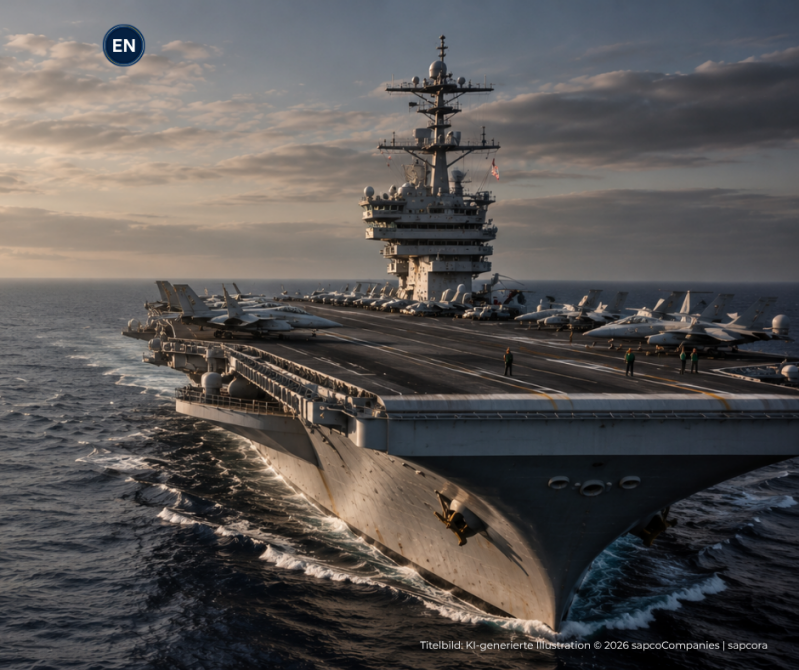
What began as a scheduled deployment has become an increasingly demanding test of American naval endurance. The USS Abraham Lincoln has been away from San Diego since November 2025, with roughly 5,000 sailors and Marines facing an extended mission, limited time in port and no publicly announced homecoming date. As the confrontation with Iran continues, questions about operational necessity are now converging with concerns about crew fatigue, living conditions and how long the Navy can sustain its current tempo.
A deployment that no longer resembles the original mission
The USS Abraham Lincoln left San Diego on November 21, 2025. The carrier strike group initially deployed into the Indo Pacific and was conducting routine operations in the Seventh Fleet area when the ship made a scheduled visit to Guam in December. By late January, however, the carrier had moved into the Middle East as Washington reinforced its military posture toward Iran.
That shift fundamentally changed the character of the deployment. The Lincoln became a central naval platform in Operation Epic Fury and subsequent US operations in the region, placing its air wing and crew inside an extended period of high operational demand. US Central Command has documented the carrier supporting operations in the Arabian Sea since February, while Navy reporting confirms that the strike group was positioned to support maritime security and regional stability.
The original expectation was that the deployment would conclude around May, according to reporting on Navy families and the crew. Instead, the mission continued into August, with no public return date. The result is no longer merely an unusually long absence from home, but an extended deployment in which combat operations, equipment demands and crew endurance are increasingly inseparable.
More than eight months away, with little time ashore
The numbers explain why the Lincoln is attracting attention far beyond traditional defense circles. About 5,000 sailors and Marines are serving with the carrier, and the ship has now been deployed for more than eight months. Following its brief Guam visit in December, the Lincoln reportedly spent about 208 consecutive days at sea before reaching Oman in July, a period widely described as a modern record for a US aircraft carrier.
Long carrier deployments are not unprecedented. The Lincoln itself completed a seven month deployment in 2022, while the USS Theodore Roosevelt returned from a nine month deployment in October 2024. What distinguishes the Lincoln’s present mission is the combination of length, sustained operations in a conflict zone and the unusually limited opportunities for the crew to leave the ship.
That distinction matters because deployment duration alone does not measure operational strain. A carrier can remain away from home for months while still receiving regular port calls and maintenance periods. Continuous operations at sea compress the opportunities for rest, resupply and repair, while the ship remains responsible for flight operations around the clock.
A carrier still operating at full tempo
The Navy continues to insist that the Lincoln remains capable of performing its mission. A Fifth Fleet spokesman said the carrier had supported more than 10,000 aircraft sorties over roughly eight months and remained fully capable of meeting assigned operational requirements. The statement is important because it separates concerns about conditions aboard the ship from any suggestion that the carrier itself has become operationally ineffective.
Yet the same figures illustrate the intensity of the workload. Aircraft carriers are among the most complex and dangerous working environments in the US military, even outside combat conditions. Reports from families describe long work schedules, problems with plumbing and laundry facilities, shortages of some everyday supplies and growing concern about exhaustion among personnel.
The Navy has acknowledged some of those concerns while disputing or qualifying others. Officials have said psychological readiness is continuously monitored and that counselors, chaplains and medical personnel are available aboard the carrier. Reports of serious mental health incidents have also emerged through family accounts, but the Navy has not publicly provided a verified number, making restraint essential when assessing individual cases.
Families are no longer asking only about morale
The pressure has increasingly moved ashore. More than 200 relatives attended a meeting with senior Navy leadership in San Diego, where families raised concerns about fatigue, living conditions, communication and the absence of a firm return date. Senior Navy officials acknowledged the strain on personnel and families but stopped short of providing a timetable for the carrier’s return.
That uncertainty may be the most consequential element of the deployment from the perspective of military families. Deployment is an established part of naval service, but the ability to plan around an expected return carries considerable importance for spouses, children and service members themselves. When a deployment is repeatedly extended without a publicly defined end point, operational flexibility for commanders becomes personal uncertainty for thousands of people at home.
The issue therefore extends beyond questions of comfort aboard one carrier. It touches readiness, retention and the limits of a force structure expected to sustain major commitments across several regions at once. A Navy capable of keeping a carrier on station is not automatically a Navy that can do so indefinitely without accumulating costs in personnel, maintenance and future deployment cycles.
The Theodore Roosevelt is emerging as the key to relief
The clearest indication that the Lincoln’s deployment could eventually end is the USS Theodore Roosevelt. Acting Navy Secretary Hung Cao told families that the Theodore Roosevelt carrier strike group was being prepared to relieve the Lincoln, according to reports from the San Diego meeting. Officials have not disclosed when that transition could occur, citing operational security.
The Theodore Roosevelt was still in San Diego in early August, where it hosted a friends and family cruise on August 8. That public Navy activity confirms the carrier was at home only days ago, meaning any eventual relief operation involves preparation, transit and integration into an active theater rather than an immediate handover.
For the Lincoln’s crew, the distinction is substantial. A replacement carrier being prepared is evidence of movement toward relief, but it is not the same as a confirmed return date. Until the Navy announces a transition or the Theodore Roosevelt begins the relevant deployment, expectations about the Lincoln’s homecoming remain estimates rather than facts.
Iran keeps the operational equation open
The reason Washington is reluctant to publish a simple timetable lies in the broader conflict. US operations against Iran remain active, maritime security in the Gulf of Oman and surrounding waterways remains unstable, and diplomatic efforts have yet to produce a durable settlement. Reuters reported on August 12 that an Iranian official rejected claims that talks were underway to extend the ceasefire, while attacks on shipping and disputes over the Strait of Hormuz continue to complicate the strategic picture.
That leaves the Lincoln caught between two competing imperatives. US commanders want sufficient carrier power available for contingencies involving Iran, shipping routes and regional forces, while the Navy must also rotate crews and preserve readiness for the next crisis. Carrier availability is therefore not simply a scheduling question. It is part of the United States’ wider calculation about how much military presence it believes the Middle East still requires.
The real question is how long the system can absorb the strain
The USS Abraham Lincoln remains combat capable, and there is no verified evidence that the carrier can no longer perform its assigned mission. The more difficult question is whether maintaining that capability through prolonged deployment is creating costs that become visible only later, through exhausted crews, deferred maintenance, disrupted families and pressure on future fleet rotations.
For now, the Navy has offered one important signal but not the answer families are waiting for. A replacement is being prepared, but the Lincoln has no publicly confirmed homecoming date. Until that changes, the carrier remains both a symbol of American military reach in the Middle East and an increasingly visible measure of what sustaining that reach demands from the people ordered to keep it there.
USS Abraham Lincoln Deployment Extended as Iran Mission Strains Crew. The USS Abraham Lincoln deployment has stretched into its ninth month amid the Iran conflict, raising questions about crew strain, operational demands and when the carrier could finally return home.
Kommentar hinzufügen
Kommentare