

Rubric: Politics
Format: Special Report
Author: Sinisa Brkic (sb)
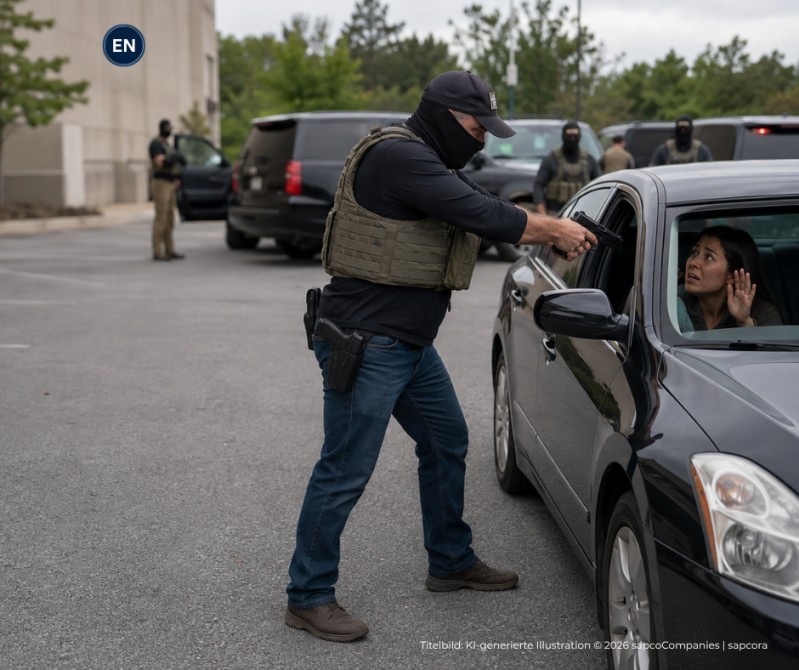
A confrontation in Northern Virginia is drawing national attention after video showed a masked ICE officer pointing a handgun at 36-year-old U.S. citizen Carolina Molina. Federal officials say Molina tried to endanger agents with her vehicle, an allegation she firmly denies, while publicly released dashcam footage does not show her attempting to strike them. The dispute has turned a brief encounter in a parking lot into a larger test of evidence, federal authority and accountability.
A confrontation captured from two cameras
The encounter occurred on August 10 near Falls Church, Virginia, where Molina, a licensed professional counselor, said she was visiting law offices to distribute business cards. Her work includes psychological evaluations connected to immigration cases. While driving through the area, she encountered federal immigration officers involved in an enforcement operation and shouted an insult toward one of them.
Video from Molina’s vehicle shows her moving through the parking area before several unmarked vehicles converge around her car. Cellphone footage then captures a masked ICE officer at her driver’s side window with a handgun pointed toward her while accusing her of nearly running agents over. Molina rejects the accusation immediately and tells the officers that she has dashcam video.
She was not arrested. The officers collected information, according to the Department of Homeland Security, and Molina was ultimately allowed to leave.
DHS and Molina describe fundamentally different events
The central dispute concerns what happened before the firearm appeared.
DHS says Molina drove her vehicle around ICE personnel and attempted to harm officers by using the car against them. The department says the agents feared for their safety and stopped her vehicle as a result. Federal officials have also said she could potentially face criminal prosecution.
Molina gives a sharply different account. She says she never tried to strike or threaten the officers with her car and argues that the accusation emerged during the confrontation after agents blocked her vehicle. Her account is supported in part by publicly released dashcam footage showing the moments leading into the encounter, although the available recordings cannot by themselves establish every fact that may ultimately be relevant to a legal review.
That distinction matters. The footage creates serious questions about the federal description, but responsible reporting cannot convert those questions into a finding of criminal innocence or official misconduct before the complete evidentiary record is known.
What the dashcam shows, and what it does not
The public video is important precisely because it captures more than the moment when the gun is already drawn. It shows Molina’s movements through the parking area, her verbal confrontation with officers and the positioning of federal vehicles immediately before agents approach her.
In the footage released publicly, Molina is not seen attempting to strike an officer with her vehicle. That places significant pressure on DHS to explain what specific conduct supports its allegation that she used the car as a weapon. It does not, however, rule out the existence of additional footage, officer observations or evidence that has not been made public.
Body camera recordings, complete federal vehicle footage and any contemporaneous reports prepared by the officers could therefore become critical. Until those materials are released or formally reviewed, the most accurate description remains straightforward: DHS alleges a vehicular threat, Molina denies one, and the publicly available video does not show the alleged attempt to hit agents.
What changes because Molina is a U.S. citizen
Molina repeatedly identified herself as a U.S. citizen during the encounter. That fact is legally significant, but not for the simplistic reason sometimes suggested in online discussion.
ICE officers do not lose all law enforcement authority when dealing with a citizen. Federal immigration officers can question individuals under defined circumstances and may have authority to detain or arrest people, including citizens, when sufficient lawful grounds exist for suspected federal criminal conduct. Citizenship therefore does not provide immunity from an otherwise lawful investigative stop.
It does, however, matter greatly when the basis for government action is immigration enforcement. Federal immigration authority does not permit officers to disregard the Fourth Amendment, and the Supreme Court has long held that broad immigration powers do not eliminate constitutional protections for citizens who may be stopped during enforcement activity. Any compulsory detention requires an adequate legal basis, while the force used during that detention remains subject to constitutional scrutiny.
Criticizing an officer is not the same as threatening one
There is no dispute that Molina verbally confronted the officers. Her language was confrontational and included profanity. That fact may explain why the encounter became heated, but it does not by itself resolve whether the subsequent stop or display of a firearm was legally justified.
The Supreme Court has recognized substantial First Amendment protection for verbal criticism and challenges directed at law enforcement officers. Protected speech does not give a person permission to interfere physically with an operation, assault an officer or use a vehicle as a weapon. Equally, offensive speech alone cannot simply be transformed into criminal conduct because an officer finds it provocative.
That makes the factual sequence unusually important. If agents had an independent and objectively reasonable basis to believe Molina presented a physical threat, the legal analysis changes substantially. If the escalation followed primarily from her verbal criticism without such a threat, a very different constitutional question emerges.
The gun is the most consequential moment
Pointing a firearm at a civilian is not a routine extension of an argument. It is a serious use of police authority, and its legality depends heavily on the circumstances confronting the officer at that moment.
Under established Fourth Amendment principles, force used by law enforcement is judged by objective reasonableness based on the facts known to the officer at the scene. The key issue is therefore not whether Molina was polite, politically sympathetic or personally confrontational. It is whether the officer had an objectively reasonable basis to perceive a threat serious enough to justify approaching her vehicle with a handgun drawn and pointed toward her.
The available videos make that question unavoidable. They do not provide a final legal answer.
Political pressure is beginning to build
Democratic Representative Don Beyer, whose district includes the area, said his office had been in contact with Molina and called for answers and consequences. Local officials and civil liberties advocates have also demanded greater transparency about the encounter.
The next stage will depend less on the viral cellphone clip than on evidence that remains outside public view. Any body camera recordings, internal reports, dispatch communications and additional surveillance footage could determine whether the federal account can be independently substantiated.
DHS has raised the possibility of criminal prosecution against Molina, but no publicly established criminal case against her has emerged from the encounter itself. The department also has not publicly established, through the material currently available, the precise sequence that it says constituted an attempt to harm its officers.
A dispute that now turns on evidence
The significance of the Molina case lies in its unusual evidentiary clarity and its remaining gaps. A federal officer can be seen pointing a gun at a U.S. citizen. DHS says that action followed a dangerous vehicular threat, while the woman at the center of the encounter says no such threat occurred.
Those accounts cannot both describe the crucial moments in the same way. The public video has made the federal government’s explanation testable in a manner that many enforcement encounters are not.
What matters now is not which version travels fastest online, but whether the government can substantiate the allegation that justified the stop and escalation. Until the complete record is available, that is the central unresolved question, and the one on which any serious judgment of the encounter must depend.
ICE Agent Points Gun at U.S. Citizen as Video Raises Questions About DHS Account. Video shows an ICE officer pointing a gun at U.S. citizen Carolina Molina in Virginia. DHS says she endangered agents with her car, while Molina denies the allegation and dashcam footage raises questions about the federal account.
Kommentar hinzufügen
Kommentare