

Section: Geopolitics
Format: Special Report
Author: Sinisa Brkic (sb)
South Korean troops fired warning shots after several North Korean soldiers crossed the Military Demarcation Line, creating a fresh security test on one of the world’s most heavily guarded frontiers. No exchange of fire followed and no casualties were reported, but the timing gives the incident unusual political weight as President Lee Jae myung calls for renewed dialogue with Pyongyang and major military exercises with the United States are about to begin.
A border incident without a battle
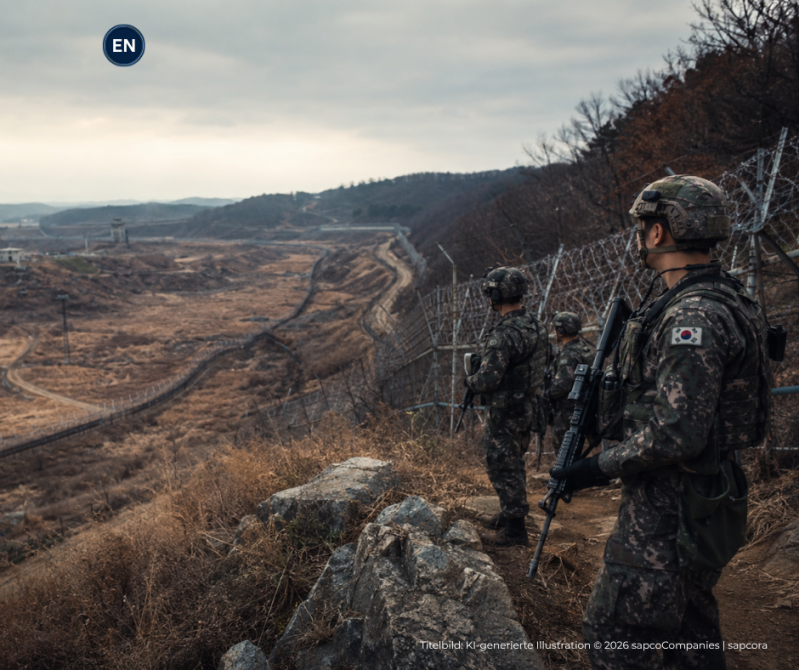
South Korean soldiers fired warning shots after several North Korean troops crossed the Military Demarcation Line along the eastern section of the inter Korean frontier. The North Korean soldiers subsequently returned to their side of the line, and South Korean military authorities reported no further unusual movement after the incident.
What happened is serious, but the limits of what is known matter just as much as the event itself. There is currently no confirmed evidence that North Korean troops opened fire, no indication that the incident developed into an armed exchange and no report of casualties. There is also no verified basis for describing the crossing as a deliberate attack or an attempted military incursion.
That distinction is essential. The Korean Peninsula remains one of the most militarized and politically sensitive regions in the world, and even limited incidents near the Demilitarized Zone can acquire strategic significance far beyond their immediate military dimension. But warning shots are not the same as a firefight, and a border violation is not automatically evidence of a planned provocation.
The central question remains unanswered
The most important unresolved issue is whether the North Korean soldiers crossed the line intentionally.
At present, that has not been established. Available reporting leaves open the possibility that the troops crossed during a patrol movement or entered the area unintentionally. Until more detailed information emerges about their route, distance across the line and behavior before South Korean troops reacted, any stronger interpretation would go beyond the evidence.
The number of soldiers involved and the precise circumstances surrounding the crossing also remain important. Those details will help determine whether the incident fits the pattern of a localized frontier mistake or whether it carried a more deliberate military signal.
According to South Korean reporting, this was the first known incident in 2026 in which North Korean soldiers crossed the Military Demarcation Line and South Korean forces responded with warning fire. Earlier this year, South Korea’s military had said that no comparable violations had been recorded up to that point. That makes the incident notable even without evidence of escalation.
Seoul is talking about peace
The political timing gives the episode its broader significance.
President Lee Jae myung has been attempting to reopen a diplomatic path toward North Korea. On August 15, he called for discussions aimed at establishing a more durable peace framework on the peninsula and ultimately moving beyond the armistice structure that has governed the divided Koreas since 1953.
The message from Seoul is therefore one of cautious engagement. Lee’s government is signaling that reducing confrontation and restoring dialogue should again become part of South Korea’s strategic approach toward the North. The warning shots at the border do not invalidate that policy. They do, however, expose the difficulty of pursuing it.
Seoul must simultaneously demonstrate openness to dialogue and maintain military credibility along a frontier where miscalculation can carry immediate consequences. The government cannot afford to appear passive in response to a border violation, but it also has little incentive to inflate an incident for which deliberate hostile intent has not been established. That balance may become one of the defining tests of Lee’s North Korea policy.
Military exercises raise the temperature
The incident also comes immediately before the start of Ulchi Freedom Shield, the major annual military exercises conducted by South Korea and the United States.
The drills are scheduled to begin on August 17. North Korea has already condemned them and has repeatedly portrayed joint United States and South Korean military exercises as evidence of hostile intentions toward Pyongyang. That creates a particularly sensitive environment around the border episode.
There is no confirmed evidence that the original crossing was connected to the exercises. Linking the two directly would therefore be speculative. Politically, however, the proximity matters because North Korea may choose to place the incident within its broader confrontation with Seoul and Washington.
Any official response from Pyongyang will be closely watched. A restrained reaction would support the interpretation of the crossing as an isolated military event. A sharper statement, military demonstration or renewed threat connected to Ulchi Freedom Shield could transform a limited border incident into a wider cycle of escalation.
A test of crisis management
The immediate military outcome was contained. South Korean troops responded, the North Korean soldiers withdrew and there was no reported exchange of fire. The larger question is whether the incident remains contained politically.
The Korean Peninsula has repeatedly shown how quickly routine military activity, political signaling and strategic mistrust can reinforce one another. A border incident does not need to begin as a deliberate provocation to become part of a broader confrontation once governments, militaries and state media begin interpreting it through competing security narratives.
For Seoul, that makes disciplined communication particularly important. The government has an interest in explaining clearly what happened while avoiding language that suggests certainty where none exists. For Pyongyang, the coming days will reveal whether it intends to let the episode pass or use it as another argument against military cooperation between South Korea and the United States.
The peace initiative now meets the reality of the border
The strongest significance of the incident lies not in the warning shots themselves but in the political contradiction they reveal.
South Korea is attempting to reopen the possibility of dialogue at precisely the moment when the military frontier reminds both sides how fragile the security environment remains. The two developments are not mutually exclusive. In fact, they describe the central challenge facing any renewed peace strategy on the Korean Peninsula.
Diplomacy must operate in parallel with deterrence. Engagement must survive incidents that can be interpreted as provocation. Military discipline must prevent local events from becoming strategic crises. For now, the border remained quiet after the warning shots. There is no confirmed evidence of a wider confrontation, no reported North Korean return fire and no indication of casualties.
But the political test has already begun. Lee’s peace initiative is entering an environment in which a few soldiers crossing a heavily guarded line can instantly become a question of regional security, alliance credibility and the future of relations between the two Koreas. How Seoul and Pyongyang handle the next move may matter more than the crossing itself.
South Korea Fires Warning Shots After North Korean Troops Cross DMZ. South Korean troops fired warning shots after North Korean soldiers crossed the Military Demarcation Line, putting Seoul’s new peace initiative under an early geopolitical test.
Kommentar hinzufügen
Kommentare