

Section: Technology & AI
Format: Special Report
Author: Sinisa Brkic (sb)
Flock cameras have become one of the most powerful and controversial tools in American policing, allowing agencies to search vehicle sightings across a rapidly expanding network of automated license plate readers. Now documented cases of alleged police misuse, new restrictions from Flock Safety and mounting resistance from cities are forcing a larger question into public view: how much vehicle tracking should law enforcement be able to conduct without a warrant?
What Flock cameras actually record
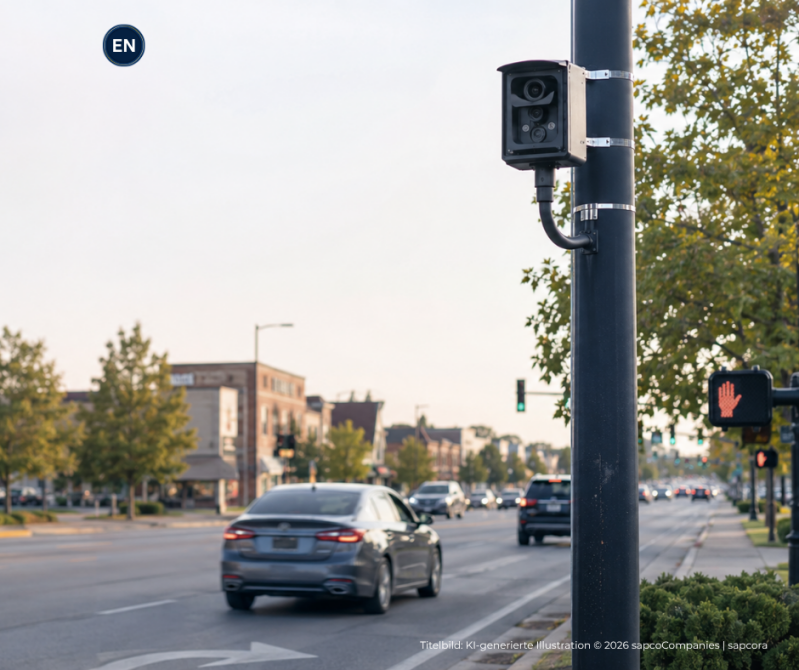
Flock Safety’s automated license plate readers, commonly called ALPRs, photograph vehicles traveling on public roads and record information that can include the license plate, vehicle make and model, color, distinguishing features, time and location. The resulting records can be searched by authorized users and, depending on local sharing arrangements, made available across agency boundaries. Flock does not describe the system as facial recognition technology, but its cameras can create a searchable record showing where a particular vehicle was observed.
That distinction is central to the dispute surrounding the technology. A single roadside image may look little different from conventional traffic monitoring. A network containing large numbers of cameras, searchable across locations and jurisdictions, can produce something considerably more consequential: a record of vehicle movements that investigators may be able to reconstruct after the fact.
Thousands of law enforcement agencies in 49 states use Flock’s network, according to reporting by the Associated Press. Police departments say the technology has helped locate missing people, identify stolen vehicles and find suspects in violent crimes. Critics argue that the same infrastructure gives authorities an unprecedented ability to search the movements of people who were never suspected of committing an offense.
The backlash is moving from activists to city governments
The debate is no longer confined to privacy organizations and technology policy circles. Municipal governments are increasingly being forced to decide whether Flock cameras should remain in operation, what restrictions should apply and who should be permitted to search the information they collect.
Milford, Connecticut, has temporarily halted the installation of additional automated license plate readers while officials reconsider the program. The move followed an August 3 Board of Aldermen meeting that stretched past midnight after more than three hours of public testimony. Sixty-four speakers raised concerns ranging from privacy and data security to possible Fourth Amendment implications. A special meeting is scheduled for August 27, with a public forum planned beforehand.
Milford is part of a wider pattern. More than 50 agencies or jurisdictions have canceled, suspended or rejected contracts, or deactivated cameras since the beginning of 2026, according to a tracker cited by the Associated Press. The resistance cuts across conventional political lines because the questions surrounding the system reach beyond ordinary debates about policing. They involve government surveillance, private technology providers, interstate data sharing and the practical limits of local oversight.
Alleged misuse exposed the weakness of internal controls
The privacy debate became considerably harder for Flock to contain after cases emerged in which police officers were accused of using the system for personal purposes rather than legitimate investigations.
In Florida, Haines City police officer Christopher Goodson was accused of searching his estranged wife’s vehicle in the Flock database 717 times between September 2024 and June 2026. Investigators alleged that the searches were conducted even though the woman was not connected to a criminal investigation. Goodson faces charges including official misconduct and an offense involving computer systems, and authorities said he was placed on administrative leave while the case remained under investigation.
The significance of such cases extends beyond the conduct of any individual officer. They expose the central vulnerability of large searchable surveillance databases: access controls matter only if improper searches are detected, challenged and punished. Once a system allows an authorized user to retrieve location records, the difference between legitimate investigation and personal surveillance can depend heavily on auditing, supervision and enforceable rules.
Recent reporting has identified numerous officers accused of unauthorized use of Flock technology, including searches involving current or former partners and family members. That record has transformed the privacy argument from a hypothetical warning about what could happen into a debate shaped by documented allegations of what apparently already has.
Flock is tightening its rules
Flock Safety responded on August 13 with a package of changes designed to strengthen privacy, security and accountability. The company is reducing its recommended default retention period for automated license plate reader data from 30 days to seven days, while introducing an evidence function that can preserve selected records for active investigations. Existing customers with previously approved retention policies may continue operating under those rules.
The company is also making its Audit Assistance system mandatory for law enforcement customers. The tool is designed to identify abnormal search behavior and flag it for review. Users will be required to associate searches with case codes, while emergency overrides can be subjected to additional scrutiny. Flock is also introducing controls that allow communities to restrict which types of investigations outside agencies may conduct using locally collected data.
Those changes are substantial because they address several of the vulnerabilities at the center of the controversy. They do not, however, end the underlying argument. Flock itself continues to leave important decisions, including some retention and data sharing choices, in the hands of individual customers and local governments. Critics maintain that stronger company policies cannot substitute for independent legal authorization when police want to reconstruct a person’s movements.
Can police search Flock cameras without a warrant?
There is no simple nationwide answer that makes every Flock database search either lawful or unlawful.
Courts have long recognized that drivers generally have a reduced expectation of privacy in a vehicle’s exterior while traveling on public roads. In one federal case involving Flock data, United States v. Martin, a federal district court in Virginia rejected a Fourth Amendment challenge to a warrantless database search where the available camera records produced only a limited picture of the defendant’s movements. The court distinguished that situation from more comprehensive forms of location tracking capable of reconstructing a person’s movements over time.
That distinction may become more important as networks grow. The constitutional question is not necessarily whether police may observe a license plate on a public street. The harder issue is whether thousands of automated observations, aggregated and searchable over time, become qualitatively different from an officer seeing a vehicle pass through an intersection.
Civil liberties advocates argue that extensive historical location searches should require judicial oversight. Flock and law enforcement supporters point to court decisions permitting ALPR use and emphasize the public safety value of rapidly identifying vehicles connected to crimes. No single rule currently resolves every use of a nationwide, interconnected license plate database.
The real issue is no longer whether the cameras work
Flock cameras can provide police with information that would have required far more time and manpower to collect through conventional investigation. That capability explains their rapid adoption. It also explains why the scrutiny surrounding them is intensifying.
The political question confronting American cities is increasingly about control rather than technical performance. Who may search the database, for what purpose, across which jurisdictions, for how long, and under whose authority are becoming the decisive questions.
Flock’s new safeguards acknowledge that technological access without meaningful oversight creates risks the company can no longer treat as theoretical. Municipal moratoriums and contract cancellations show that some communities are unwilling to leave those safeguards entirely to a private vendor or individual police department.
The next phase of the Flock debate will therefore be decided less by the cameras mounted beside American roads than by the rules governing the database behind them. As vehicle tracking becomes easier, cheaper and more interconnected, the boundary between useful investigative technology and persistent surveillance will depend on who is permitted to search, what they must prove before doing so and whether anyone outside the system is empowered to say no.
Flock Cameras: Why U.S. Cities Are Pushing Back on License Plate Tracking. Flock cameras are facing growing scrutiny across the U.S. as cities question police access, vehicle tracking, data retention and privacy protections.
Kommentar hinzufügen
Kommentare