

Rubric: Business
Format: Special Report
Author: Sinisa Brkic (sb)
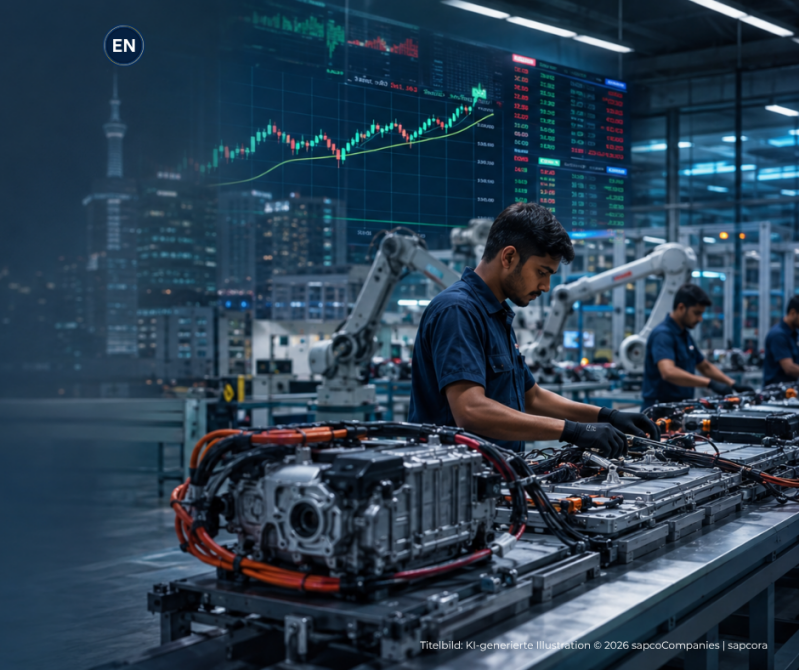
Dhoot Transmission made a striking entrance on India’s public markets, opening nearly 38 percent above its IPO price after an offering that drew extraordinary investor demand. Behind the first day surge lies a broader bet on India’s electric vehicle supply chain, but also questions about valuation, customer concentration and how much future growth the company can actually deliver.
A powerful opening for one of India’s newest listings
Dhoot Transmission began trading on India’s National Stock Exchange on August 17 at 1,200 rupees a share, well above its IPO price of 871 rupees. That represented a listing premium of about 37.8 percent, while the stock climbed as much as roughly 38.3 percent above the issue price during early trading.
The debut gave the automotive components manufacturer a market value of approximately 236.3 billion rupees, equivalent to about $2.47 billion. For a company historically associated with wiring harnesses and electrical systems, the valuation reflects more than enthusiasm for a successful IPO.
Investors are increasingly treating Dhoot as part of a much larger industrial shift. India’s expanding electric vehicle market is changing the economics of automotive supply chains, and companies positioned inside that transition are attracting growing attention from domestic and international capital.
Investor demand was already intense before trading began
The size of the first day gain did not emerge in isolation. Dhoot Transmission’s roughly 30.7 billion rupee offering was approximately 74 times subscribed by the final day of bidding, signaling demand far beyond the number of shares available.
That level of oversubscription is significant because it shows that enthusiasm was established before the stock reached the market. The listing gain therefore reflects not only speculative first day trading, but a broader willingness among investors to pay a premium for exposure to the company’s growth story. Major institutional participation added further weight to the transaction. Bain Capital is a significant financial investor in Dhoot Transmission, while BlackRock and the Abu Dhabi Investment Authority were among the anchor investors in the IPO.
The EV story is central to the valuation
Dhoot Transmission manufactures wiring harnesses and a range of electrical and electronic components used in vehicles. Its relevance to the electric vehicle market comes from the fact that EVs generally require greater electrical content and more complex wiring systems than conventional internal combustion vehicles.
The company is also expanding beyond traditional harnesses. Its portfolio includes battery assemblies, onboard chargers, DC to DC converters and charging connectors, placing Dhoot deeper inside the architecture required by electric vehicles.
That distinction matters. The market is not simply valuing a supplier of automotive wiring. Investors appear to be pricing in the possibility that Dhoot can increase the value of the components it supplies as Indian vehicle manufacturers accelerate electrification. The key question is whether that expansion can translate into sustained earnings growth. A strong market narrative can support a premium valuation, but eventually the company will have to demonstrate that its EV related businesses are growing fast enough to justify the expectations now attached to the stock.
Bajaj Auto is both a strength and a concentration risk
Dhoot’s relationship with Bajaj Auto gives the company an important position inside India’s vehicle manufacturing ecosystem. Bajaj is its largest customer and accounts for roughly one third of annual revenue, providing Dhoot with substantial business from one of India’s best known automotive manufacturers.
At the same time, that dependence creates concentration risk. A supplier generating such a significant share of revenue from one customer remains exposed to changes in production volumes, sourcing policies, pricing negotiations and future platform decisions.
This does not diminish the value of the relationship, but it places an important limit on the simpler version of the investment story. The durability of Dhoot’s growth will depend in part on whether it can expand its customer base while increasing the proportion of revenue generated by higher value electrical and EV components.
IPO proceeds could shape the next phase
The capital raised through the IPO is expected to support several strategic priorities. Dhoot plans to use proceeds for debt reduction, investment in a new wiring harness manufacturing facility, funding for subsidiaries and potential acquisitions.
Debt reduction could strengthen the balance sheet, while additional manufacturing capacity would give the company more room to capture rising demand. Acquisitions could also accelerate expansion into products or markets where organic development would take longer. Execution will now become more important than the strength of the listing. Once the excitement surrounding an IPO fades, investors typically turn their attention to margins, revenue growth, cash generation, capital discipline and the returns produced by new investment.
A wider signal from India’s IPO market
Dhoot’s debut also arrives during renewed activity in Indian equity issuance. Since July, 26 IPOs have reportedly been launched or announced in India, nearly as many as during the entire first half of 2026.
That revival matters because strong listings can reinforce confidence across the market. Successful deals encourage additional issuers, while institutional demand can deepen when investors believe newly listed companies are offering exposure to structural growth themes. Dhoot sits at the intersection of several of those themes. It is an industrial manufacturer linked to India’s domestic automotive market, an emerging supplier to the EV economy and now a newly public company benefiting from renewed appetite for Indian listings.
The first day is not the final verdict
A gain of almost 38 percent immediately attracts attention, but a listing premium is not proof that a stock will continue to perform. The market has already placed a substantial value on Dhoot Transmission’s future, meaning the company now faces the harder task of converting expectations into measurable operating results.
Its opportunity is clear. Greater vehicle electrification can increase demand for wiring systems, charging technology and electronic components, while new capacity and investment could expand the company’s reach.
The risks are equally visible. Customer concentration, execution challenges and a valuation lifted sharply by first day demand leave less room for disappointment. Dhoot Transmission’s debut therefore tells two stories at once. It is a powerful vote of confidence in an Indian automotive supplier positioned for the EV transition, but it is also the beginning of a much more demanding test: whether the business can grow into the valuation that investors assigned to it almost immediately.
Dhoot Transmission Shares Surge 38% in India IPO Debut. Dhoot Transmission jumped nearly 38% above its IPO price in its market debut as investors backed the Indian auto supplier’s growing exposure to electric vehicle components.
Kommentar hinzufügen
Kommentare