

Section: International
Format: INVESTIGATIONS
Author: Sinisa Brkic (sb)
It was built fast, opened without the inspection ICE policy required and backed by a service contract valued at up to $1.3 billion. Federal auditors later documented wasted millions, serious medical failures, inadequate oversight, a loaded firearm that disappeared inside the facility and evidence that was missing or destroyed after a detainee death classified as a homicide. The original contractor was replaced, but the camp remained open and ICE moved toward another massive sole-source contract to keep it running.
A Detention Camp Built at Government Speed
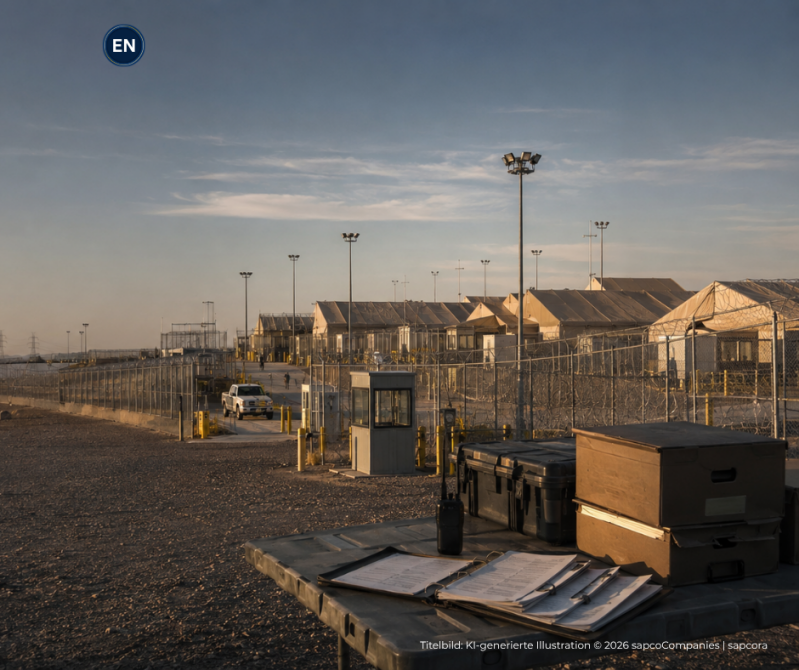
Camp East Montana sits on the grounds of Fort Bliss in El Paso, Texas. Despite the name, it is nowhere near the state of Montana. The sprawling complex of large, soft-sided structures was designed to hold as many as 5,000 people in federal immigration detention.
Its creation was driven by speed. After the Trump administration moved to rapidly expand immigration detention capacity in 2025, Immigration and Customs Enforcement sought space on military installations. ICE first attempted to procure the Fort Bliss facility itself, but one contract awarded in April 2025 was terminated three days later and another procurement effort in May failed.
The Army then took over the acquisition process. In July 2025, roughly one month after issuing its solicitation, it awarded a detention services contract valued at up to $1.3 billion, with a base period lasting only two and a half months and two option years attached. The facility was expected to reach an initial capacity of 1,000 detainees within 30 days and then expand rapidly toward 5,000.
Speed had become the organizing principle, and federal auditors would later conclude that it also contributed to serious operational problems. The issue was not simply that the government moved quickly, but that essential safeguards, contracting structures and oversight mechanisms did not keep pace.
A Contracting Method Built for Something Else
The Army used a contracting vehicle known as WEXMAC, the Worldwide Expeditionary Multiple Award Contract. It was designed to provide supplies and operational services for expeditionary needs, and according to the Government Accountability Office, this was the first time ICE officials knew of WEXMAC being used for detention facility services.
That choice narrowed the field to contractors already inside the WEXMAC pool. Most of the companies that submitted proposals had no previous experience providing detention services, and the winning contractor, Acquisition Logistics LLC, had no prior detention experience.
ICE contracting officials later told federal auditors that using the WEXMAC system contributed to the selection of a contractor facing a significant learning curve. They also raised concerns about the procurement method itself, which relied on a lowest price technically acceptable approach.
Under that model, once basic technical requirements were satisfied, price became decisive. ICE officials told the GAO that they normally did not use that approach for detention services because the work was too complex and the risk of unsuccessful performance was too high.
The Army had not consulted ICE contracting officials before making that choice. The government was building a detention facility for ICE while using a procurement structure that ICE itself did not consider suitable for this kind of operation.
The Facility Opened Before ICE Performed Its Required Inspection
Camp East Montana began receiving detainees in August 2025. It did so without a required pre-occupancy inspection by ICE’s Custody Management Division, which is supposed to determine whether a new detention facility complies with standards before people are housed inside it.
ICE officials told federal auditors that expedited timelines were the reason. When the facility opened, important requirements had not been met, including elements involving perimeter security cameras, accessible showers for people with disabilities, outdoor recreation space and facilities for attorney and family visits.
The GAO later stated that ICE still had obligations under federal law and its own detention standards to provide safe and humane conditions, even under accelerated timelines. Speed did not eliminate the standards, but it had overtaken the process designed to verify them.
Millions Were Spent Before Anyone Was Detained
The financial structure produced another problem almost immediately. The government began paying the full cost of guards, medical services, transportation, meals and other operations on August 1, 2025, although the first detainees did not arrive until August 16.
Federal auditors calculated that up to $11.5 million was wasted during those 15 days on services for a detention population that did not yet exist. The contract had been structured around fixed costs tied to capacity rather than actual population, creating a system in which lower occupancy did not automatically produce lower expenditure.
Between August 16 and September 30, the Army paid approximately another $423,000 for meals that were not needed. When ICE assumed responsibility for administering the contract in October, the same basic pricing problem continued.
1,600 People, Meals Priced for 5,000
By the end of February 2026, Camp East Montana held roughly 1,600 detainees. ICE was still paying the full meal cost associated with a population of 5,000.
The GAO calculated that ICE paid approximately $7.1 million for meals it did not need between October 1, 2025 and March 12, 2026. ICE officials told auditors that the contractor prepared food according to the actual population, meaning the problem was not necessarily thousands of meals being physically discarded but a pricing structure tied to unused capacity.
The contract also required all five housing units to remain operational despite the lower population. ICE officials argued that the units were needed to separate detainees according to gender, security classification and medical requirements, while auditors observed that individual housing units contained multiple dormitories capable of separating populations internally.
The central problem was therefore not merely that Camp East Montana was under capacity. It was that the contract had little ability to become cheaper when the population fell.
The Government Had Seen This Problem Before
The lesson was not entirely new. Federal auditors had previously identified similar waste at temporary border facilities, and other parts of the Department of Homeland Security had already adopted mechanisms allowing facilities to reduce operations when populations declined.
Those mechanisms included tiered pricing and the ability to place parts of a facility into reduced operational status. Camp East Montana did not initially use them, and ICE officials told the GAO that they had not sought lessons from Customs and Border Protection before the Army awarded the contract.
Institutional knowledge existed inside the federal government. It was not effectively transferred into the new detention contract, even though the financial risks of paying for unused capacity were already known.
Then the Medical Failures Appeared
The operational problems became more serious as the camp filled. In December 2025, ICE issued a discrepancy report after finding that tuberculosis screening was being conducted with symptom questionnaires rather than the required skin testing procedure at intake.
A detainee with tuberculosis had been housed with the general population. ICE medical officials visiting the facility that month also found broader failures in health care, including the absence of required comprehensive follow-up assessments after initial screenings.
Federal auditors reported that detainees with chronic illnesses were not receiving care in accordance with national detention standards. In the sample examined, none of the detainees with diabetes or HIV had treatment plans in place.
These findings did not originate with advocacy organizations or political opponents of ICE. They appeared in the federal government’s own audit of the facility.
A Loaded Gun Disappeared Inside the Camp
Security failures were not limited to detainee supervision. In January 2026, a contract security guard lost a loaded firearm somewhere inside Camp East Montana, triggering searches for the missing weapon.
As of March, according to an ICE official cited by the GAO, the firearm had not been recovered. The federal watchdog described the incident as creating a significant risk to staff, detainees and the public, including the possibility of unauthorized access to the weapon.
The episode turned an abstract oversight problem into something physical. A detention facility designed to control the movement of thousands of people had lost control of a loaded firearm inside its own perimeter.
A Detainee Died. The Medical Examiner Called It a Homicide.
On January 3, 2026, 55-year-old Cuban detainee Geraldo Lunas Campos died at Camp East Montana after an encounter with security personnel. An autopsy by the El Paso County Medical Examiner determined that he died from asphyxia caused by compression of his neck and torso, and the manner of death was classified as homicide.
That word requires precision. A medical finding of homicide means that the death resulted from the actions of another person, but it does not by itself establish murder, criminal intent or individual guilt.
ICE initially reported that Lunas Campos experienced medical distress. DHS later said he had attempted suicide and that security personnel intervened to save him while he resisted, while witness accounts reported by news organizations described the restraint differently.
Those competing accounts remain matters for investigators and, if charges are brought, the courts. The medical examiner’s classification establishes the manner of death, not criminal responsibility.
Required Reports Were Missing. So Was Evidence.
After Lunas Campos died, the contractor was required to provide ICE with use-of-force and death reports. According to the GAO, those required reports were not provided, and evidence associated with the incident was missing or destroyed.
The federal report did not establish who was responsible for the loss or destruction, whether it was intentional or exactly which evidence was affected. Any assertion that a specific person deliberately destroyed evidence would therefore go beyond what the available federal findings prove.
The verified facts remain serious. After a death later classified as a homicide, required reporting was incomplete and evidence connected to the incident was no longer fully available.
As of April 2026, ICE’s Office of Professional Responsibility investigation was on hold pending an ongoing criminal investigation. That means important questions surrounding the death remained unresolved.
Another Death Exposed the Suicide Prevention System
Eleven days after Lunas Campos died, 36-year-old Nicaraguan detainee Victor Manuel Diaz died at Camp East Montana. Federal auditors examined the circumstances as a failure involving suicide prevention procedures.
ICE standards required a person identified as being at risk to be placed in a suicide-resistant cell and monitored at intervals of no more than 15 minutes. According to the GAO, Diaz exhibited suicide risk factors but was placed in a medical holding room instead and was left unattended for periods longer than the required interval.
ICE officials had already raised concerns in October 2025 that medical holding rooms lacked vision panels, preventing staff from maintaining a direct line of sight. Those panels had not been installed by the time Diaz died in January.
The sequence matters because the weakness was known before the death occurred. The problem was not merely discovered afterward.
The Camp Accumulated Federal Violations
The problems were not confined to isolated incidents. ICE’s own oversight process documented failures across medical care, suicide prevention, use of force, security operations and other areas, while a February inspection identified dozens of deficiencies under national detention standards.
The GAO separately found eight discrepancy reports and an additional oversight report issued between December 2025 and early March 2026. Some concerned dramatic events, while others exposed the daily mechanics of a facility repeatedly failing to meet contractual expectations.
Dormitories were supposed to be cleaned and sanitized daily, but federal auditors found that some were being cleaned only weekly. Some contract security guards offered detainees cookies in exchange for cleaning their own housing areas.
Transportation failures caused delayed departure flights and rescheduled immigration hearings. In another incident, a detainee escaped in October 2025, and ICE oversight personnel attributed the escape to the contractor’s inability to account properly for people held at the facility.
The picture had moved well beyond a difficult startup experiencing minor defects. The federal government was documenting failures across several essential systems at the same time.
The Oversight Plan Was Missing Too
There was a deeper contracting weakness behind many of those problems. The government had not finalized a Quality Assurance Surveillance Plan for the original contract, the document intended to establish how federal officials monitor contractor performance, how frequently monitoring occurs and how deficiencies are measured.
Army and ICE officials told the GAO that the plan had not been included because of the accelerated timeline. That absence complicated the government’s ability to oversee the contractor and respond effectively when performance deteriorated.
Even when discrepancy reports were issued, ICE officials said they could not apply meaningful financial penalties because the contract lacked sufficient performance metrics and the necessary quality assurance framework. The government had built a massive detention operation around a private contractor and then discovered that key tools for holding that contractor financially accountable were not fully in place.
The Original Contractor Was Replaced
By March 2026, ICE was changing course. The agency awarded a new, initially undefinitized contract to Amentum Services Inc., a much larger federal contractor with extensive government experience, to take over detention operations, medical care, transportation and facility management.
The original Acquisition Logistics contract was terminated for convenience in April. This distinction matters because many of the most serious incidents documented by the GAO occurred while Acquisition Logistics was the prime contractor and should not simply be attributed to Amentum after the fact.
DHS presented the change as an improvement, saying the new arrangement would allow stronger oversight, greater on-site medical capacity and higher operational standards. The unresolved question was whether changing contractors could fix a system whose weaknesses had also originated in the government’s own procurement decisions.
A New Contractor Did Not Mean a New Camp
ICE initially turned to Amentum through a sole-source arrangement intended to prevent disruption in operations. The initial contract was valued at approximately $452 million.
In July, ICE published a justification for keeping Amentum at Camp East Montana through September 30, 2027 without conducting a full competitive procurement. The potential additional value was approximately $776 million.
If the contemplated period and contract value are fully realized, Amentum could receive more than $1.2 billion for operating Camp East Montana from 2026 through September 2027. That does not mean $1.2 billion has already been paid, because contract ceilings and potential values are not the same as funds already obligated or spent. The distinction is essential, but so is the scale. The government replaced the contractor without retreating from the billion-dollar detention model.
ICE Said Changing Again Would Be Too Risky
ICE’s justification for extending Amentum without a new competition reveals one of the most important institutional dilemmas in the story. The agency argued that moving detainees elsewhere would be impractical because sufficient alternative detention space was not available.
Changing contractors would also create operational problems. ICE cited Amentum’s proprietary infrastructure, the need to recruit or replace personnel and the costs and risks associated with another transition.
A lapse in contract coverage, the agency argued, could threaten detainee safety, disrupt enforcement operations and expose the government to operational, legal and humanitarian risks. Those concerns are not trivial, because a detention facility holding thousands of people cannot simply stop functioning when a contract expires.
The logic nevertheless exposes how emergency infrastructure can become difficult to unwind. A system can be built quickly, become operationally indispensable and then use that very dependence as the justification for continuity.
The Abuse Allegations Go Further Than the Federal Audit
Government findings are not the only accusations surrounding Camp East Montana. Human Rights Watch and the American Civil Liberties Union published a report in July alleging physical abuse, dangerous medical neglect, coercive removal practices and degrading conditions inside the facility.
A federal lawsuit filed on behalf of detainees contains additional allegations involving violence by guards, inadequate medical treatment, excessive isolation and unsafe conditions. Those allegations are serious, but they remain allegations rather than established judicial findings.
DHS has rejected claims that conditions at Camp East Montana are inhumane and has said ICE takes detainee health and safety seriously. The disputed claims should therefore not be presented as proven simply because they appear in litigation or advocacy reports.
What makes Camp East Montana particularly significant is that criticism of its performance does not depend on those allegations. A substantial portion of the documented case comes from the federal government’s own records.
The Government’s Own Watchdog Found the System Failing
The GAO did not base its conclusions on political rhetoric. Its investigators visited Camp East Montana, reviewed contracts, invoices, federal standards, internal ICE reports and acquisition documents, and interviewed Army personnel, ICE officials and contractors.
Their conclusions were direct. The expedited acquisition process contributed to negative operational outcomes, the government wasted millions and the facility opened without meeting key detention requirements.
Federal auditors also documented serious medical gaps, weaknesses in weapons control, inadequate oversight and a contract that lacked the flexibility needed to prevent continued spending on unused capacity. DHS agreed with the GAO’s recommendations and said it was taking corrective action, including moving toward tiered pricing and assessing lessons from the acquisition.
That response is important because it shows that the government itself accepts the need for substantial reform. The dispute is no longer about whether significant problems existed, but whether the lessons will alter the next wave of detention expansion.
Camp East Montana Is Not an Isolated Procurement Problem
The larger significance reaches well beyond El Paso. ICE is expanding detention on a scale that makes Camp East Montana a warning about future procurement rather than merely a troubled facility from the past year.
The GAO noted that ICE was preparing a new acquisition approach valued at approximately $38 billion, including plans involving the conversion of warehouses into detention facilities. Federal auditors explicitly warned that similar challenges could recur if the lessons from Camp East Montana were not incorporated into future contracting.
ICE had not previously undertaken warehouse conversion for detention at that scale. The agency was therefore moving toward another major expansion while still dealing with the consequences of an earlier rushed procurement.
That is why Camp East Montana matters nationally. It is a live case study in what happens when detention capacity becomes an urgent procurement objective and operational speed begins to outrun the systems designed to control cost, safety and accountability.
Detention Is a Government Power, Even When Contractors Run It
Private companies can build the structures, provide food, employ guards, arrange transportation and deliver medical services. The people inside, however, remain in federal custody.
That distinction cannot be outsourced. The government decides who is detained, chooses the contractual structure, sets the standards and determines whether those standards are being met.
When those systems fail, accountability cannot stop at the contractor’s corporate name. This is particularly true when the government itself created procurement conditions that federal auditors later identified as contributing to poor performance.
Camp East Montana exposes a recurring tension in privatized public power. The state can delegate operations, but it cannot delegate responsibility for the consequences of confinement carried out in its name.
The Billion-Dollar Question
The largest numbers surrounding Camp East Montana are easy to understand. The original Army-awarded contract carried a potential value of up to $1.3 billion, while the initial Amentum arrangement was worth approximately $452 million and the proposed extension could add another $776 million.
Federal auditors also identified tens of millions in waste or avoidable expenditure under poorly structured pricing. Yet the most important question is not simply how much the camp costs.
It is what the government received in return. The facility opened before the inspection required by ICE policy, medical systems failed detainees with serious chronic conditions, a loaded firearm disappeared and required reports after a death were not provided.
Evidence associated with that death was missing or destroyed, while another death exposed suicide prevention failures despite concerns that had already been identified. Federal auditors also found that the original quality assurance structure was insufficient to enforce accountability effectively.
This is not fundamentally a debate about whether the United States has authority to enforce immigration law. It is a debate about what happens after the government exercises that authority and assumes custody of another human being.
The Camp That Became Too Important to Disrupt
ICE’s argument for continuity contains the final paradox. Camp East Montana was created rapidly because the government said it needed detention capacity, but the speed of that process contributed to weaknesses later identified by federal auditors.
The original contractor was replaced, yet the facility became important enough that another competitive transition was considered too disruptive. What began as an emergency response had become infrastructure the government said it could not easily replace.
This is how temporary systems acquire permanence. Not every original choice needs to be defended once operational dependence has made reversal itself costly and risky.
Camp East Montana began as an answer to an urgent demand for detention space. Less than a year later, continuity was being defended because alternatives had become too difficult. At that point, procurement had become policy.
What Is Proven, What Is Alleged and What Remains Unknown
Several facts are established through federal records. Camp East Montana opened without the pre-occupancy inspection required by ICE policy, the government paid millions for unused capacity and unnecessary meal costs, and federal inspectors documented medical, security and oversight failures.
A loaded firearm was lost and had not been recovered as of the period covered by the GAO review. The death of Geraldo Lunas Campos was medically classified as a homicide caused by asphyxia from neck and torso compression, but that classification does not establish murder, criminal intent or individual guilt.
The GAO also found that required reports were not provided and evidence associated with the incident was missing or destroyed. What has not been established publicly is who was responsible for the missing or destroyed evidence or whether any loss was intentional.
Allegations of systematic beatings, coercion and other forms of abuse described by detainees, advocacy organizations and plaintiffs in federal litigation remain allegations. DHS denies that detainees are being subjected to inhumane conditions.
The planned $776 million extension for Amentum is supported by ICE’s procurement justification. That figure represents potential additional contract value and should not be described as money already spent or paid. These distinctions are not editorial caution for its own sake. They are what separate an investigation from an accusation.
The Cost of Losing Control
Camp East Montana was created to expand the government’s control over immigration detention. The federal record instead documents periods in which the government struggled to control the contract, the costs, medical performance, security procedures and even the systems designed to measure whether its contractor was doing the job properly.
That contradiction is the central story. A government can decide to detain more people, appropriate billions, mobilize military property and hire private companies to build infrastructure quickly, but accountability cannot safely be accelerated in the same way.
Every missing inspection, weak contract provision and failed oversight mechanism eventually meets a human consequence. At Camp East Montana, some of those consequences were measured in wasted millions, while others were measured in lives.
The United States is now preparing for a much larger expansion of detention capacity. Before billions more are committed and new facilities begin filling with people, Camp East Montana leaves Washington with a question more important than whether another camp can be built quickly.
The real test is whether the government has learned how to remain in control once the gates close.
ICE: The Billion-Dollar Detention Camp at Fort Bliss: Inside Camp East Montana, ICE’s massive detention facility in Texas, where federal auditors documented wasted millions, medical failures, deaths, missing evidence and major oversight breakdowns.
Kommentar hinzufügen
Kommentare