

Rubric: Justice & Law
Format: Special Report
Author: Sinisa Brkic (sb)
President Donald Trump’s plan for a roughly $400 million White House ballroom has become something considerably larger than a dispute over architecture. The administration is now asking the Supreme Court to let construction continue after a federal appeals court concluded that the executive branch cannot erect such a major new structure on White House grounds without congressional authorization. At stake is not simply whether Trump gets his ballroom, but who ultimately controls the physical seat of the American presidency. The Justice Department says the project is inseparable from an extensive new security complex and is vital to national security. The appellate majority saw the matter differently, finding that Congress retains constitutional authority over federal property and that existing statutes do not give a president a blank check to demolish and replace major portions of the White House estate. The Supreme Court has not decided the underlying legality of the project. For now, it is being asked whether construction may continue while the government pursues further review.
A ballroom dispute becomes a constitutional fight
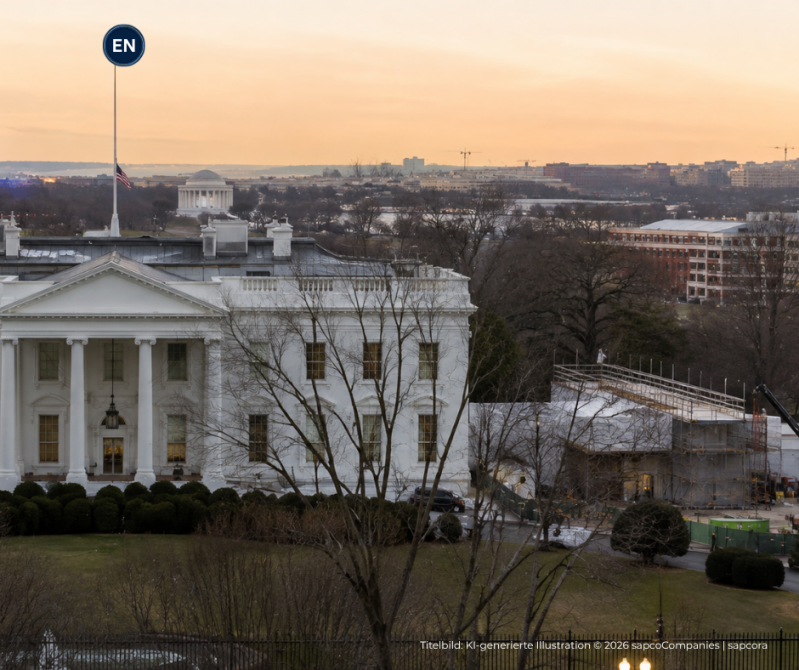
The case began as a battle over an unusually ambitious reconstruction of the White House East Wing. Trump announced the project in July 2025. The planned new complex includes a large ballroom intended for official events, new offices and extensive security infrastructure. The East Wing was subsequently demolished, and construction proceeded while preservation advocates challenged both the process and the legal authority behind the project.
The scale matters. The D.C. Circuit described the planned structure as approximately 90,000 square feet and about 55 feet high, large enough to alter the architectural balance of the White House grounds significantly. The National Park Service itself had concluded during environmental review that the project would have permanent effects on the cultural landscape and would change the historic setting and visual character of the property.
That transformed what might otherwise have been treated as a presidential renovation into a much deeper legal question. Does control of the White House as the president’s working residence include authority to construct a major new building, or does such an undertaking require Congress to act first? A majority of the D.C. Circuit answered that question in Congress’s favor.
Congress controls the property, the appeals court says
The central constitutional provision is the Property Clause. It gives Congress authority to make rules concerning property belonging to the United States. In its August 7 ruling, the D.C. Circuit majority described congressional control over the White House and surrounding federal land as plenary. Its language was deliberately institutional: presidents occupy the White House temporarily, but they do not own it.
Federal law adds another obstacle for the administration. Under 40 U.S.C. § 8106, a building or structure generally may not be erected on federal reservations, parks or public grounds in Washington without express congressional authority. The appellate majority concluded that the ballroom falls within that requirement and that the government had not identified the necessary congressional authorization.
The administration relies heavily on a separate statute, 3 U.S.C. § 105(d), which allows money appropriated for the Executive Residence to be used for matters including care, maintenance, repair, alteration and improvement. The government argues that this language, combined with presidential practice and National Park Service authority, provides sufficient legal power for the project.
The appellate majority rejected that interpretation. It concluded that terms such as alteration and improvement cannot reasonably be stretched into authority for demolishing an existing wing and replacing it with an entirely new structure of this magnitude. Congress, the judges reasoned, has historically distinguished between maintaining an existing federal building and constructing a new one.
That distinction is the heart of the case. Presidents plainly have substantial practical authority over their residence and workplace. The question is where renovation ends and unilateral reconstruction begins.
Private money does not end the congressional question
Trump has emphasized that private money is paying for the ballroom. The government’s Supreme Court filing says approximately $400 million in private donations from Trump and other donors is funding the ballroom itself and asserts that taxpayer dollars are not required for that component.
The actual financial mechanism is more complicated than a private donor simply paying a contractor. According to the administration’s filing, private contributions are made to the National Park Service, then transferred to the Office of the Executive Residence through an arrangement under the Economy Act. The Executive Residence manages the project. The government told the Supreme Court that roughly $200 million had already been spent or committed.
This structure is legally important because private financing does not necessarily remove federal controls once money enters a government account and is used for a federal project. The D.C. Circuit majority concluded that the National Park Service cannot use donated funds to accomplish something it lacks statutory authority to undertake in the first place. Nor, according to the majority, can an interagency transfer create authority that Congress never granted.
The ruling therefore attacks one of the project’s most politically attractive defenses. Even if taxpayers are not financing the ballroom itself, the legal question remains whether private donors can finance a major alteration of federal property without the congressional authorization that would otherwise be required.
The appellate court’s reasoning reaches beyond this particular construction project. If private financing alone could bypass statutory limits on federal projects, future administrations could potentially obtain outside money for significant changes to government property while reducing Congress’s ability to control those decisions through appropriations.
Why Trump wanted a ballroom in the first place
The administration presents the ballroom as both functional and presidential. The White House has argued that the existing complex lacks an adequate secure indoor venue for large official gatherings and that a new space would improve the government’s ability to host major ceremonies, diplomatic events and visiting leaders.
Trump has pursued the concept of a major White House ballroom for years. In its present form, however, the project has moved far beyond an entertainment venue. The government now describes the East Wing reconstruction as a single integrated complex involving ceremonial space, hardened security systems, medical capabilities and military infrastructure.
That evolution is crucial to understanding why the dispute has reached the Supreme Court with such urgency.
The government now calls it an integrated military complex
The Justice Department’s emergency Supreme Court application describes a structure extending five stories underground and incorporating hardened concrete, steel and reinforced materials. Government declarations cited in the filing describe bomb shelters, medical facilities, protected communications, military systems, reinforced glass, missile resistant construction, drone defenses, sniper positions and a rooftop facility intended to support protection against aerial threats. These are government representations made in litigation, not independent judicial findings about the necessity of every element. That distinction matters.
The administration argues that the ballroom cannot realistically be separated from the infrastructure underneath and around it. It says the structure follows a single integrated design and that stopping the visible construction would interfere with the security systems that depend upon the building above. Senior security, military and intelligence officials have supported uninterrupted completion, according to the government’s filing.
The administration also points to an evolving threat environment surrounding the president. Its Supreme Court filing cites multiple threats and attacks as evidence that presidential security requirements have changed substantially and that courts should not substitute judicial assessments for those of the Secret Service, military and intelligence agencies.
National security is therefore not merely an additional argument. It has become the government’s principal explanation for why construction should continue immediately.
The courts noticed that the security argument changed
The government faces an uncomfortable problem in the record. Earlier in the litigation, federal officials had represented that the underground security work and the visible ballroom could be treated separately.
The district court relied on those representations when it crafted its injunction. Above ground ballroom construction was restricted, but work strictly necessary for White House safety and security was permitted to continue. The order also allowed measures needed to protect the existing construction site and preserve structural integrity.
Later, the administration argued that the entire complex had to be treated as a single security system. The district court said that position conflicted with earlier government representations that underground elements did not lock in the design of the ballroom above them. The D.C. Circuit majority accepted the lower court’s handling of that problem and concluded that the security exception adequately protected legitimate national security interests while the litigation continued.
The Supreme Court application now challenges that conclusion directly. The administration says separating security construction from ballroom construction has become impossible because the project is physically integrated and has advanced substantially.
This is more than a technical disagreement about construction sequencing. It affects the credibility and weight of the government’s emergency argument. The justices must consider not only the claimed security consequences of stopping work today, but also why the project was previously described in ways that allowed security work and ballroom construction to be separated.
Construction has moved rapidly while the case was in court
Timing now favors the administration in a practical sense. Because earlier court orders were temporarily stayed during appeals, construction continued for months. The government told the Supreme Court that approximately 250 workers have been operating for as much as 20 hours a day, seven days a week. It says the overall project is now about 65 percent complete, with a concrete and steel structure extending deep underground and already rising above ground. The administration argues that major redesign has become impractical and that a sudden stop could create structural, operational and security problems.
That creates one of the most consequential dynamics in the case. A project challenged as unauthorized has continued advancing while courts considered whether it was authorized. Every additional stage of construction potentially increases the practical cost of stopping it.
The preservationists argue, in effect, that this cannot become a legal strategy in itself. Otherwise, an executive branch could move quickly enough to make judicial relief increasingly difficult before courts reach a final decision.
A divided appeals court reveals the larger dispute
The D.C. Circuit ruled by a 2 to 1 vote. Judges Patricia Millett and Bradley Garcia formed the majority. Judge Neomi Rao dissented.
Rao argued that the National Trust lacked standing, that the president likely possessed authority to make the improvements and that the injunction improperly elevated aesthetic concerns over presidential security. She characterized judicial supervision of the project as an intrusion into executive responsibilities and would have allowed construction to continue.
The majority took the opposite institutional view. It emphasized Congress’s constitutional control over federal property, the statutory requirement for express authorization and the importance of preventing irreversible alteration of one of the nation’s most significant public buildings before the legality of the project is resolved.
Those competing positions now give the Supreme Court a clearly defined separation of powers dispute. One side sees the injunction as judicial interference with presidential security and management of the executive residence. The other sees unchecked construction as executive interference with powers reserved to Congress.
What exactly is before the Supreme Court now
The Supreme Court has not ruled that Trump may build the ballroom, nor has it ruled that the project is unlawful.
The immediate case is an emergency application filed by the National Park Service and other government defendants. The administration is asking for a stay of the lower court injunction while it prepares a petition seeking full Supreme Court review. It has also requested an immediate administrative stay so construction does not have to stop while the justices consider the emergency request.
The D.C. Circuit deliberately stayed its own August 7 ruling for fourteen days to give the administration time to seek Supreme Court intervention. Without additional relief, the injunction is scheduled to take effect on August 21.
Chief Justice John Roberts, who receives emergency applications arising from the D.C. Circuit, has requested a response from the National Trust by noon Eastern time on August 18. As of the latest Supreme Court docket entry, no final decision on the government’s application has been issued. That means the next Supreme Court action could come quickly.
What the justices can do
The Court could temporarily preserve the status quo and allow construction to continue while it considers the application. It could grant a longer stay lasting through a petition for full review. It could deny relief, allowing the above ground restrictions to take effect. It could also fashion narrower relief addressing particular construction or security concerns. None of those procedural outcomes would necessarily settle the ultimate constitutional question.
A stay would mean that a majority believes the legal and equitable requirements for temporary relief have been met. It would not automatically establish that Trump ultimately has authority to complete the project. Conversely, denying a stay would not necessarily represent a final Supreme Court judgment that the ballroom is illegal. A definitive precedent would be more likely if the Court agrees to hear the case fully and decides the merits.
The precedent could extend far beyond one president
The strongest reason this case matters has little to do with chandeliers, state dinners or architectural taste.
The Supreme Court could eventually be asked to define how far a president may alter federal property assigned to the executive branch without specific congressional approval. That question could affect future White House renovations, security projects and potentially other federal properties under executive control.
The financing issue is equally significant. The dispute raises the question of whether private donations can supplement executive power when Congress has not authorized the underlying project. The D.C. Circuit majority effectively said money and legal authority are separate questions. Having funds available does not itself create permission to spend them on whatever project the executive chooses.
The standing dispute could also matter. The government argues that the National Trust should not be able to obtain an injunction based on the aesthetic and historic interests asserted by its members. The appellate majority accepted those injuries as sufficient at this stage, while the dissent sharply disagreed. A Supreme Court ruling on that issue could affect the ability of preservation and environmental organizations to challenge federal projects in future cases.
The White House is the object of the dispute, but Congress is the real question
Trump’s ballroom has become a striking test because the property involved is unlike any ordinary federal building. The White House is simultaneously a residence, an office, a national symbol, a secure government facility and federal property entrusted to one president after another.
That combination gives the executive branch powerful practical reasons to control what happens inside the complex. It also gives Congress powerful constitutional reasons to insist that no president can treat the property as personally disposable.
The government’s national security case is substantial enough that courts have already preserved room for genuinely necessary protective work. What remains contested is whether national security also justifies completing the ballroom and the entire above ground structure without the congressional authorization the appellate majority says federal law demands.
That is why the Supreme Court fight is larger than the building rising where the East Wing once stood. The final question is not whether the president may redecorate the White House. It is whether occupying the presidency carries the power to remake the People’s House on this scale, using privately supplied money, when Congress has never expressly said yes. The answer could determine much more than the fate of Donald Trump’s ballroom.
Trump White House Ballroom Fight Reaches Supreme Court. Trump’s $400 million White House ballroom has reached the Supreme Court, raising major questions over presidential power, Congress, private funding and national security.
Kommentar hinzufügen
Kommentare