

Rubric: Security
Format: Special Report
Author: Sinisa Brkic (sb)
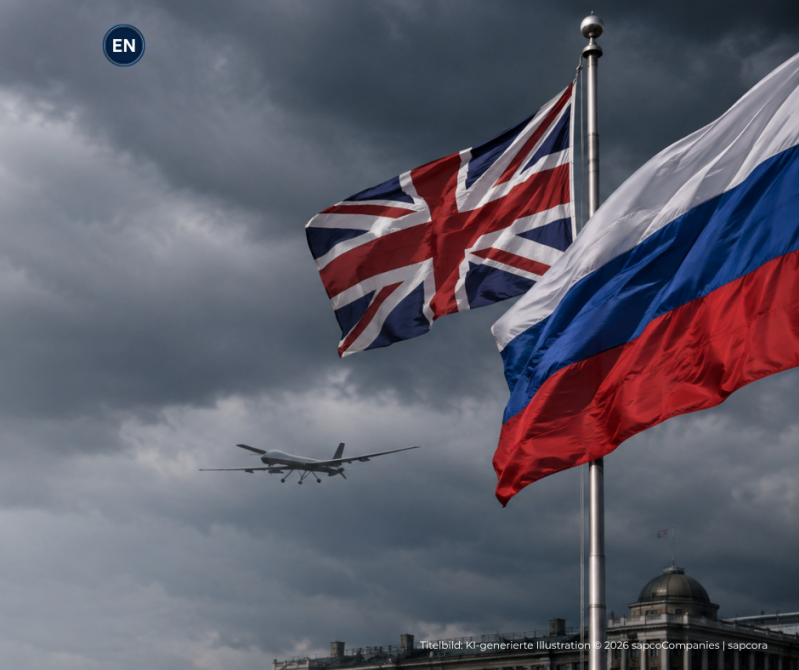
Russia has warned Britain of unspecified consequences following reports that British made drones have been used by Ukraine for strikes inside Russian territory. The UK has not confirmed the reported deployments and continues to describe its military assistance as support for Ukraine’s defence. Behind the exchange lies a wider question about where military assistance ends and direct involvement begins.
Moscow’s warning leaves the response undefined
The immediate source of the dispute is a statement from the Russian embassy in London following reports that British manufactured drones had been used in Ukrainian long range operations against targets in Russia. Moscow argued that such activity represented deeper British involvement in the conflict and warned that London would face consequences.
What those consequences might involve was not specified. That distinction is important. A political warning, even one expressed in unusually severe terms, does not in itself establish that a military, diplomatic, economic or other form of response has been decided.
Britain, for its part, has not confirmed that the drones identified in the reports were used in the operations concerned. The Ministry of Defence instead reiterated the broader British position that London will continue providing Ukraine with military equipment and support. The result is a dispute in which the political positions are clear, but a central operational fact remains publicly unconfirmed.
What is known about the British drones
The reports that triggered Moscow’s response said Ukrainian forces had used drones manufactured by two British companies during operations against targets inside Russia. One system identified in the reporting is the Nyan, a jet powered one way strike aircraft developed by Callen Lenz, which forms part of BAE Systems.
The Nyan itself is not a secret programme. Its manufacturer publicly describes the aircraft as a precision strike system designed to operate in highly contested environments. The platform has a wingspan of 2.9 metres and a stated range exceeding 250 kilometres, depending on configuration and mission profile.
Reports have linked the system to Ukrainian operations, but this does not resolve the more sensitive question now at the centre of the diplomatic dispute. The British government has not publicly confirmed that a Nyan supplied through British channels was used in the specific deep strike operations that prompted the Russian warning.
A second British manufactured drone has also been mentioned in reporting, although its manufacturer has not been publicly identified for security reasons. That makes detailed assessment of its range, payload, supply arrangements and operational restrictions considerably more difficult.
British made does not mean British operated
The distinction between manufacture, supply and operational control is crucial. A weapon or drone being produced in Britain does not by itself establish that the British government selected its targets, planned its missions or participated in its operation.
No publicly confirmed evidence presented so far establishes that British personnel controlled the reported strikes. Nor has London confirmed the operational chain through which the systems may have reached Ukrainian forces.
For Moscow, however, the question is broader. Russia has repeatedly argued that the provision of Western weapons, intelligence and increasingly sophisticated military technology draws supporting states more deeply into the conflict. Britain and other NATO members reject the conclusion that military assistance automatically makes them parties to the war. Those positions have existed for years. The drone dispute gives them a new technological and political focus.
The 150,000 drone figure requires an important distinction
One figure circulating around the current dispute risks creating a misleading impression. Britain announced in June that a £752 million package would help provide Ukraine with 150,000 drones by the end of 2026.
According to the British government’s own description of that programme, those 150,000 systems are Ukrainian produced drones. The figure therefore should not be presented as evidence that Britain is supplying 150,000 British manufactured attack drones for operations inside Russia.
Britain separately supports its own drone industry and has funded a range of British companies developing reconnaissance, logistics and strike systems for Ukraine. Those programmes form part of a much wider military relationship, but they are not identical to the 150,000 drone package. That distinction matters because the present dispute is specifically about the reported use of British manufactured systems, not simply about British financing of Ukrainian drone production.
Has London authorised attacks inside Russia?
The answer depends on what is meant by authorisation. Britain has consistently supported Ukraine’s right to defend itself and has previously accepted that military targets inside Russian territory can, under certain circumstances, form part of legitimate Ukrainian self defence.
That broad policy position is different from confirming permission for a particular weapon, target or mission. Restrictions attached to individual weapons systems are not always disclosed publicly, and the Ministry of Defence has not confirmed the operational conditions governing the drones cited in the latest reports. There is therefore no public basis at present for stating that London specifically approved the individual attacks now under discussion. Nor is there sufficient evidence to state the opposite.
This is one of the central limits of the available information. Political support for Ukraine, supply of military equipment and direct approval of an individual strike are separate questions and should not be treated as interchangeable.
What could Russia mean by “consequences”?
Moscow has deliberately left the term open. Without a specified measure, any attempt to predict the Russian response remains analysis rather than established fact. At the lower end of the escalation spectrum, consequences could involve diplomatic measures, additional restrictions on British interests or intensified political pressure. Russia could also increase military signalling or other forms of strategic pressure intended to demonstrate that it regards British involvement as unacceptable.
A direct military action against British territory would represent a fundamentally different threshold. Nothing in the Russian embassy’s statement establishes that such a step has been decided or is imminent.
The ambiguity may itself have political value. By leaving the form of any response undefined, Moscow can issue a warning without committing itself publicly to a specific course of action.
Does this create a direct Russia NATO confrontation?
Not by itself. NATO’s stated position remains that the Alliance is not a party to the war in Ukraine, while individual member states continue to provide Kyiv with military assistance.
The supply of a weapon by a NATO country does not automatically trigger a direct conflict between NATO and Russia if that weapon is subsequently used by Ukrainian forces. The more sensitive question would arise if personnel from a NATO member state were shown to be directly conducting attacks, selecting targets or exercising operational control.
No such British role has been publicly established in connection with the drone strikes now being discussed.
A Russian armed attack against British territory would raise a very different set of questions because the United Kingdom is a NATO member. Article 5 treats an armed attack against one ally as an attack against all, although the nature of each ally’s response depends on the circumstances and the decisions taken by NATO members. For that reason, both the political language and the operational facts matter. There is a substantial difference between warning a NATO government over weapons supplies and attacking that government directly.
The deeper issue is control, not nationality
The nationality of a drone is politically significant, but it is not the decisive test of involvement. Modern military supply chains frequently cross borders, and Ukrainian forces operate equipment originating from numerous countries alongside systems developed and manufactured domestically.
The more consequential questions concern who chooses the target, who prepares the mission, who controls the aircraft and what conditions the supplier has imposed on its use.
Those details determine whether a system is simply foreign supplied equipment under Ukrainian command or part of a deeper operational relationship. Publicly available information on the latest British drone reports does not yet provide a complete answer. That uncertainty explains why the dispute is likely to remain politically sensitive even if no immediate escalation follows.
A new pressure point in an already expanded drone war
The war has increasingly moved beyond the immediate front through long range missiles and unmanned aircraft. Ukraine has expanded strikes against targets inside Russia, while Russia continues extensive missile and drone operations against Ukraine.
This has turned range, production capacity and air defence into increasingly important strategic factors. Relatively inexpensive unmanned systems can be produced and deployed in numbers that would be difficult to sustain with conventional long range missiles alone.
Britain is one of several countries investing heavily in this technological shift. Russia regards the growing Western role in Ukraine’s military capabilities as a security concern and has repeatedly warned against deeper involvement. The latest dispute therefore reflects more than the use of one particular aircraft. It concerns the changing character of military support and the increasingly blurred political boundaries created by remotely operated and autonomous weapons.
The facts currently stop short of the rhetoric
For now, the most important conclusion is also the most restrained. Russia has issued a clear warning to Britain, but has not publicly specified what action it intends to take. Britain continues its support for Ukraine, but has not confirmed that the British made drones identified in reporting were used in the particular strikes at the centre of the controversy.
There is likewise no publicly established evidence that British personnel selected targets or directly operated those missions.
That leaves a situation carrying genuine escalation risk, but not one that can accurately be described as a direct confrontation between Russia and Britain. The next significant development will depend less on the rhetoric itself than on whether either government provides new operational details, changes its policy or translates its warnings into concrete action. Until then, the distinction between reported use, confirmed supply and direct state involvement remains the essential line separating evidence from assumption.
Russia Warns UK Over British Drones Used by Ukraine. Russia has warned Britain over reports that British made drones were used in Ukrainian strikes inside Russia. What is confirmed, what remains unclear, and how serious is the risk of escalation?
Kommentar hinzufügen
Kommentare