

Rubrik: Politics
Format: Special Report / Political Profile
Autor: Sinisa Brkic (sb)
Natalie Harp is not a Cabinet secretary, a senior policy strategist or one of the familiar public faces of the Trump administration. Yet she occupies an unusually close position around the president, helping deliver information, assisting with his communications and traveling with him. After Democratic Senator Jon Ossoff invoked her name in a campaign attack and the White House responded with striking intensity, a little known presidential aide has suddenly become a national political story.
The woman suddenly at the center of Washington
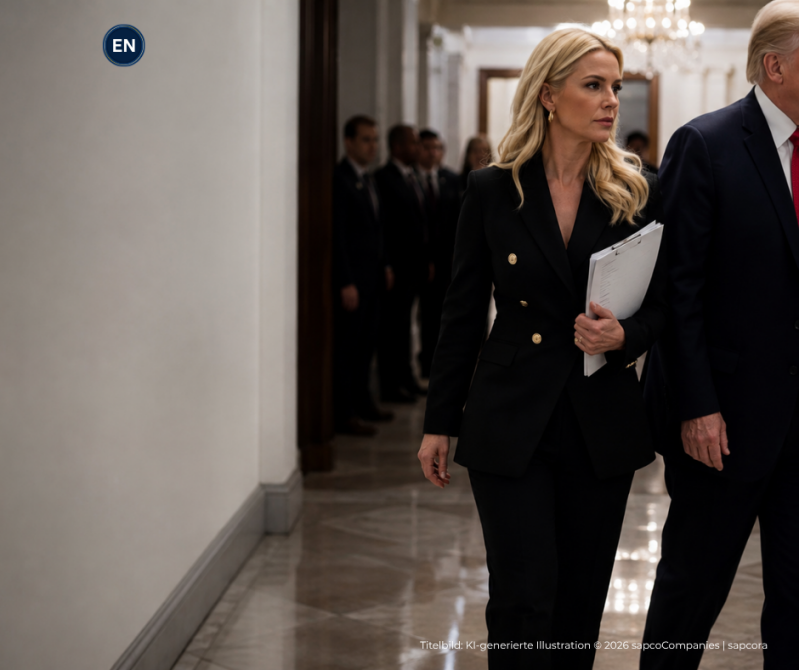
Until this week, Natalie Harp was largely unknown to Americans outside the political world surrounding Donald Trump. Inside that world, however, she has held a far more consequential position for years, one defined less by public visibility than by sustained proximity to the president.
Official White House records identify Harp as Special Assistant to the President and Executive Assistant to the President. Those titles establish her place within the administration, but they do not fully explain why a reference to her in a campaign speech provoked such a forceful response from Trump and senior White House officials.
The answer begins with access. Harp is regularly seen alongside Trump, assists with material he consumes and has been involved in his social media operation. During the 2024 campaign, she became known for carrying a portable printer so that articles and other material could be handed to Trump in paper form, earning her the nickname “human printer.” The nickname sounds almost trivial. The function behind it is not.
From political supporter to presidential aide
Harp first came to broad public attention in 2019 through her advocacy for Trump’s Right to Try legislation. A cancer survivor, she publicly credited the 2018 law with giving her hope and access to treatment options during her illness, eventually appearing with Trump and becoming a visible supporter of his health care policy.
Her account requires careful qualification. Medical experts later questioned whether the federal Right to Try law could have played the role in her treatment that Harp described, based on the timing and nature of the therapy involved. What is established is that Harp herself credited Trump and the law publicly, and that her story helped bring her into his political orbit.
By 2020, she was serving on an advisory board for Trump’s reelection campaign and appeared as a speaker at the Republican National Convention. She later worked as a presenter for One America News Network before returning to Trump’s political operation and becoming increasingly involved in his daily working environment. By the 2024 campaign, Harp had become a regular presence around him. When Trump returned to the White House in January 2025, she entered the administration as one of the aides working closest to the president.
Access can become a form of influence
Washington tends to measure power through formal rank. Chiefs of staff manage institutions, Cabinet secretaries control departments, national security advisers shape presidential decisions and communications directors organize public messaging. Presidential influence does not operate exclusively through titles, however. A different kind of importance can emerge from being present when others are not, from being able to deliver information directly and from understanding how a president prefers to receive material.
That distinction is particularly relevant to Trump. His political operation has long combined formal chains of command with a highly personalized network of longtime aides, political allies, media figures and advisers who have varying degrees of direct access to him.
Harp occupies an unusual position within that environment. Reporting over several years has described her printing news articles and other material for Trump, assisting with social media posts and remaining close to him during much of his working day. None of that establishes that Harp controls what the president sees or independently determines policy. It does establish that she operates near an important junction in any presidency: the point where information reaches the person who ultimately makes the decisions.
The secret flight revealed the extent of her access
A security episode in July offered an unusually clear indication of Harp’s place within Trump’s immediate circle. During Trump’s departure from Turkey following a NATO summit, security officials moved the president from Air Force One to a smaller military aircraft because of a credible threat. The transfer was carried out covertly, with Trump moved using an airport catering vehicle before boarding the alternate plane.
Harp was among the close aides who made the transfer with him, alongside Deputy Chief of Staff Dan Scavino and Oval Office Operations Director Walt Nauta. Reuters later confirmed her presence as part of the group accompanying the president during the operation.
Her inclusion does not establish any role in the security decision itself, and it should not be interpreted that way. What it demonstrates is narrower but still significant: when Trump’s traveling party was abruptly reduced under exceptional security conditions, Harp remained among those immediately around him. That detail gave new visibility to a staff member whose proximity to the president had previously attracted attention largely inside political and media circles. Then Jon Ossoff said her name.
How Natalie Harp entered the midterm campaign
At a campaign event in Atlanta on August 16, Democratic Senator Jon Ossoff launched a broad attack on Trump’s performance in office. Ossoff, who is seeking reelection in Georgia this November, portrayed the president as distracted by personal priorities at a moment of serious domestic and international pressure.
As part of that criticism, he referred to Trump wanting to build his White House ballroom and travel with “Natalie” aboard the aircraft donated by Qatar for presidential use. Harp was not identified by her full name, but the reference was unmistakable.
The political construction of the attack was deliberate. Ossoff was attempting to turn Trump’s personal working environment into a symbol of a broader argument about presidential priorities, surrounding the president with images of luxury, construction projects, travel and trusted aides.
It was also a risky choice. Harp is a government employee rather than an elected official or public political surrogate, and the reference immediately prompted accusations from Trump allies that Ossoff had crossed from criticism of the president into a personal attack on a female staff member.
That distinction matters because there are two very different stories that can be told about Natalie Harp. One concerns access to the president, the movement of information and the structure of his inner circle. The other relies on insinuation about the nature of a private relationship for which credible public evidence has not been established. Only the first is necessary to understand why Harp matters politically.
The White House response changed the story
The reaction from Trump’s political operation was immediate and unusually personal. White House Communications Director Steven Cheung attacked Ossoff in highly derogatory terms, while other Trump officials and allies accused the Georgia senator of sexism and of denigrating a woman serving in the administration. Trump himself responded by mocking Ossoff rather than engaging directly with the substance of the criticism.
A White House is entitled to defend an employee it believes has been unfairly attacked. What made this episode politically notable was the intensity and breadth of the response to a passing reference to an aide who, until then, had remained largely outside mainstream public attention.
The counterattack produced an obvious consequence. It turned curiosity about Harp into a much larger question about why her name had touched such a sensitive nerve inside Trump’s political operation. The controversy was no longer only about what Ossoff had said. It was about why saying it generated such a reaction.
Kristen Holmes asked the question Washington was already asking
The dispute widened further on August 17 when CNN White House correspondent Kristen Holmes asked Trump about Ossoff’s remarks during an Oval Office event. Trump attacked Holmes during the exchange, calling her disrespectful and fake news. The White House’s official rapid response operation subsequently escalated the confrontation online, attacking the reporter personally and invoking her children while condemning her questioning.
CNN defended Holmes and maintained that she had asked a legitimate question about comments made by a sitting senator concerning the president and a White House employee. By that point, the episode had moved beyond the original campaign speech and into a broader confrontation between the administration and the press.
The issue is straightforward from a journalistic perspective. When a presidential aide has regular access to the president, assists with communications and information, travels with him and becomes the subject of a public dispute involving a U.S. senator and the White House, questions about that aide’s official role are legitimate. Those questions do not require speculation about private conduct. They require an examination of power, access and institutional responsibility.
What is established and what is not
The distinction is especially important because Harp’s loyalty to Trump has itself become part of her public profile. She has spoken in intensely appreciative terms about the president since first entering his orbit and has remained beside him through campaigns, legal controversies and his return to the White House. Reporting has also described an exceptionally close working arrangement in which Harp is frequently available to provide material and assist with Trump’s communications.
That evidence supports describing Harp as a highly trusted and unusually proximate presidential aide. It does not establish a romantic or sexual relationship between Harp and Trump, and no credible reporting reviewed for this report provides a factual basis for presenting such a relationship as established. Political insinuation cannot close that evidentiary gap. Neither can the intensity of the White House response. For a serious examination of Harp’s role, it does not need to.
The real story is the president’s information environment
Every modern presidency has an information architecture. The president receives intelligence assessments, economic data, legal advice, political strategy, television coverage, news reports, correspondence and an endless stream of digital material. No president can consume all of it, which means that aides, systems and institutional processes inevitably help determine what receives attention.
Trump’s working style gives that process particular importance. Formal government structures remain central, but his political career has also been characterized by direct relationships, personal loyalty and informal channels through which information reaches him.
Harp’s position sits close to that intersection. Providing printed material or helping prepare a social media post may appear administrative when viewed in isolation. When those tasks are performed repeatedly for the president by someone with extensive direct access, they become part of the machinery through which information and presidential communication move. That does not make Harp a hidden policymaker. It makes her a relevant figure in understanding how this White House operates.
Why Harp has become politically useful
The timing of the dispute is crucial. Ossoff is seeking reelection in one of the country’s most closely watched Senate contests, and the November 2026 midterms are rapidly turning the Trump presidency itself into the central political battlefield. Democrats have a clear incentive to frame the election around presidential conduct, priorities and competence.
Harp offers a potentially powerful image for that argument because she represents something larger than one staff position. For Trump’s critics, her constant proximity can be used to illustrate a presidency built around personal trust, loyalty and a tightly held inner circle.
Republicans have an equally clear response. They can portray criticism of Harp as an attempt to demean an accomplished female employee simply because she works closely with the president, particularly if opponents drift from scrutiny of her official responsibilities into personal insinuation. That makes precision politically important as well as journalistically necessary. Questions about access, information and authority can withstand scrutiny. Unsupported speculation cannot.
The question behind the question
Natalie Harp did not become important because Jon Ossoff mentioned her at a campaign rally. She became visible because he did. The force of the White House response then amplified that visibility, drawing national attention toward an aide whose position had previously been understood mainly by people who closely follow Trump’s inner circle. What emerged is not evidence of a secret role, but a clearer public picture of a staff member with sustained proximity to the president and a place inside his daily information and communications environment.
That distinction should remain at the center of the story. Harp’s importance does not have to be exaggerated to be worth examining. Presidential power is shaped not only by the officials whose names appear in headlines, but also by the people who are consistently present, trusted and able to reach the president when others cannot. Understanding who occupies those positions is part of understanding how an administration works. That is the real question behind the provocative one in the headline. Who is Natalie Harp, Mr. President?
Who Is Natalie Harp? Inside the Trump Aide’s White House Role. Natalie Harp has become a political flashpoint after Jon Ossoff targeted Trump’s close aide. A look at her White House role, access and growing significance.
Kommentar hinzufügen
Kommentare